
GroqCloud
Fast batch transcription for under-cap audio, with strong jargon handling but a hard 25 MB ceiling.
Strong on jargon, weaker on code-switching, blocked by oversize uploads.
- You need inexpensive batch transcription for audio under the documented 25 MB cap.
- You want strong technical-jargon handling on single-speaker narration.
- You can work with verbose JSON and segment-level timing but do not need native diarization.
- Your audio files often exceed 25 MB.
Our take
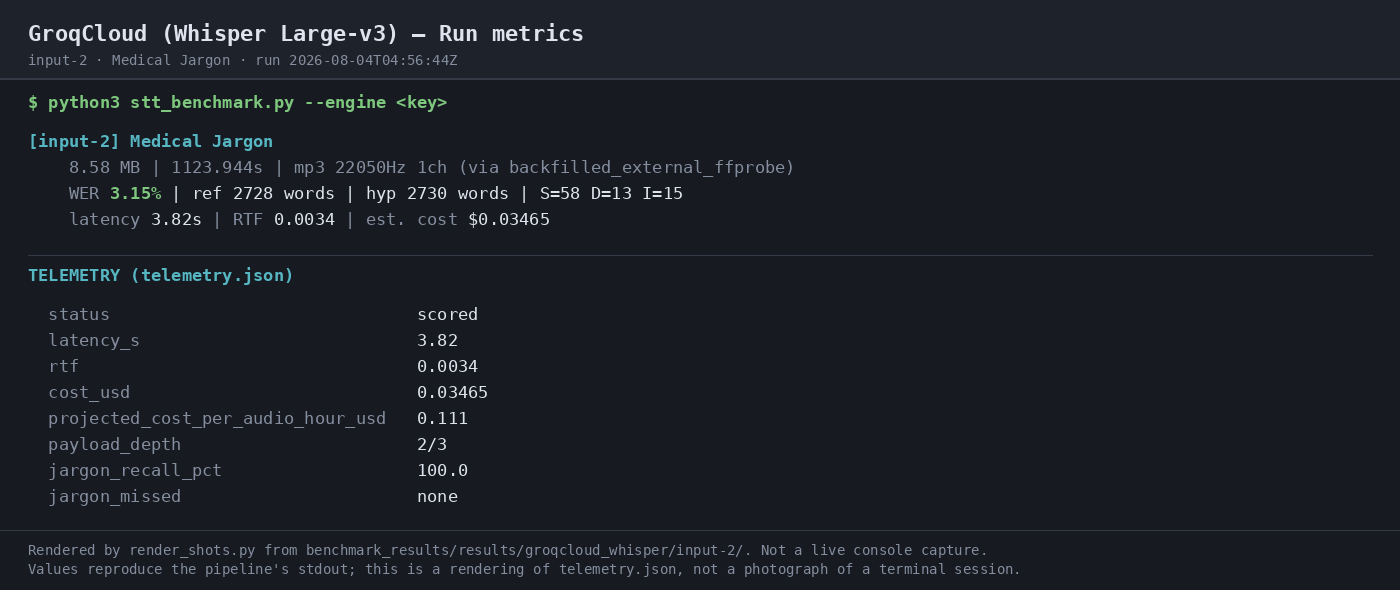
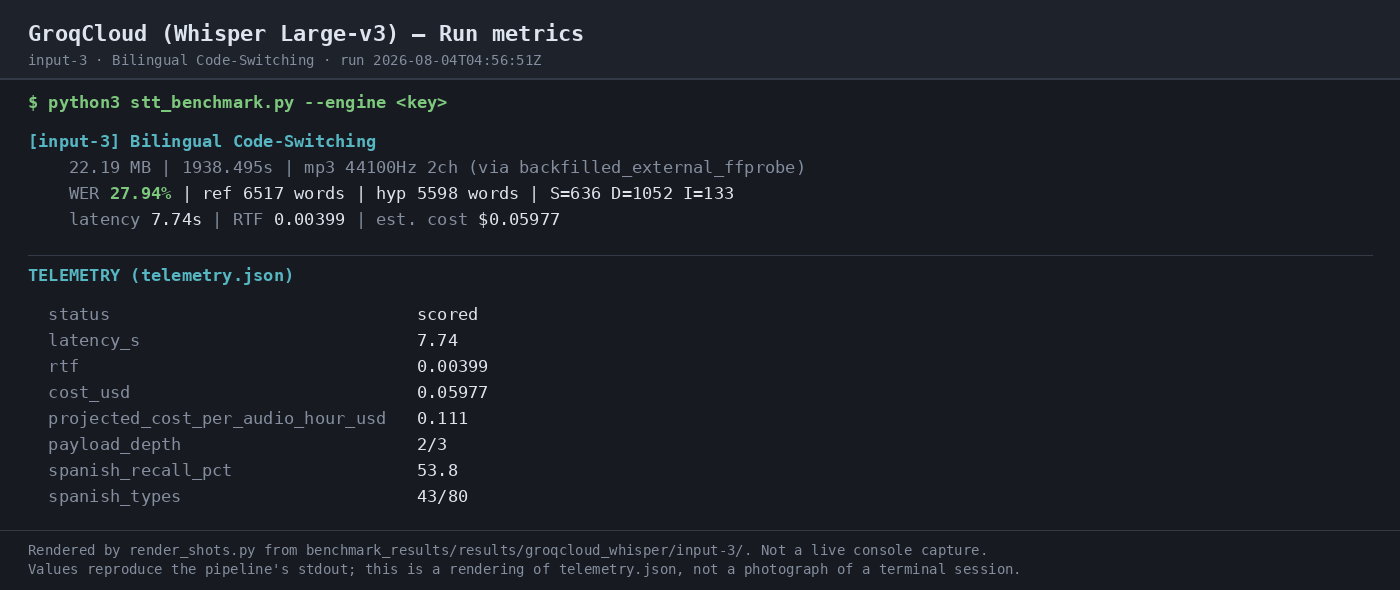
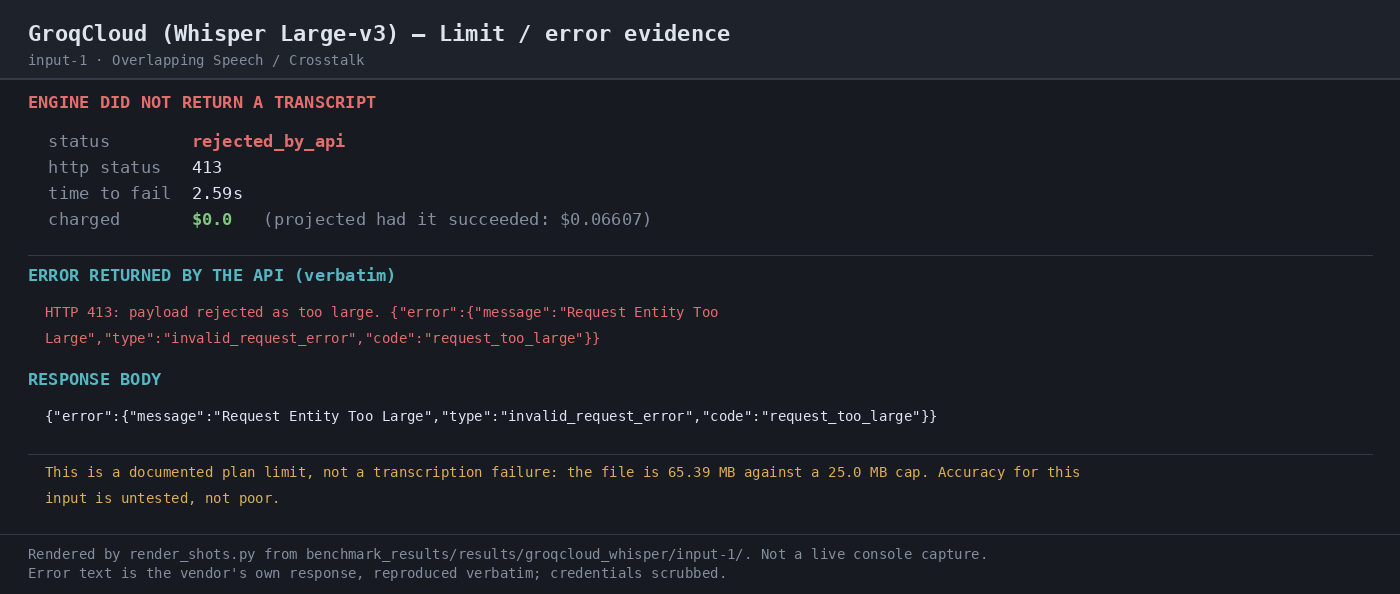
GroqCloud (Whisper Large-v3) is a strong low-cost batch STT engine for under-cap audio: it scored 3.15% WER on the medical-jargon file, recalled all 9 scored jargon terms, and ran very fast at 3.82s wall clock. It also produced usable output on the bilingual Spanish-English sample, but accuracy dropped sharply there (27.94% WER, 53.8% Spanish recall). The operational limit is the main risk: a 65.39 MB crosstalk file was rejected with HTTP 413 before transcription, and the service exposes no native speaker diarization.
In-Depth Review
Our detailed analysis of GroqCloud — features, performance, and real-world testing.
Feature-by-Feature Breakdown
Audio TranscriptionWorks well on under-cap audio, but the 65.39 MB overlap file was rejected before transcription and the bilingual case was materially weaker than the medical-jargon run.▾
Feature tested: Audio Transcription
Result: Partial
Verdict: Works well on under-cap audio, but the 65.39 MB overlap file was rejected before transcription and the bilingual case was materially weaker than the medical-jargon run.
Expected behavior: Groq’s audio transcription endpoint converts uploaded audio files into text transcripts, and the benchmark exercised it on an 8.58 MB medical-jargon file and a 22.19 MB bilingual file. The same endpoint was also tested with verbose JSON and word timestamps enabled, producing structured transcript outputs with timing and metadata.
Test case: Audio file → Text/code file
Input type: Audio file
Input used: Input artifact (Audio file): INPUT: Medical Jargon audio with verbose_json and word timestamps enabled. — medical_terms.mp3
Observed output: Output artifact (Text/code file): The raw response includes task, language, duration, transcript text, and segment objects; the benchmark detected word_timestamps=yes, confidence=yes, speaker_labels=no, and only segment-level timing rather than native speaker attribution. — raw-response.json
Input artifact: Input artifact (Audio file): INPUT: Medical Jargon audio with verbose_json and word timestamps enabled. — medical_terms.mp3
Output artifact: Output artifact (Text/code file): The raw response includes task, language, duration, transcript text, and segment objects; the benchmark detected word_timestamps=yes, confidence=yes, speaker_labels=no, and only segment-level timing rather than native speaker attribution. — raw-response.json
What changed: Audio file transformed into Text/code file
Test case: Audio file → Text/code file
Input type: Audio file
Input used: Input artifact (Audio file): INPUT: Bilingual Code-Switching audio with verbose_json and word timestamps enabled. — mix_language.mp3
Observed output: Output artifact (Text/code file): The raw response again includes transcript text and segment metadata, with word_timestamps=yes, confidence=yes, speaker_labels=no, and segment-level timing only. — raw-response-2.json
Input artifact: Input artifact (Audio file): INPUT: Bilingual Code-Switching audio with verbose_json and word timestamps enabled. — mix_language.mp3
Output artifact: Output artifact (Text/code file): The raw response again includes transcript text and segment metadata, with word_timestamps=yes, confidence=yes, speaker_labels=no, and segment-level timing only. — raw-response-2.json
What changed: Audio file transformed into Text/code file
Test case: Audio file → Image
Input type: Audio file
Input used: Input artifact (Audio file): The benchmark's scored run for the Gray's Anatomy narration, including speed and cost measurements. — medical_terms.mp3
Observed output: Output artifact (Image): The run completed in 3.82s with RTF 0.0034 and estimated cost $0.03465, making it the fastest engine on this input in the report. — 03-terminal-metrics-2.png
Input artifact: Input artifact (Audio file): The benchmark's scored run for the Gray's Anatomy narration, including speed and cost measurements. — medical_terms.mp3
Output artifact: Output artifact (Image): The run completed in 3.82s with RTF 0.0034 and estimated cost $0.03465, making it the fastest engine on this input in the report. — 03-terminal-metrics-2.png
What changed: Audio file transformed into Image
Test case: Audio file → Image
Input type: Audio file
Input used: Input artifact (Audio file): The scored benchmark run for the Spanish-English conversation, including latency, RTF, and cost. — mix_language.mp3
Observed output: Output artifact (Image): The run completed in 7.74s with RTF 0.00399 and estimated cost $0.05977 while remaining in scored status. — 03-terminal-metrics-3.png
Input artifact: Input artifact (Audio file): The scored benchmark run for the Spanish-English conversation, including latency, RTF, and cost. — mix_language.mp3
Output artifact: Output artifact (Image): The run completed in 7.74s with RTF 0.00399 and estimated cost $0.05977 while remaining in scored status. — 03-terminal-metrics-3.png
What changed: Audio file transformed into Image
Test case: Audio file → Image
Input type: Audio file
Input used: Input artifact (Audio file): INPUT: Overlapping Speech / Crosstalk audio (`crosstalk.wav`), 65.39 MB, 35:43, tested as a four-way overlapping meeting clip. — crosstalk.wav
Observed output: Output artifact (Image): The request was rejected by the API with HTTP 413 because the 65.39 MB file exceeded the documented 25 MB cap, so no transcript was returned. Accuracy on this overlap scenario remains untested. — 05-limit-evidence.png
Input artifact: Input artifact (Audio file): INPUT: Overlapping Speech / Crosstalk audio (`crosstalk.wav`), 65.39 MB, 35:43, tested as a four-way overlapping meeting clip. — crosstalk.wav
Output artifact: Output artifact (Image): The request was rejected by the API with HTTP 413 because the 65.39 MB file exceeded the documented 25 MB cap, so no transcript was returned. Accuracy on this overlap scenario remains untested. — 05-limit-evidence.png
What changed: Audio file transformed into Image
Why it matters / Conclusion: Strong under the file-size cap and excellent on the technical-jargon input, but code-switching accuracy drops on harder bilingual audio and oversized files fail at the API boundary.
Groq’s audio transcription endpoint converts uploaded audio files into text transcripts, and the benchmark exercised it on an 8.58 MB medical-jargon file and a 22.19 MB bilingual file. The same endpoint was also tested with verbose JSON and word timestamps enabled, producing structured transcript outputs with timing and metadata.
Audio Upload Size ValidationClear and fast failure mode, but it blocks evaluation of the crosstalk scenario on this oversized file.▾
Feature tested: Audio Upload Size Validation
Result: Passed
Verdict: Clear and fast failure mode, but it blocks evaluation of the crosstalk scenario on this oversized file.
Expected behavior: The API rejects oversized audio uploads at the boundary instead of attempting transcription. In the tested case, an over-limit file failed immediately with HTTP 413.
Test case: Audio file → Image
Input type: Audio file
Input used: Input artifact (Audio file): Input-1: crosstalk.wav, 65.39 MB, 2142.709s, overlapping speech/crosstalk meeting audio. — crosstalk.wav
Observed output: Output artifact (Image): The API rejected the request with HTTP 413 in 2.59s because the file exceeded the documented 25 MB cap; no transcript was produced and overlap accuracy remains untested. — 05-limit-evidence.png
Input artifact: Input artifact (Audio file): Input-1: crosstalk.wav, 65.39 MB, 2142.709s, overlapping speech/crosstalk meeting audio. — crosstalk.wav
Output artifact: Output artifact (Image): The API rejected the request with HTTP 413 in 2.59s because the file exceeded the documented 25 MB cap; no transcript was produced and overlap accuracy remains untested. — 05-limit-evidence.png
What changed: Audio file transformed into Image
Why it matters / Conclusion: Clear and fast guardrail, but the intended overlap test could not be scored because the upload exceeded the cap.
The API rejects oversized audio uploads at the boundary instead of attempting transcription. In the tested case, an over-limit file failed immediately with HTTP 413.
How it scored on the research's own criteria
The 4 evaluation dimensions from our hands-on research on GroqCloud, each judged from recorded runs on 3 test inputs — the same verdicts the ranking page ranks on.
held up partial failed not exercised by this input
| Criterion | Verdict | What the runs showed | Per input | Proof |
|---|---|---|---|---|
| Output quality | Mixed3/5 | It was excellent on the medical narration, fell apart on the bilingual conversation, and produced no transcript at all for the oversized meeting file. That split lands it in the middle: strong on clean single-speaker speech, weak on code-switching, and unscored when transcription never started. | open proof ↗ | |
| Automation level | Strong5/5 | Every run finished in a single multipart request with no manual follow-up. Even the oversized file came back through the same end-to-end path, so the integration stayed fully hands-off throughout. | — | |
| Export | Mixed3/5 | Two successful runs returned useful timed JSON, but only at segment level and without speaker labels, and the oversized file returned nothing beyond an error object. It exports partial transcripts well enough for basic downstream use, but not the richer metadata needed for captions or diarized workflows. | — | |
| Input handling | Mixed3/5 | Two files were accepted and processed quickly with low RTF and low list-price cost, but the oversized meeting recording hit the upload ceiling and was refused before transcription. That makes the input path broadly usable, but not consistently reliable across file sizes. | open proof ↗ |
Verdicts come verbatim from the study's recorded observations, never re-derived at render; a criterion with no recorded run shows Not exercised — this section cannot invent a score.
Official Groq ASR pricing
Per-hour list prices and free-tier limits from Groq's speech-to-text docs.
Free tier is capped at 25 MB per file; audio is billed at a 10-second minimum per request. Groq also documents a developer plan and Batch/Flex processing, but no STT-specific batch discount was published in the fetched docs.
Banner Preview
How the embed badge will look on your site

Embed HTML
Copy this code to your website source
Quick Integration Guide
- 1Copy the HTML code block above.
- 2Paste it into your site's HTML or CMS editor.
- 3Banner appears instantly on your page.
- 4Links back to your tool profile here.
Similar Tools
Discover more AI tools like GroqCloud to enhance your workflow.
Comments (0)
Need a custom AI solution for this use case?
If you are looking to build a custom speech-to-text, audio transcription, or batch transcription workflow for your business or internal workflow, email us at contact@futuresmart.ai.
Found something inaccurate or missing? We try to keep our AI research accurate and useful. If you found outdated information, an issue, or have a suggestion, email us at collaborate@aidemos.com.