
AssemblyAI (Universal)
Fast batch STT with strong metadata and mixed-language performance, but overlap-heavy meetings can drop too many words.
Reliable batch transcription, with one major crosstalk caveat
- You need a batch transcription API that returns completed JSON with word-level timestamps, confidence values, and speaker labels.
- You care about technical jargon or mixed-language audio and can accept batch-only operation.
- You want throughput in the roughly 0.016-0.018 RTF range on the tested files.
- You need validated speaker-attribution correctness rather than just detected speaker labels.
Our take
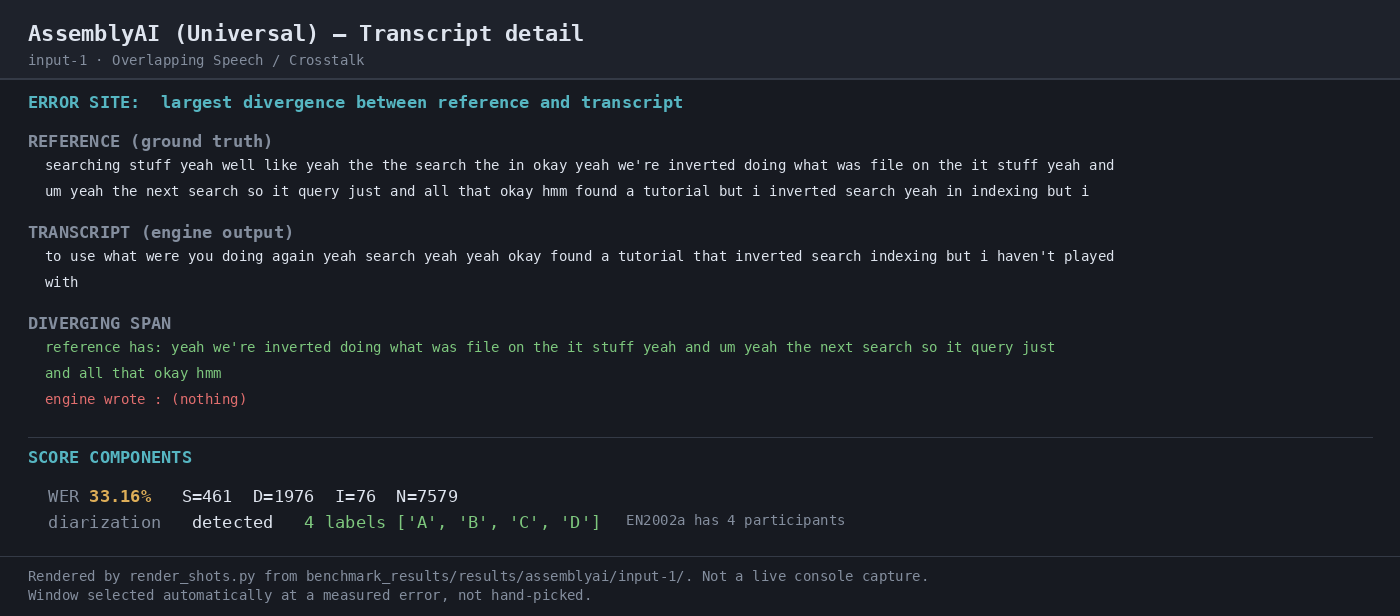
AssemblyAI completed all three batch runs and stayed consistently fast at about 0.016-0.018 RTF. It was excellent on the medical-jargon clip and best on the bilingual code-switching clip, but the overlapping-speech sample dropped 1,976 words and finished at 33.16% WER. That makes it a strong structured-transcription API for hard audio, as long as overlap-heavy meetings are not the main workload.
In-Depth Review
Our detailed analysis of AssemblyAI (Universal) — features, performance, and real-world testing.
Feature-by-Feature Breakdown
Batch Speech-to-Text TranscriptionReliable end-to-end job completion.▾
Feature tested: Batch Speech-to-Text Transcription
Result: Failed
Verdict: Reliable end-to-end job completion.
Expected behavior: AssemblyAI turns uploaded audio files into completed JSON transcripts. The member cards exercised it on overlapping crosstalk, medical narration, and bilingual code-switching inputs, all reaching a completed result through the batch API path.
Test case: Audio file → Text/code file
Input type: Audio file
Input used: Input artifact (Audio file): INPUT: Overlapping Speech / Crosstalk — crosstalk.wav (65.39 MB, 2142.709s) — crosstalk.wav
Observed output: Output artifact (Text/code file): Completed JSON response for the crosstalk run; the job reached status completed and returned a transcript payload. — raw-response.json
Input artifact: Input artifact (Audio file): INPUT: Overlapping Speech / Crosstalk — crosstalk.wav (65.39 MB, 2142.709s) — crosstalk.wav
Output artifact: Output artifact (Text/code file): Completed JSON response for the crosstalk run; the job reached status completed and returned a transcript payload. — raw-response.json
What changed: Audio file transformed into Text/code file
Test case: Audio file → Text/code file
Input type: Audio file
Input used: Input artifact (Audio file): INPUT: Medical Jargon — medical_terms.mp3 (8.58 MB, 1123.944s) — medical_terms.mp3
Observed output: Output artifact (Text/code file): Completed JSON response for the medical-jargon run; the job reached status completed and returned a transcript payload. — raw-response-2.json
Input artifact: Input artifact (Audio file): INPUT: Medical Jargon — medical_terms.mp3 (8.58 MB, 1123.944s) — medical_terms.mp3
Output artifact: Output artifact (Text/code file): Completed JSON response for the medical-jargon run; the job reached status completed and returned a transcript payload. — raw-response-2.json
What changed: Audio file transformed into Text/code file
Test case: Audio file → Text/code file
Input type: Audio file
Input used: Input artifact (Audio file): INPUT: Bilingual Code-Switching — mix_language.mp3 (22.19 MB, 1938.495s) — mix_language.mp3
Observed output: Output artifact (Text/code file): Completed JSON response for the bilingual run; the job reached status completed and returned a transcript payload. — raw-response-3.json
Input artifact: Input artifact (Audio file): INPUT: Bilingual Code-Switching — mix_language.mp3 (22.19 MB, 1938.495s) — mix_language.mp3
Output artifact: Output artifact (Text/code file): Completed JSON response for the bilingual run; the job reached status completed and returned a transcript payload. — raw-response-3.json
What changed: Audio file transformed into Text/code file
Why it matters / Conclusion: Operationally dependable across all three runs: every job completed and returned JSON without manual intervention.
AssemblyAI turns uploaded audio files into completed JSON transcripts. The member cards exercised it on overlapping crosstalk, medical narration, and bilingual code-switching inputs, all reaching a completed result through the batch API path.
Transcript Metadata ExportUseful metadata, but speaker attribution correctness was not validated.▾
Feature tested: Transcript Metadata Export
Result: Partial
Verdict: Useful metadata, but speaker attribution correctness was not validated.
Expected behavior: AssemblyAI includes word-level timestamps, confidence values, and related payload fields in the transcript JSON. The tests observed these downstream metadata fields consistently across the returned transcripts.
Test case: Audio file → Text/code file
Input type: Audio file
Input used: Input artifact (Audio file): INPUT: Overlapping Speech / Crosstalk — check returned payload structure and metadata. — crosstalk.wav
Observed output: Output artifact (Text/code file): Raw JSON payload showing word timestamps, confidence values, speaker labels, and 4 distinct speakers detected in the crosstalk run. — raw-response.json
Input artifact: Input artifact (Audio file): INPUT: Overlapping Speech / Crosstalk — check returned payload structure and metadata. — crosstalk.wav
Output artifact: Output artifact (Text/code file): Raw JSON payload showing word timestamps, confidence values, speaker labels, and 4 distinct speakers detected in the crosstalk run. — raw-response.json
What changed: Audio file transformed into Text/code file
Test case: Audio file → Text/code file
Input type: Audio file
Input used: Input artifact (Audio file): INPUT: Medical Jargon — check returned payload structure and metadata. — medical_terms.mp3
Observed output: Output artifact (Text/code file): Raw JSON payload showing word timestamps, confidence values, speaker labels, and 1 distinct speaker detected in the medical-jargon run. — raw-response-2.json
Input artifact: Input artifact (Audio file): INPUT: Medical Jargon — check returned payload structure and metadata. — medical_terms.mp3
Output artifact: Output artifact (Text/code file): Raw JSON payload showing word timestamps, confidence values, speaker labels, and 1 distinct speaker detected in the medical-jargon run. — raw-response-2.json
What changed: Audio file transformed into Text/code file
Test case: Audio file → Text/code file
Input type: Audio file
Input used: Input artifact (Audio file): INPUT: Bilingual Code-Switching — check returned payload structure and metadata. — mix_language.mp3
Observed output: Output artifact (Text/code file): Raw JSON payload showing word timestamps, confidence values, speaker labels, and 2 distinct speakers detected in the bilingual run. — raw-response-3.json
Input artifact: Input artifact (Audio file): INPUT: Bilingual Code-Switching — check returned payload structure and metadata. — mix_language.mp3
Output artifact: Output artifact (Text/code file): Raw JSON payload showing word timestamps, confidence values, speaker labels, and 2 distinct speakers detected in the bilingual run. — raw-response-3.json
What changed: Audio file transformed into Text/code file
Why it matters / Conclusion: The metadata export is consistently available, but this benchmark only proved label presence and count, not speaker-attribution correctness.
AssemblyAI includes word-level timestamps, confidence values, and related payload fields in the transcript JSON. The tests observed these downstream metadata fields consistently across the returned transcripts.
Speaker Labeling▾
Feature tested: Speaker Labeling
Result: Partial
Expected behavior: AssemblyAI assigns speaker IDs in the transcript output and reports how many distinct speakers were detected. The tests saw speaker labels surfaced on crosstalk, medical, and bilingual audio clips.
Test case: Audio file → Image
Input type: Audio file
Input used: Input artifact (Audio file): Input 1 — Overlapping Speech / Crosstalk with four participants. — crosstalk.wav
Observed output: Output artifact (Image): Transcript-detail view for the crosstalk run; it reports four detected speaker labels and shows the largest divergence between the reference and transcript. — 04-transcript-detail.png
Input artifact: Input artifact (Audio file): Input 1 — Overlapping Speech / Crosstalk with four participants. — crosstalk.wav
Output artifact: Output artifact (Image): Transcript-detail view for the crosstalk run; it reports four detected speaker labels and shows the largest divergence between the reference and transcript. — 04-transcript-detail.png
What changed: Audio file transformed into Image
Why it matters / Conclusion: Speaker IDs are present and useful, but this benchmark only measured label presence and count, not whether every attribution was correct.
AssemblyAI assigns speaker IDs in the transcript output and reports how many distinct speakers were detected. The tests saw speaker labels surfaced on crosstalk, medical, and bilingual audio clips.
How it scored on the research's own criteria
The 4 evaluation dimensions from our hands-on research on AssemblyAI (Universal), each judged from recorded runs on 3 test inputs — the same verdicts the ranking page ranks on.
held up partial failed not exercised by this input
| Criterion | Verdict | What the runs showed | Per input | Proof |
|---|---|---|---|---|
| Output quality | Mixed3/5 | Accuracy is excellent on the medical narration, acceptable but still noisy on the bilingual sample, and clearly weak on heavy crosstalk where long stretches disappear. That spread is too uneven for a strong score, but it is not a total collapse either, so the middle fits best. | open proof ↗ | |
| Automation level | Strong5/5 | All three runs finished on their own after the same upload, transcript creation, and polling sequence. Because the workflow closed cleanly every time without intervention, this is full automation in the tested mode. | — | |
| Export | Strong5/5 | The API consistently returned the rich transcript package across all runs: timed words, confidence, and speaker labeling were all present, and the payloads were deeply structured. That is the maximum level of export detail the benchmark looks for. | — | |
| Input handling | Strong5/5 | Every test file was accepted and finished, and the run times stayed far below real time with a price reported for each one. That is the pattern of a dependable batch ingester, not a system that only works on one easy case. | open proof ↗ |
Verdicts come verbatim from the study's recorded observations, never re-derived at render; a criterion with no recorded run shows Not exercised — this section cannot invent a score.
Official pricing
The benchmark used the pay-as-you-go Universal-3.5 Pro async rate.
Add-ons such as diarization, prompting, translation, entity detection, sentiment, topic detection, custom formatting, key phrases, and redaction are billed separately and stack additively; multichannel audio is billed per channel.
Banner Preview
How the embed badge will look on your site
Embed HTML
Copy this code to your website source
Quick Integration Guide
- 1Copy the HTML code block above.
- 2Paste it into your site's HTML or CMS editor.
- 3Banner appears instantly on your page.
- 4Links back to your tool profile here.
Similar Tools
Discover more AI tools like AssemblyAI (Universal) to enhance your workflow.
Comments (0)
Need a custom AI solution for this use case?
If you are looking to build a custom speech-to-text transcription, audio transcription, or meeting transcription system for your business or internal workflow, email us at contact@futuresmart.ai.
Found something inaccurate or missing? We try to keep our AI research accurate and useful. If you found outdated information, an issue, or have a suggestion, email us at collaborate@aidemos.com.