
ElevenLabs Scribe
Fast batch speech-to-text with word-level metadata, strongest on jargon and weaker on overlap/code-switching.
Strong default batch STT API
- You need batch speech-to-text from a single multipart POST.
- You need word-level timestamps, confidence values, and speaker labels in the transcript payload.
- You need strong accuracy on jargon-heavy English narration.
- You need validated speaker attribution correctness on overlapping conversations.
Our take
Tested here as `scribe_v1`, ElevenLabs Scribe looks like a strong batch speech-to-text API for developers: every scored run returned word-level timestamps, confidence values, and speaker labels, and the medical-jargon sample came back at 3.01% WER. The tradeoff is clear on harder audio: crosstalk produced heavy insertions and over-segmentation, and the bilingual run lost Spanish tokens, so it is best when you need a fast, metadata-rich transcript and can tolerate weaker overlap and code-switching.
In-Depth Review
Our detailed analysis of ElevenLabs Scribe — features, performance, and real-world testing.
Feature-by-Feature Breakdown
Batch Speech-to-Text TranscriptionStrong on jargon, weak on overlap/code-switching▾
Feature tested: Batch Speech-to-Text Transcription
Result: Partial
Verdict: Strong on jargon, weak on overlap/code-switching
Expected behavior: ElevenLabs Scribe performs one-shot batch transcription over long audio via a single multipart POST. The benchmark exercised it on jargon-heavy narration, crosstalk, and bilingual code-switching, showing the core transcript engine works across these audio inputs but with varying quality.
Test case: Audio file → Image
Input type: Audio file
Input used: Input artifact (Audio file): INPUT - Overlapping speech / crosstalk audio (crosstalk.wav), 65.39 MB, 2,142.709 s; batch multipart speech-to-text with diarization and word timestamps enabled. — crosstalk.wav
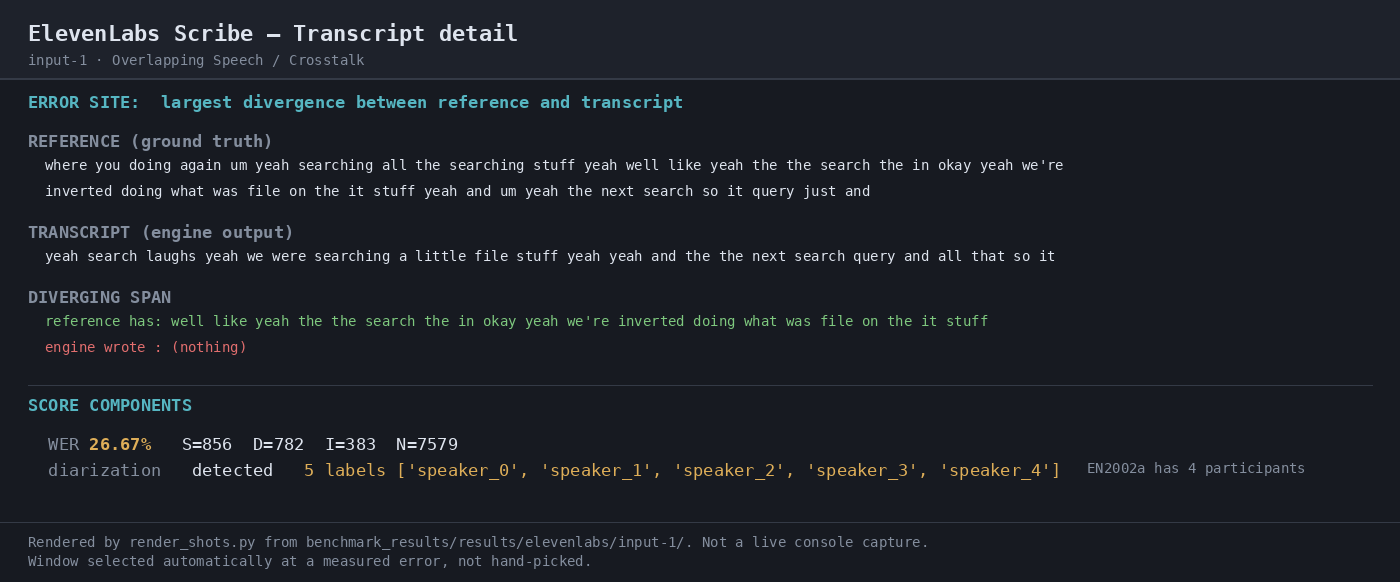
Observed output: Output artifact (Image): On the crosstalk sample, ElevenLabs Scribe scored 26.67% WER with 856 substitutions, 782 deletions, and 383 insertions. The highlighted divergence shows a large missing span and the run over-segmented speakers. — 04-transcript-detail-input-1.png
Input artifact: Input artifact (Audio file): INPUT - Overlapping speech / crosstalk audio (crosstalk.wav), 65.39 MB, 2,142.709 s; batch multipart speech-to-text with diarization and word timestamps enabled. — crosstalk.wav
Output artifact: Output artifact (Image): On the crosstalk sample, ElevenLabs Scribe scored 26.67% WER with 856 substitutions, 782 deletions, and 383 insertions. The highlighted divergence shows a large missing span and the run over-segmented speakers. — 04-transcript-detail-input-1.png
What changed: Audio file transformed into Image
Test case: Audio file → Image
Input type: Audio file
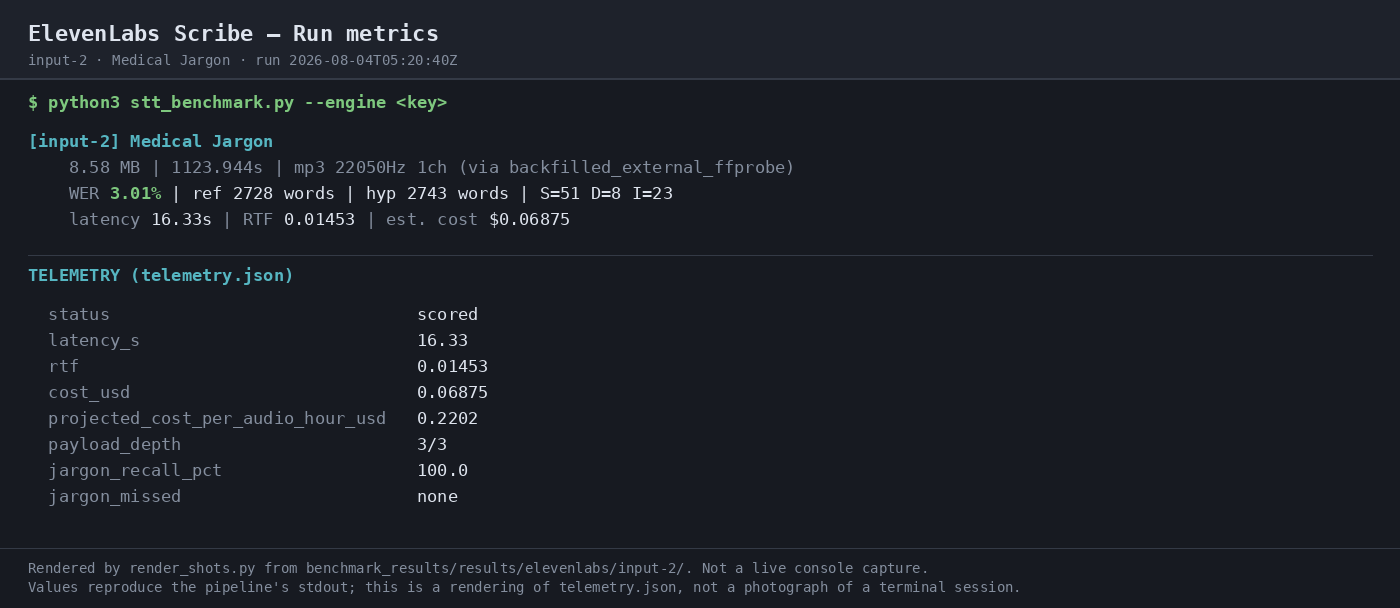
Input used: Input artifact (Audio file): INPUT - Medical jargon narration (medical_terms.mp3), 8.58 MB, 1,123.944 s; batch multipart speech-to-text with diarization and word timestamps enabled. — medical_terms.mp3
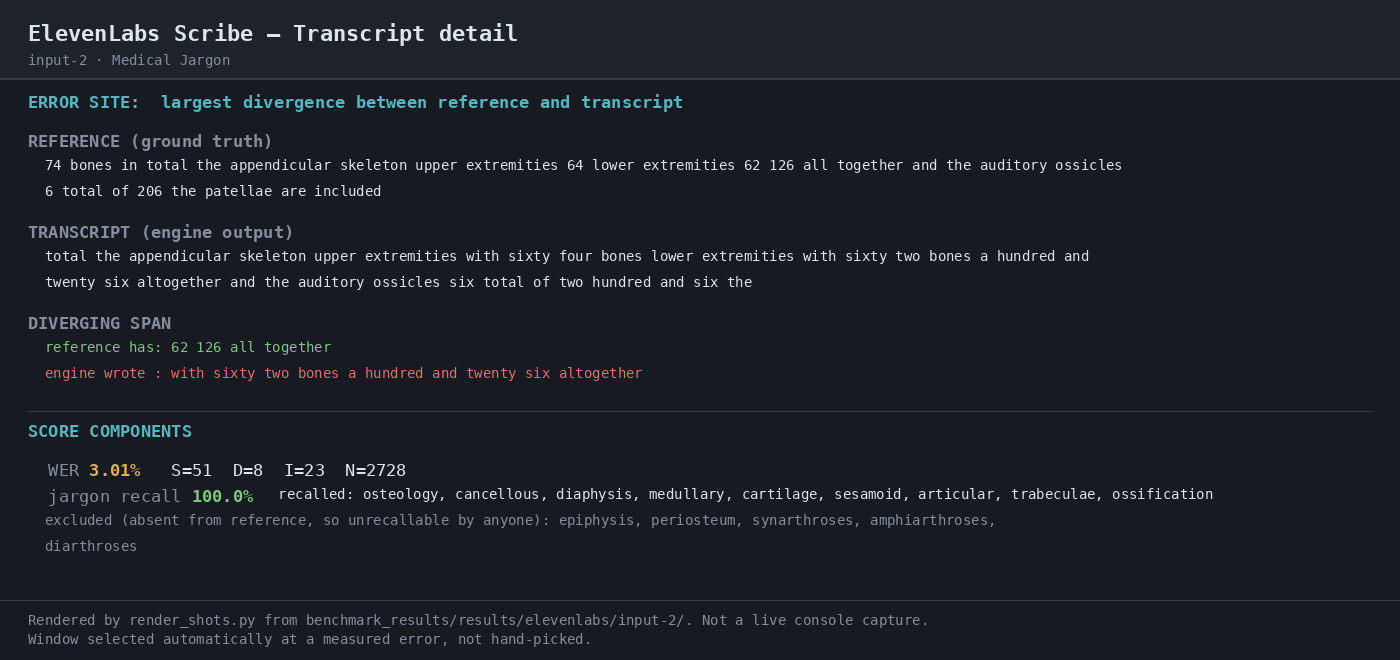
Observed output: Output artifact (Image): On the medical-jargon sample, ElevenLabs Scribe scored 3.01% WER and stayed close to the reference, with only a narrow substitution span in the highlighted diff. — 04-transcript-detail-input-2.png
Input artifact: Input artifact (Audio file): INPUT - Medical jargon narration (medical_terms.mp3), 8.58 MB, 1,123.944 s; batch multipart speech-to-text with diarization and word timestamps enabled. — medical_terms.mp3
Output artifact: Output artifact (Image): On the medical-jargon sample, ElevenLabs Scribe scored 3.01% WER and stayed close to the reference, with only a narrow substitution span in the highlighted diff. — 04-transcript-detail-input-2.png
What changed: Audio file transformed into Image
Test case: Audio file → Image
Input type: Audio file
Input used: Input artifact (Audio file): INPUT - Bilingual code-switching audio (mix_language.mp3), 22.19 MB, 1,938.495 s; batch multipart speech-to-text with diarization and word timestamps enabled. — mix_language.mp3
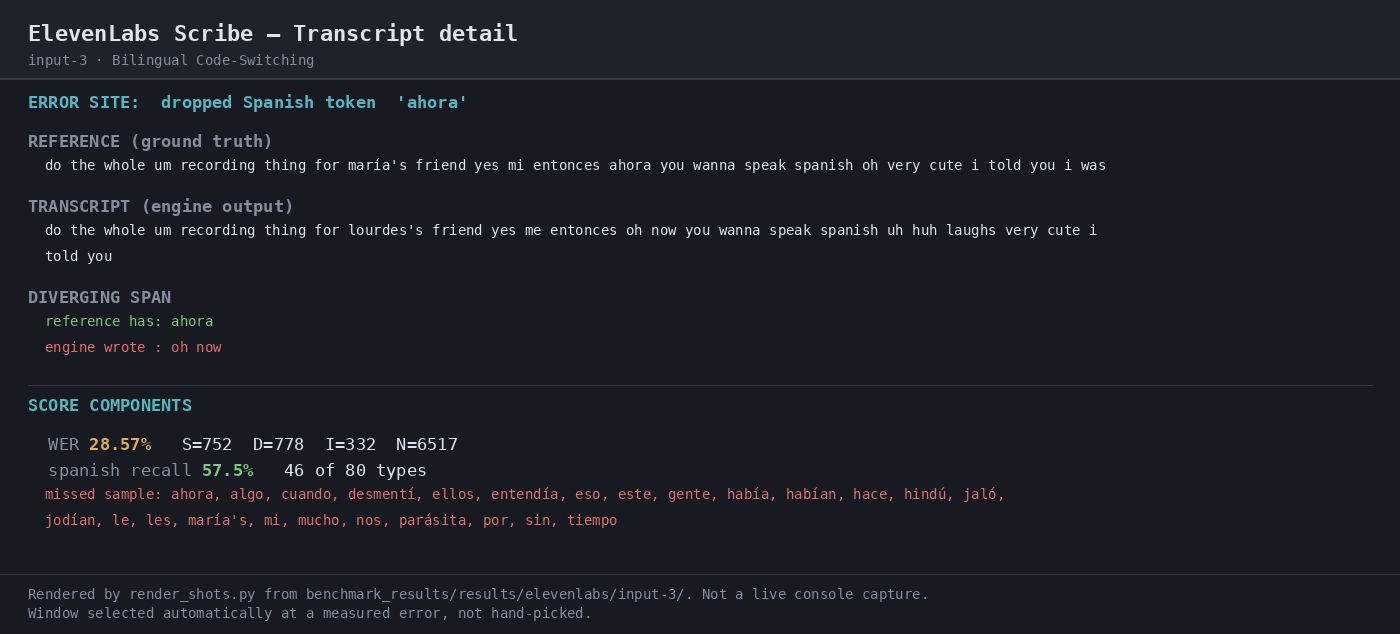
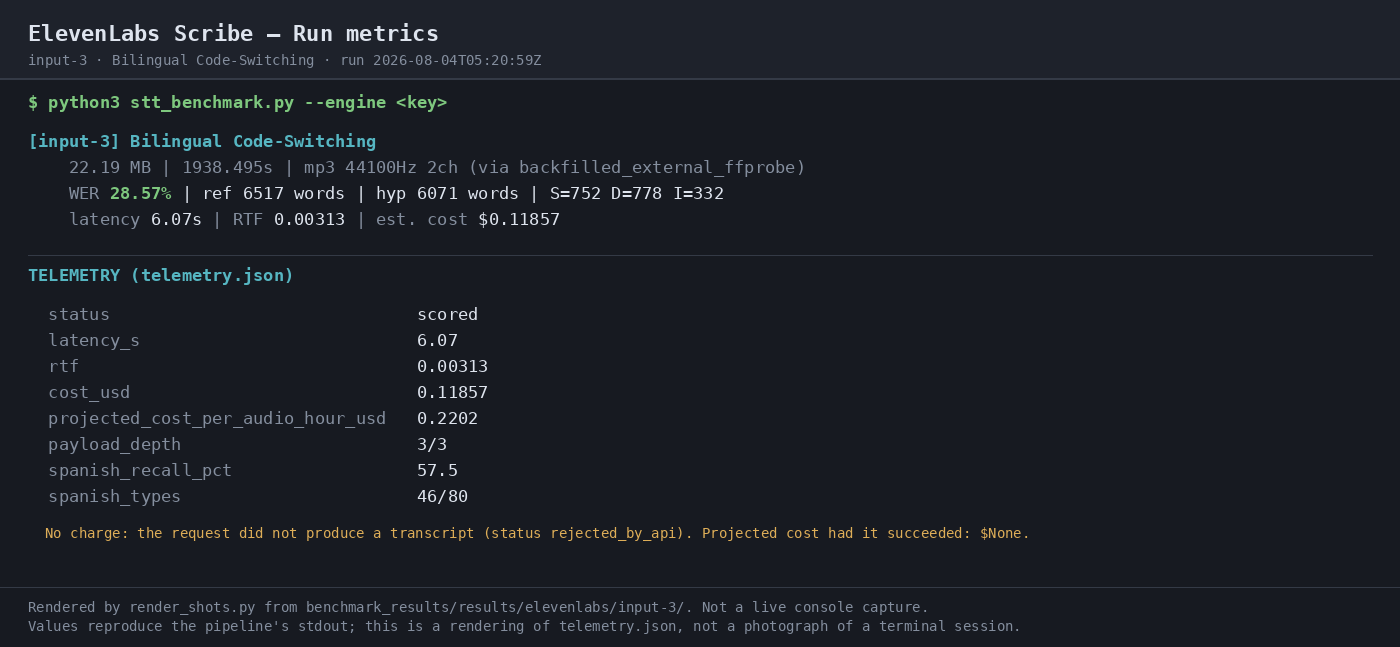
Observed output: Output artifact (Image): On the bilingual sample, ElevenLabs Scribe scored 28.57% WER; the highlighted error site drops the Spanish token 'ahora' and the run leaves Spanish recall at 57.5%. — 04-transcript-detail-input-3.png
Input artifact: Input artifact (Audio file): INPUT - Bilingual code-switching audio (mix_language.mp3), 22.19 MB, 1,938.495 s; batch multipart speech-to-text with diarization and word timestamps enabled. — mix_language.mp3
Output artifact: Output artifact (Image): On the bilingual sample, ElevenLabs Scribe scored 28.57% WER; the highlighted error site drops the Spanish token 'ahora' and the run leaves Spanish recall at 57.5%. — 04-transcript-detail-input-3.png
What changed: Audio file transformed into Image
Why it matters / Conclusion: The core transcript engine is very input-sensitive: it can be excellent on technical English, but hard conversational audio and code-switching both degrade sharply.
ElevenLabs Scribe performs one-shot batch transcription over long audio via a single multipart POST. The benchmark exercised it on jargon-heavy narration, crosstalk, and bilingual code-switching, showing the core transcript engine works across these audio inputs but with varying quality.
Transcript Metadata OutputConsistent developer payload▾
Feature tested: Transcript Metadata Output
Result: Passed
Verdict: Consistent developer payload
Expected behavior: The API returns structured transcript payloads with developer-facing metadata such as word-level timestamps, confidence/logprob values, speaker IDs, and stable JSON shape. The evidence came from transcript outputs used for captioning, search, and speaker-aware downstream workflows.
Test case: Audio file → Image
Input type: Audio file
Input used: Input artifact (Audio file): INPUT - Overlapping speech / crosstalk audio (crosstalk.wav), 65.39 MB, 2,142.709 s. — crosstalk.wav
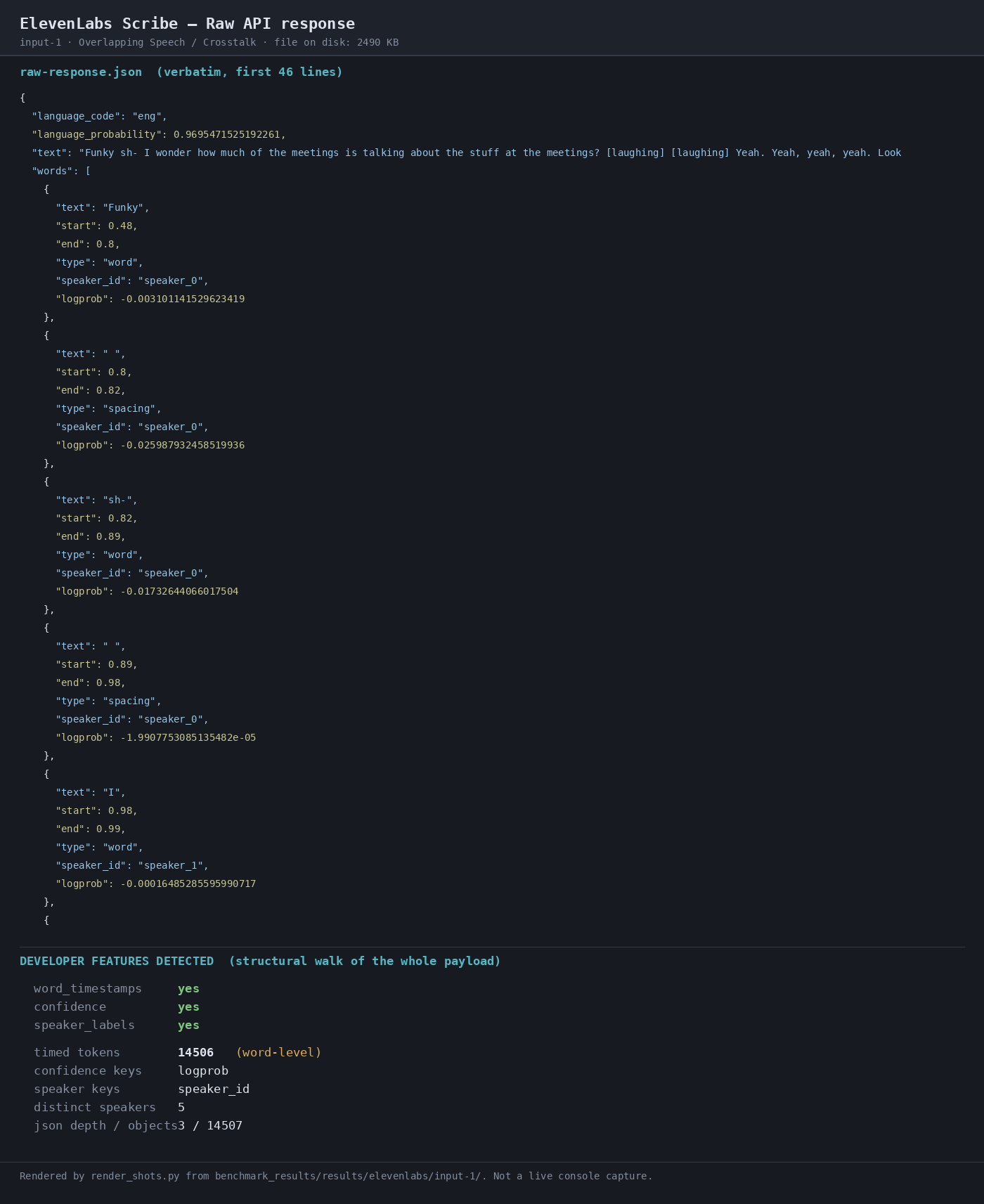
Observed output: Output artifact (Image): Raw response preview showing `word_timestamps yes`, `confidence yes`, `speaker_labels yes`, 14,506 timed tokens, and 5 distinct speakers. — 02-response-raw-input-1.png
Input artifact: Input artifact (Audio file): INPUT - Overlapping speech / crosstalk audio (crosstalk.wav), 65.39 MB, 2,142.709 s. — crosstalk.wav
Output artifact: Output artifact (Image): Raw response preview showing `word_timestamps yes`, `confidence yes`, `speaker_labels yes`, 14,506 timed tokens, and 5 distinct speakers. — 02-response-raw-input-1.png
What changed: Audio file transformed into Image
Test case: Audio file → Image
Input type: Audio file
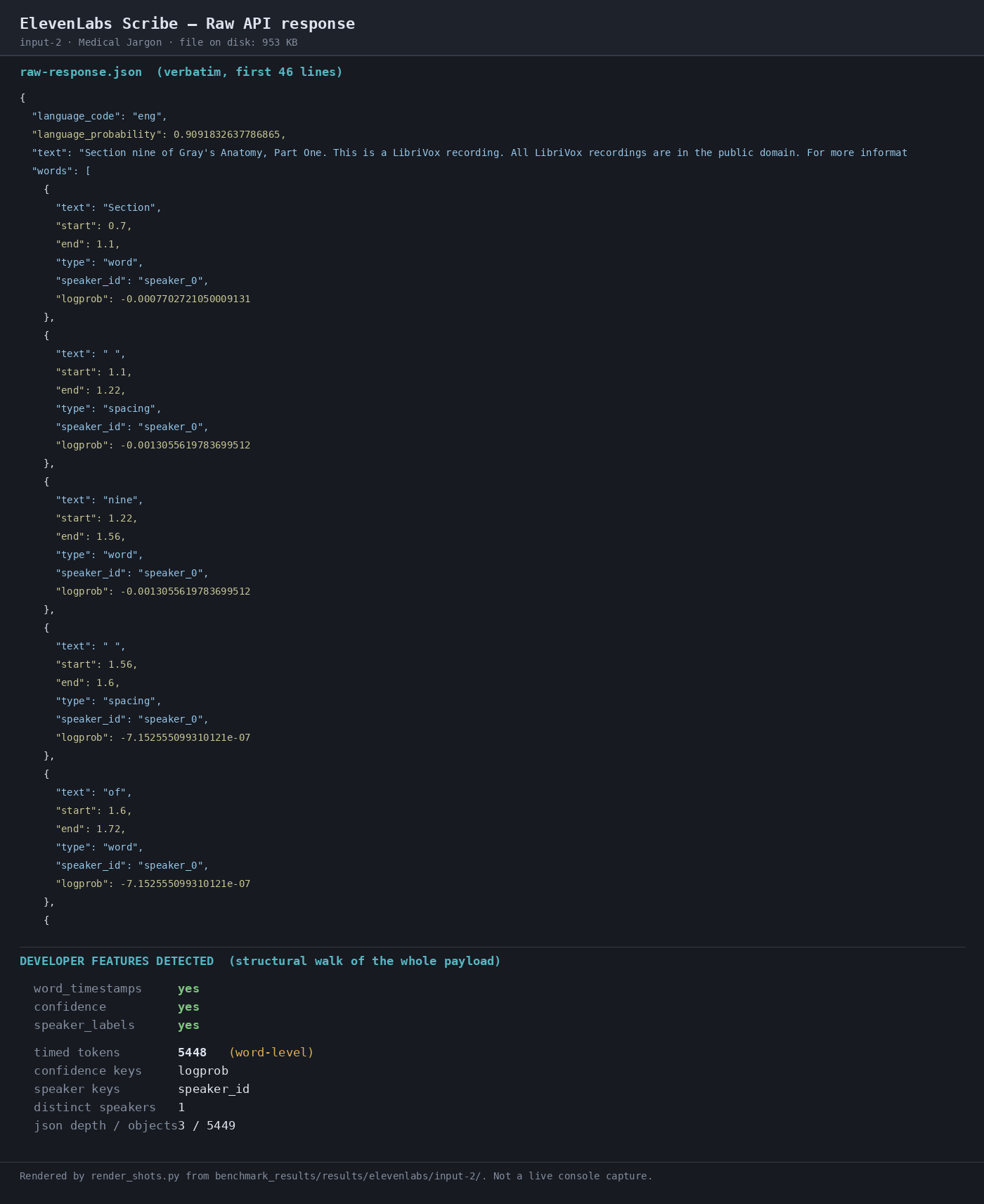
Input used: Input artifact (Audio file): INPUT - Medical jargon narration (medical_terms.mp3), 8.58 MB, 1,123.944 s. — medical_terms.mp3
Observed output: Output artifact (Image): Raw response preview showing `word_timestamps yes`, `confidence yes`, `speaker_labels yes`, 5,448 timed tokens, and 1 distinct speaker. — 02-response-raw-input-2.png
Input artifact: Input artifact (Audio file): INPUT - Medical jargon narration (medical_terms.mp3), 8.58 MB, 1,123.944 s. — medical_terms.mp3
Output artifact: Output artifact (Image): Raw response preview showing `word_timestamps yes`, `confidence yes`, `speaker_labels yes`, 5,448 timed tokens, and 1 distinct speaker. — 02-response-raw-input-2.png
What changed: Audio file transformed into Image
Test case: Audio file → Image
Input type: Audio file
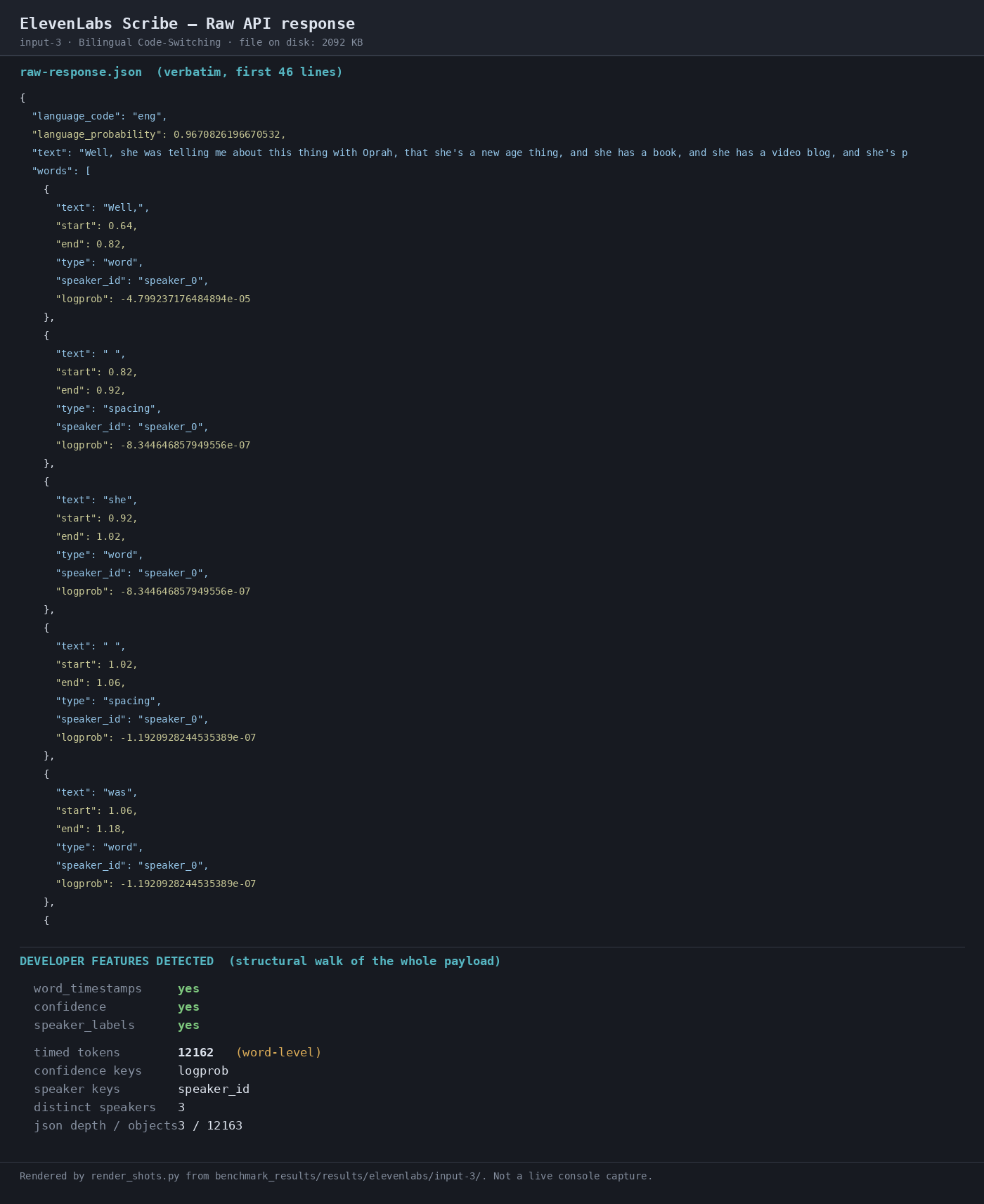
Input used: Input artifact (Audio file): INPUT - Bilingual code-switching audio (mix_language.mp3), 22.19 MB, 1,938.495 s. — mix_language.mp3
Observed output: Output artifact (Image): Raw response preview showing `word_timestamps yes`, `confidence yes`, `speaker_labels yes`, 12,162 timed tokens, and 3 distinct speakers. — 02-response-raw-input-3.png
Input artifact: Input artifact (Audio file): INPUT - Bilingual code-switching audio (mix_language.mp3), 22.19 MB, 1,938.495 s. — mix_language.mp3
Output artifact: Output artifact (Image): Raw response preview showing `word_timestamps yes`, `confidence yes`, `speaker_labels yes`, 12,162 timed tokens, and 3 distinct speakers. — 02-response-raw-input-3.png
What changed: Audio file transformed into Image
Why it matters / Conclusion: The payload shape is stable across runs and includes the metadata a downstream developer would expect from a production STT API.
The API returns structured transcript payloads with developer-facing metadata such as word-level timestamps, confidence/logprob values, speaker IDs, and stable JSON shape. The evidence came from transcript outputs used for captioning, search, and speaker-aware downstream workflows.
Speaker DiarizationPresent, but attribution correctness unvalidated▾
Feature tested: Speaker Diarization
Result: Partial
Verdict: Present, but attribution correctness unvalidated
Expected behavior: The engine emits speaker labels and speaker counts in the transcript output, enabling rough diarization and inspection of how many speakers appear in the audio. The benchmark only verified label presence and count, not correct attribution.
Test case: Audio file → Image
Input type: Audio file
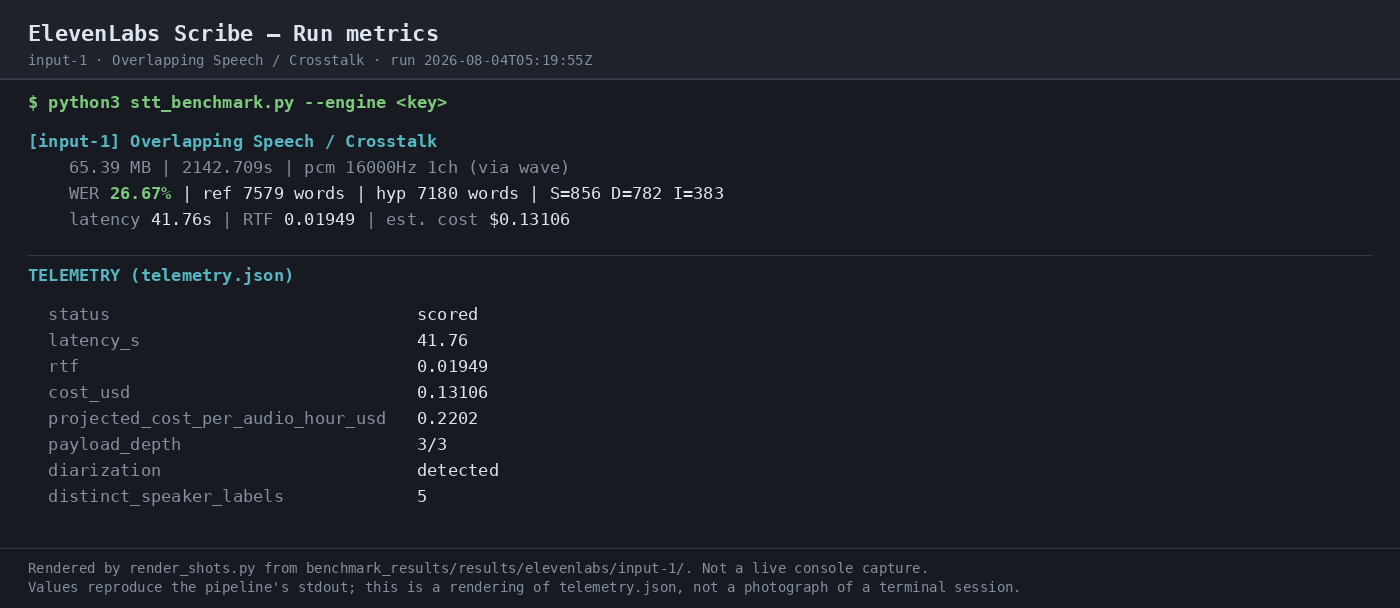
Input used: Input artifact (Audio file): INPUT - Overlapping speech / crosstalk audio (crosstalk.wav), 65.39 MB, 2,142.709 s; 4-way meeting overlap. — crosstalk.wav
Observed output: Output artifact (Image): Run metrics report `diarization detected` and `distinct_speaker_labels 5` on the crosstalk sample, while the reference meeting had 4 participants. — 03-terminal-metrics-input-1.png
Input artifact: Input artifact (Audio file): INPUT - Overlapping speech / crosstalk audio (crosstalk.wav), 65.39 MB, 2,142.709 s; 4-way meeting overlap. — crosstalk.wav
Output artifact: Output artifact (Image): Run metrics report `diarization detected` and `distinct_speaker_labels 5` on the crosstalk sample, while the reference meeting had 4 participants. — 03-terminal-metrics-input-1.png
What changed: Audio file transformed into Image
Test case: Audio file → Image
Input type: Audio file
Input used: Input artifact (Audio file): INPUT - Medical jargon narration (medical_terms.mp3), 8.58 MB, 1,123.944 s; single-speaker narration. — medical_terms.mp3
Observed output: Output artifact (Image): Run metrics report `diarization detected` and `distinct_speaker_labels 1` on the medical-jargon sample, matching the single-speaker setup at the label-count level. — 03-terminal-metrics-input-2.png
Input artifact: Input artifact (Audio file): INPUT - Medical jargon narration (medical_terms.mp3), 8.58 MB, 1,123.944 s; single-speaker narration. — medical_terms.mp3
Output artifact: Output artifact (Image): Run metrics report `diarization detected` and `distinct_speaker_labels 1` on the medical-jargon sample, matching the single-speaker setup at the label-count level. — 03-terminal-metrics-input-2.png
What changed: Audio file transformed into Image
Test case: Audio file → Image
Input type: Audio file
Input used: Input artifact (Audio file): INPUT - Bilingual code-switching audio (mix_language.mp3), 22.19 MB, 1,938.495 s; spontaneous two-language conversation. — mix_language.mp3
Observed output: Output artifact (Image): Run metrics report `diarization detected` and `distinct_speaker_labels 3` on the bilingual sample, showing that speaker labels are returned even in mixed-language audio. — 03-terminal-metrics-input-3.png
Input artifact: Input artifact (Audio file): INPUT - Bilingual code-switching audio (mix_language.mp3), 22.19 MB, 1,938.495 s; spontaneous two-language conversation. — mix_language.mp3
Output artifact: Output artifact (Image): Run metrics report `diarization detected` and `distinct_speaker_labels 3` on the bilingual sample, showing that speaker labels are returned even in mixed-language audio. — 03-terminal-metrics-input-3.png
What changed: Audio file transformed into Image
Why it matters / Conclusion: Speaker labels are there, but the benchmark only proves label presence and count, not correct attribution.
The engine emits speaker labels and speaker counts in the transcript output, enabling rough diarization and inspection of how many speakers appear in the audio. The benchmark only verified label presence and count, not correct attribution.
Multilingual Transcription▾
Feature tested: Multilingual Transcription
Result: Partial
Expected behavior: ElevenLabs Scribe can transcribe mixed Spanish-English or code-switched audio without special configuration. The sampled evidence shows usable mixed-language transcription, though Spanish recall is weaker than in clean-English narration.
Test case: Audio file → Image
Input type: Audio file
Input used: Input artifact (Audio file): INPUT - Bilingual code-switching audio (mix_language.mp3), 22.19 MB, 1,938.495 s; mixed Spanish-English conversation. — mix_language.mp3
Observed output: Output artifact (Image): The metrics view reports 28.57% WER and Spanish recall of 57.5% (46/80 types) on the bilingual run, which is the clearest summary of multilingual quality. — 03-terminal-metrics-input-3.png
Input artifact: Input artifact (Audio file): INPUT - Bilingual code-switching audio (mix_language.mp3), 22.19 MB, 1,938.495 s; mixed Spanish-English conversation. — mix_language.mp3
Output artifact: Output artifact (Image): The metrics view reports 28.57% WER and Spanish recall of 57.5% (46/80 types) on the bilingual run, which is the clearest summary of multilingual quality. — 03-terminal-metrics-input-3.png
What changed: Audio file transformed into Image
Test case: Audio file → Image
Input type: Audio file
Input used: Input artifact (Audio file): INPUT - Bilingual code-switching audio (mix_language.mp3), 22.19 MB, 1,938.495 s; mixed Spanish-English conversation. — mix_language.mp3
Observed output: Output artifact (Image): The transcript-detail view shows the specific bilingual failure site: the reference has `ahora`, while the engine wrote `oh now` instead. — 04-transcript-detail-input-3.png
Input artifact: Input artifact (Audio file): INPUT - Bilingual code-switching audio (mix_language.mp3), 22.19 MB, 1,938.495 s; mixed Spanish-English conversation. — mix_language.mp3
Output artifact: Output artifact (Image): The transcript-detail view shows the specific bilingual failure site: the reference has `ahora`, while the engine wrote `oh now` instead. — 04-transcript-detail-input-3.png
What changed: Audio file transformed into Image
Why it matters / Conclusion: It can transcribe mixed-language audio, but Spanish quality is materially weaker than the clean-English medical sample.
ElevenLabs Scribe can transcribe mixed Spanish-English or code-switched audio without special configuration. The sampled evidence shows usable mixed-language transcription, though Spanish recall is weaker than in clean-English narration.
Official pricing
Current Scribe v2 list pricing from ElevenLabs' pricing page; the benchmark run itself used `scribe_v1`.
The per-hour Scribe rate is flat across plans at $0.22/hr; paid tiers mainly increase included hours and concurrency. Add-ons are priced separately: entity detection +$0.070/hr and keyterm prompting +$0.050/hr. Prices exclude taxes.
Featured in Rankings
Independent rankings where ElevenLabs Scribe was tested and rated.
Banner Preview
How the embed badge will look on your site
Embed HTML
Copy this code to your website source
Quick Integration Guide
- 1Copy the HTML code block above.
- 2Paste it into your site's HTML or CMS editor.
- 3Banner appears instantly on your page.
- 4Links back to your tool profile here.
Similar Tools
Discover more AI tools like ElevenLabs Scribe to enhance your workflow.
Comments (0)
Need a custom AI solution for this use case?
If you are looking to build a custom speech-to-text transcription, audio transcription, or subtitle generation system for your business or internal workflow, email us at contact@futuresmart.ai.
Found something inaccurate or missing? We try to keep our AI research accurate and useful. If you found outdated information, an issue, or have a suggestion, email us at collaborate@aidemos.com.