RN
Rugved Nichite
Verified Review
Tested Hands-OnResume ParserPDF ParsingJSON OutputMulti-Format SupportStructured Data Extraction

Best AI Tools for Parsing Resumes via API (2026)

0
Tested: Affinda vs Airparser vs LlamaParse vs Extracta Labs vs Hrflow · April 2026

This ranking evaluates AI resume parsing APIs based on their ability to convert resume PDFs into structured, machine-readable data. Using the same three resume inputs across all tools—a clean single-column resume, a multi-column sidebar resume, and a messy real-world resume—we tested extraction accuracy, layout handling, JSON consistency, and automation readiness. The analysis highlights which APIs are best suited for ATS platforms, recruitment software, HR-tech products, and large-scale hiring workflows.

How We Tested

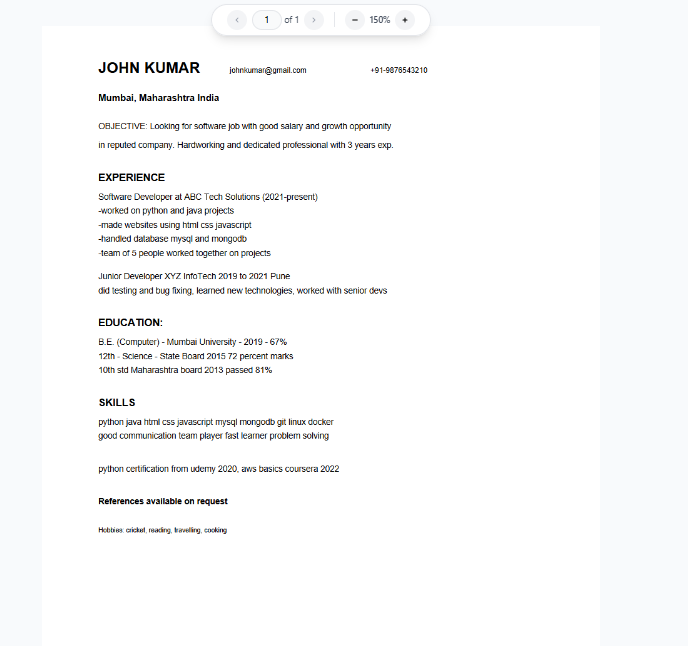
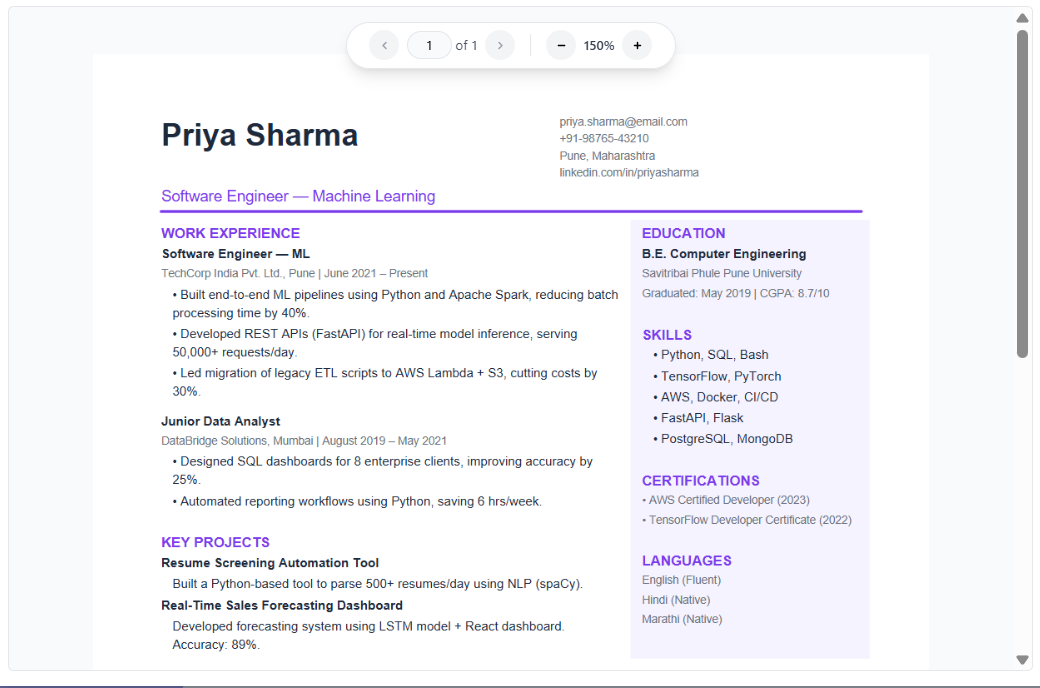
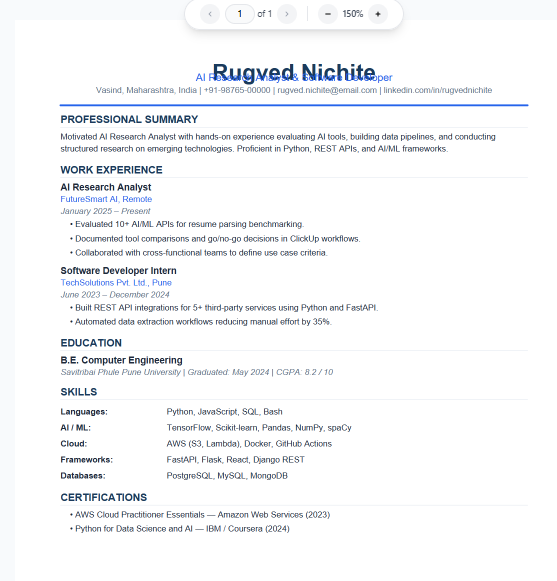
Each tool was evaluated as a production-grade parsing API — not on its feature list, but on what it actually returned for three deliberately different resumes. We fixed the success and failure criteria before testing began to keep the evaluation unbiased. Input 1 — Clean single-column resume (Rugved Nichite) A well-structured, professional, single-column layout. Contains name, email, phone, location, LinkedIn, professional summary, two work experiences with bullet points, education with CGPA, a categorised skills list, and certifications with dates. This is the baseline — every tool should handle it cleanly. Input 2 — Multi-column sidebar resume (Priya Sharma) A two-column layout with a sidebar and mixed font sizes. The header is split across columns; work experience and projects sit in the left column, while education, skills, certifications, and languages sit in the right sidebar. This tests non-linear reading order and section detection — where most parsers struggle. Input 3 — Messy real-world resume (John Kumar) Inconsistent formatting, no clear section separators, mixed date formats, mixed casing, comma-separated skills, no bullet points, education entries in mixed percentage formats, and hobbies and references buried in the body. This tests fallback heuristics on the kind of resume real candidates actually submit.

Same Input Used Across All Tools
Input 1.pdf
Input 2.pdf
Input .3.pdf
What We Evaluated
Label
Description
Field Extraction Accuracy
how correctly the parser pulled the core fields: name, email, phone, work experience, education, skills, and certifications.
Multi-Format Layout Handling
how reliably it handled two-column sidebars and messy layouts without crashing or returning garbage.
Output Structure Quality
how clean, consistent, and machine-readable the JSON was: stable field names across parses, proper arrays for skills and certifications, and no noise or hallucinated values.  
Automation Level
how much manual effort the workflow required: schema setup, template configuration, and post-processing needed to make the output usable.

The Ranking

5 toolstested head-to-head on the same input. Each card shows the verdict and per-criterion scores. Click "Full breakdown" for the artifact-level evidence.

1
Most Reliable End-to-End Parser
Full breakdown ↓

Affinda is a professional-grade resume-parsing API with 100+ configurable fields, skill-taxonomy metadata via EMSI IDs, language-proficiency extraction, and both a web UI and a REST API. It is built for HR-tech platforms, ATS vendors, and recruitment-automation pipelines that need structured JSON at scale.

Field Extraction Accuracy
5.0
Multi-Format Layout Handling
5.0
2
Strongest Custom Field Extraction
Full breakdown ↓

Airparser is a GPT-powered document-extraction platform. Developers define an extraction schema in natural language and get back exactly those fields in clean, readable JSON. It is built for selective-extraction workflows where output predictability and readability matter more than deep taxonomy metadata.

Field Extraction Accuracy
4.5
Multi-Format Layout Handling
4.5
3
Most Structurally Rich Output
Full breakdown ↓

LlamaParse is an enterprise-grade document-parsing platform with JSON, Markdown, and Excel export. Its Extract feature accepts a custom JSON schema and produced the most structurally complete output of any tool tested — categorised skill arrays, certifications as structured objects, and the strongest messy-resume result overall.

Field Extraction Accuracy
4.0
Multi-Format Layout Handling
4.5
4
Most Precise Schema-Defined Output
Full breakdown ↓

Extracta.ai is a schema-defined extraction platform that returns clean, minimal JSON containing exactly the fields you define and nothing else. It is built for teams that know precisely which fields they need and want predictable, noise-free output without taxonomy metadata or inferred values.

Field Extraction Accuracy
4.0
Multi-Format Layout Handling
4.0
5
HrflowNeeds work
Developer API with Critical Field Failures
Full breakdown ↓

HrFlow is a developer-first parsing API with a fixed 60+ field schema and no upload UI. It is built for teams assembling API-based recruitment pipelines where core contact fields, work-experience structure, and language extraction are the priority.

Field Extraction Accuracy
3.0
Multi-Format Layout Handling
3.5
Ranking visual

Resume Parser API Scorecard ⭐

Full breakdown · Tool 1 of 5

AffindaBest

Affinda is an AI resume parser built for production use — it takes a resume in, returns structured JSON out, with no field mapping or template setup required. We tested it across three input types: a clean single-column PDF, a two-column layout with a sidebar, and an unstructured resume with inconsistent formatting and missing section headers. The results across all three are what earned it the top ranking — but there are specific fields where it falls short consistently. Read through the feature tests to see exactly where.

Input 1 — Clean single-column resume (Rugved Nichite)
Input 2 — Multi-column sidebar resume (Priya Sharma)
Input 3 — Messy real-world resume (John Kumar)
What worked
  • Strongest multi-column layout parsing of all five tools.
  • 100+ configurable fields with EMSI skill-taxonomy metadata.
  • Languages extracted with proficiency levels from sidebar columns.
  • Fully automated — zero manual setup after upload.
  • Both a web UI and a REST API available for evaluation and integration.
Where it struggled
  • Critical · CGPA score never captured (all three inputs)
  • Critical · Hallucinated skill — "American Welding Society Codes" (Input 2)
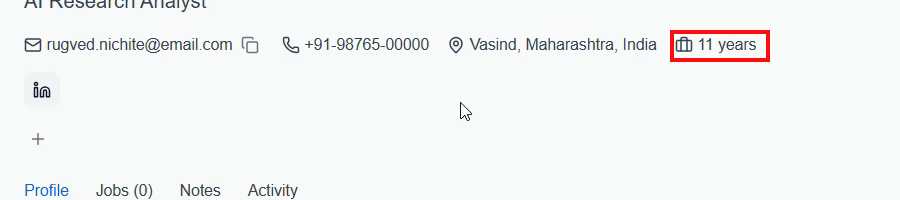
  • Wrong value · Experience inflated to 7.3 years (Input 3)
  • Missing · AWS Coursera certification silently dropped (Input 3)
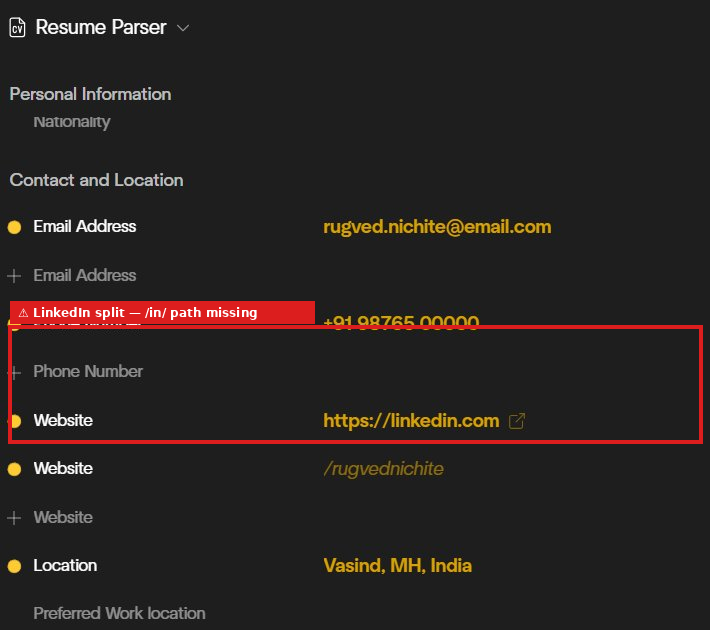
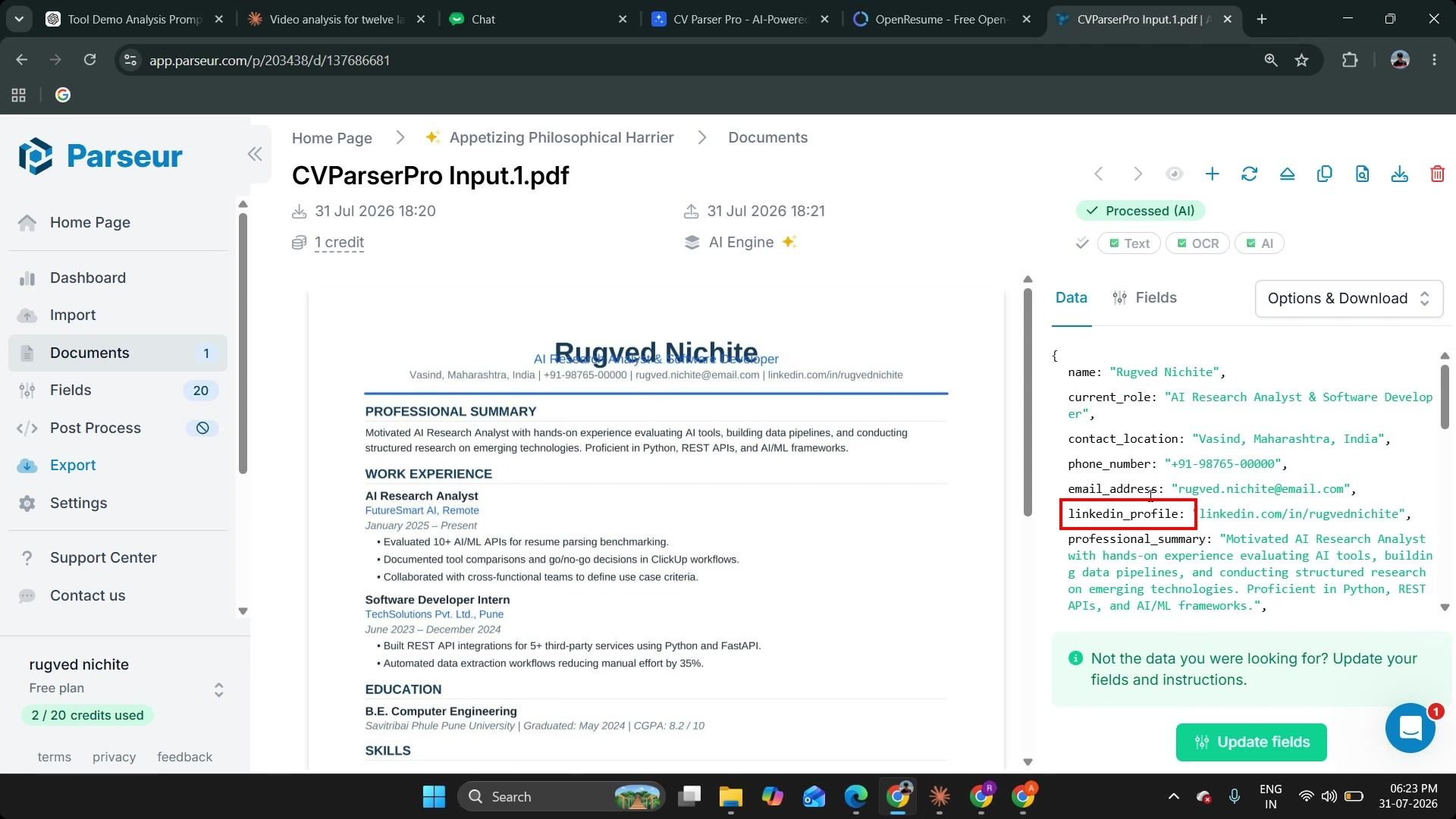
  • Partial · LinkedIn URL split across two fields (Input 1)
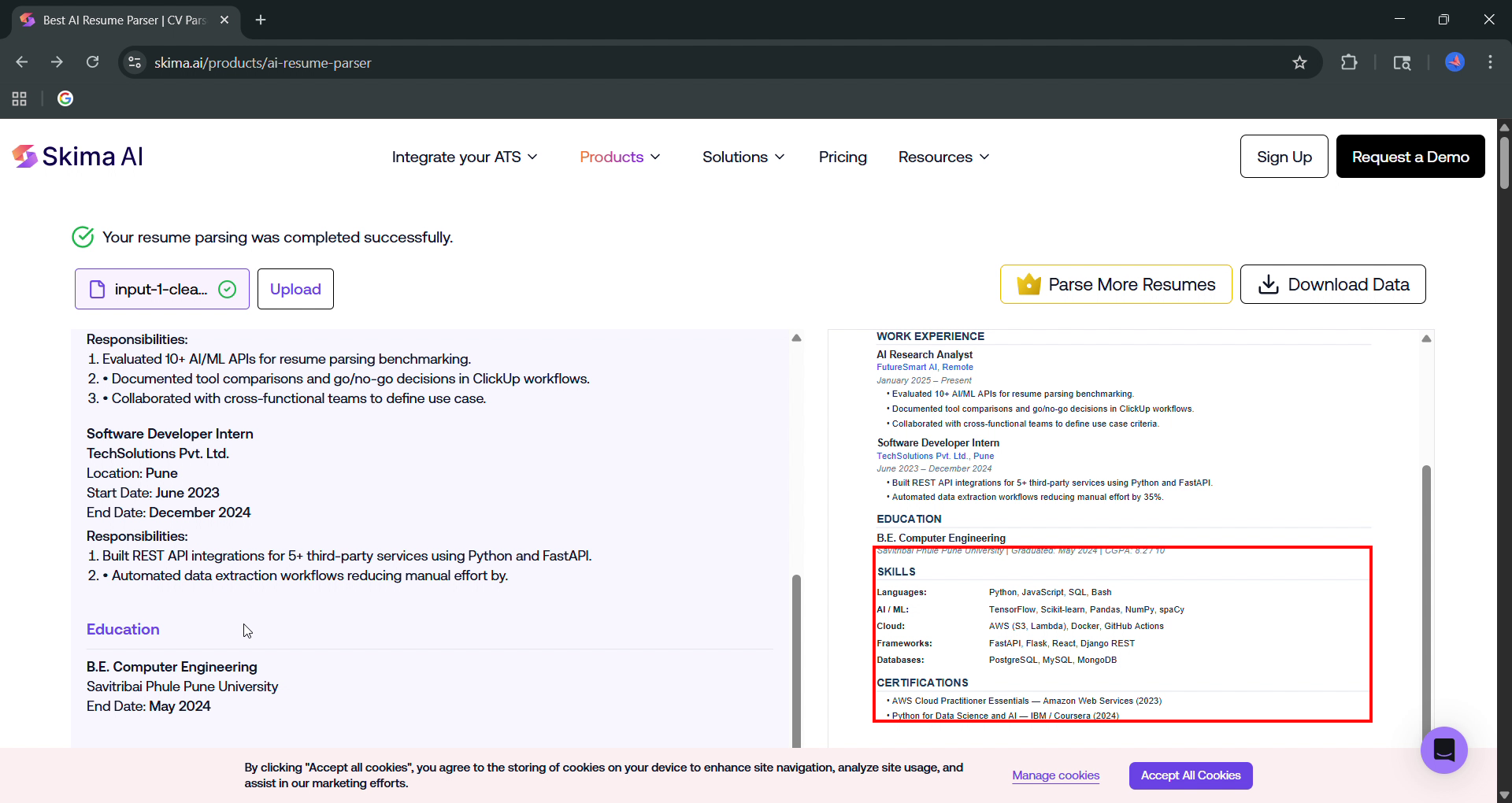
  • Noise · Duplicate and certification-name skills (Input 1)
What came out
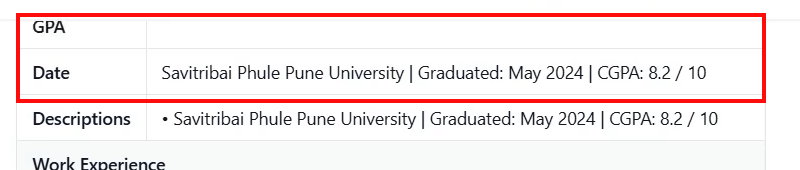
Critical · CGPA score never captured (all three inputs)

Affinda correctly tagged the grade unit as "CGPA" but left the numeric Score field empty. The values 8.2 and 8.7 were written plainly in the resumes and never reached the output. The same gap appeared on every input, which confirms a parser limitation rather than a layout problem.

Critical · Hallucinated skill — "American Welding Society Codes" (Input 2)

This term appears nowhere in Priya Sharma's resume. Affinda's EMSI taxonomy misclassified a fragment of the TensorFlow Developer Certificate and mapped it to an unrelated industrial certification code — with no confidence flag to warn a downstream system.

2 full renders · same input
Full breakdown · Tool 2 of 5

Airparser

Airparser is a strong GPT-powered resume parser that delivers clean, human-readable JSON output across all resume formats. It outperforms Affinda on CGPA capture, job title extraction, certification completeness, and soft skill inclusion. The schema is defined once in natural language and applied automatically to every file after that. Best choice when readable, selective JSON output is the priority over deep skill taxonomy metadata. Free trial available on signup.

Input 1 — Clean single-column resume (Rugved Nichite)
Input 2 — Multi-column sidebar resume (Priya Sharma)
Input 3 — Messy real-world resume (John Kumar)
What worked
  • CGPA numeric value captured correctly on both the clean and multi-column inputs.
  • Job-title headline extracted on the multi-column resume — missed by Affinda.
  • Both certifications captured on the messy resume.
  • All soft skills extracted on the messy input.
  • Project descriptions complete, including the "Accuracy: 89%" metric.
Where it struggled
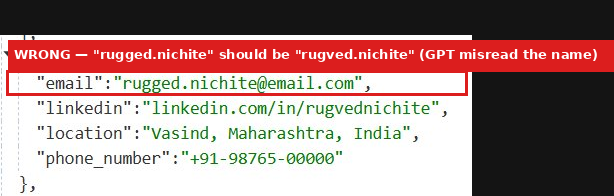
  • Airparser: email returned as rugged.nichite@email.com
  • Airparser: all 14 skills dumped as a single string
  • Airparser: job title returned as "AI Research Analyst" only
  • Airparser: multi-column skills returned as a flat list
  • Airparser: third education entry returned "72 percent marks"
What came out
 Email hallucination "rugged" instead of "rugved"
Email hallucination "rugged" instead of "rugved"

Airparser misread the name portion of the email and returned rugged.nichite@email.com instead of rugved.nichite@email.com — a GPT hallucination on a clean, clearly formatted field. Wrong contact information makes the entire parse unreliable for downstream use.

Skills returned as one concatenated string

Instead of an array, all 14 skills came back as a single concatenated string. A developer cannot loop over the skills directly — they must split the string by hand first, which defeats the purpose of structured JSON output.

2 full renders · same input
Full breakdown · Tool 3 of 5

LlamaParse

LlamaParse is an enterprise-grade document-parsing platform with JSON, Markdown, and Excel export. Its Extract feature accepts a custom JSON schema and produced the most structurally complete output of any tool tested — categorised skill arrays, certifications as structured objects, and the strongest messy-resume result overall.

Input 1 — Clean single-column resume (Rugved Nichite)
Input 2 — Multi-column sidebar resume (Priya Sharma)
Input 3 — Messy real-world resume (John Kumar)
What worked
  • Best skills categorisation — five named category arrays on the clean resume.
  • Certifications returned as structured objects with name, issuer, and year.
  • Strongest messy-resume extraction of all tools tested.
  • CGPA captured as a dedicated standalone field.
  • References returned as a boolean — the most machine-readable format tested.
Where it struggled
  • LlamaParse: name under top-level / personal_info / contact across the three inputs
  • LlamaParse: title returned as "Research Analyst & Software Developer"
  • LlamaParse: languages key present on Input 2, absent on Input 3
  • LlamaParse: issuer present on Input 1, absent on Input 2
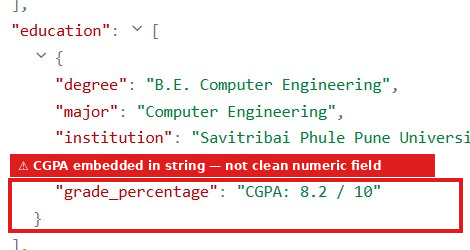
  • LlamaParse: "CGPA: 8.2 / 10" string and lowercase skills
What came out
Field naming inconsistent across parses (all inputs)

Input 1 returns the name as a top-level field, Input 2 wraps everything in a personal_info block, and Input 3 uses a top-level name plus a separate contact block. All three parse the same data with three different key structures. A production system would work on Inputs 1 and 3 and silently break on Input 2 — no error thrown, just a missing field.


Absent field · languages key omitted when no languages section exists (Inputs 1 & 3)

When a resume has no languages section, LlamaParse drops the key entirely instead of returning an empty array. A downstream system expecting that key throws a KeyError — whereas Affinda handles the same case gracefully with an empty array.

2 full renders · same input
Full breakdown · Tool 4 of 5

Extracta Labs

Extracta.ai is a schema-defined extraction platform that returns clean, minimal JSON containing exactly the fields you define and nothing else. It is built for teams that know precisely which fields they need and want predictable, noise-free output without taxonomy metadata or inferred values.

Input 1 — Clean single-column resume (Rugved Nichite)
Input 2 — Multi-column sidebar resume (Priya Sharma)
What worked
  • Cleanest output format — no metadata noise, no taxonomy IDs.
  • Both certifications captured on the messy resume.
  • Most complete skills array on the messy input.
  • Multi-column layout handled correctly with no configuration.
  • Email extracted correctly with no hallucination.
Where it struggled
  • Extracta.ai: no LinkedIn field in personal_info
  • Extracta.ai: languages = Python, JavaScript, SQL, Bash
  • Extracta.ai: languages shows 1 item with an empty value
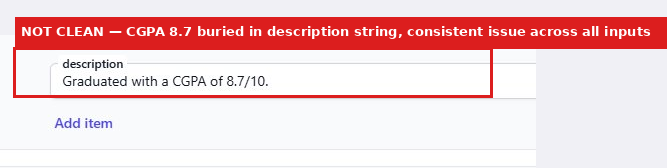
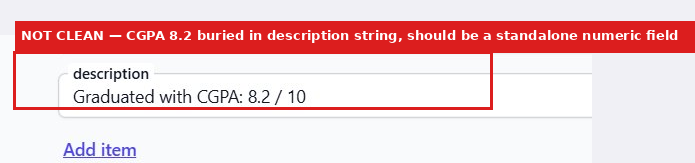
  • Extracta.ai: "Graduated with CGPA: 8.2 / 10" inside description
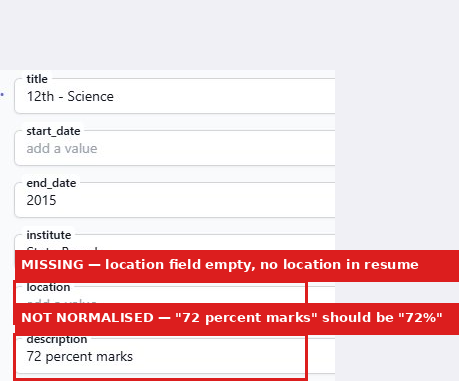
  • Extracta.ai: empty start_date / location and lowercase certs
What came out
LinkedIn silently skipped — schema limitation (all inputs)

Extracta.ai returns only fields defined in the schema upfront. Because LinkedIn was not defined, it was never extracted — on any input — even though it appears clearly in the resumes. Unlike Affinda and Airparser, Extracta.ai will silently skip anything you forget to define.

 languages returns a blank item (Input 3)
languages returns a blank item (Input 3)

The messy resume had no languages section, so Extracta.ai returned a single blank entry rather than omitting the field — creating an unexpected null-handling case downstream.

2 full renders · same input
Full breakdown · Tool 5 of 5

HrflowBest

HrFlow is a developer-first parsing API with a fixed 60+ field schema and no upload UI. It is built for teams assembling API-based recruitment pipelines where core contact fields, work-experience structure, and language extraction are the priority.

Input 1 — Clean single-column resume (Rugved Nichite)
Input 2 — Multi-column sidebar resume (Priya Sharma)
Input 3 — Messy real-world resume (John Kumar)
What worked
  • Core contact fields — name, email, phone, location, and LinkedIn — extracted correctly on all three inputs.
  • Phone number captured completely on every input, with all digits present (e.g. +91 98765 00000 on the clean resume).
  • Casing preserved where it matters — "Rugved Nichite" and "FutureSmart AI" returned with correct capitalisation rather than flattened.
  • Work-experience structure and company names extracted reliably, including the "AI" in "FutureSmart AI."
  • Both certifications correctly placed in the certifications field on the multi-column resume.
  • All three languages (English, Hindi, Marathi) extracted from the sidebar on the multi-column resume.
  • Both work experiences returned with correct titles, companies, and dates across all inputs.
Where it struggled
  • HrFlow: certification filed under education (Input 1) and as noise skills (Input 3)
  • HrFlow: soft skills absent from the messy-resume output
  • HrFlow: title returned as "Software Engineer"
  • HrFlow: "ml apis," "react dashboard," "pune did testing..." tagged as skills/tasks
What came out
Certifications inconsistent across inputs

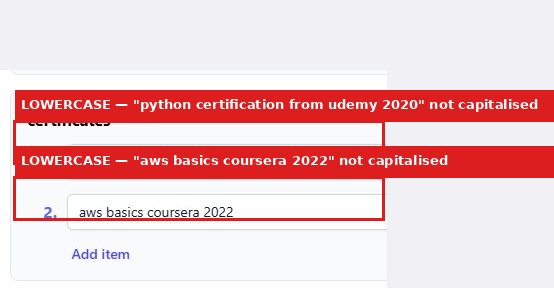
Certifications were only handled correctly on the multi-column resume. On the clean resume, "Python for Data Science and AI — IBM / Coursera" was filed under education instead of certifications; on the messy resume they weren't extracted at all, surfacing instead as the noise skill fragments "udemy 2020" and "aws basics coursera 2022." The field can't be trusted without knowing which input produced it.

Noise · Skill and task fields polluted with fragments (all inputs)

Project names, URL fragments, and API names were tagged as skills — "ml apis," "lambda," "s3," "rest apis" on Input 1, and "react dashboard," "ci," "cd," "parse 500" on Input 2. On Input 3, address text bled into a task ("pune did testing and bug fixing"), pulling "Pune" in from the address line.

2 full renders · same input

Final Take

Affinda delivered the strongest overall parsing experience — handling clean, multi-column, and messy resumes reliably, with the richest field schema and fully automated extraction. Its blind spots are specific and fixable in post-processing: CGPA scores never populate, experience is calculated from raw dates rather than the stated value, and its EMSI taxonomy occasionally injects skills that aren't in the resume. Best for production use where skill metadata and multi-column layouts matter, with mandatory post-processing to clean noise skills and validate experience and CGPA fields. Airparser came close, with better CGPA capture, the job-title headline Affinda missed, and complete soft-skill extraction. Its one serious risk is the email hallucination on a clean field, which matters wherever contact accuracy is non-negotiable. Best when readable, selective JSON is the priority over deep classification. LlamaParse produced the most structurally complete output of any tool — categorised skills, structured certifications, and the best messy-resume result — but its GPT-driven extraction changes field names between parses, which breaks integrations silently at scale. Best for research and benchmarking where output richness matters more than strict key consistency. Extracta.ai is the most predictable and noise-free tool, but it returns only what you define upfront — so a weak schema silently loses real data such as LinkedIn URLs and job-title headlines. Excellent for teams that know exactly which fields they need; weaker for exploratory parsing. HrFlow handles core fields adequately but carries three production-blocking failures across every input: truncated phone numbers, all-lowercase output, and unreliable certification extraction. It would need meaningful custom post-processing before it could be trusted in a live pipeline. These rankings reflect testing as of April 2026 and will be updated as the tools evolve.

Comments (0)

Please Log in to join the discussion.