developer-tools · tested june 2026

Best AI Tools for Structured Document Extraction from Bank Statements and Invoices

We tested seven AI document extraction tools on a dense bank statement PDF and a structured broadcast invoice PDF, checking schema adherence, row-level completeness, transaction IDs, line items, totals, confidence metadata, and export-ready JSON.

0
7 tools5 things we checked2 tests80 findings129 screenshots16 output files14 min read
Our verdictTested June 2026 · 7/7 tools tested hands-on
#1 pick
Landing AIBest4.6/5 · 5 checks

Strong schema adherence and complete row/line-item extraction, but it invents sequential transaction IDs and occasionally misreads alphanumeric codes.

The rest of the field

#2 Retab· #3 Extend AI· #4 LlamaParse· #5 Datalab· #6 Reducto

The ranking

Scores are the average across every check we scored for that tool. Not every tool was scored on every check — the count is shown.

ToolScorePriceWhere it lands
#1Landing AIBest4.6/5
5 checks
Pay-as-you-goStrong schema and record extraction, with weaker semantic identifier handling.
#2RetabUsable4.2/5
5 checks
Free · $300/monthStrong at nested schema reconstruction and semantic field labeling, with a few cleanup issues in record counts and final formatting.
#3Extend AIUsable4.2/5
5 checks
Free · $500/monthStrong structured extraction with a few cleanup gaps in ordering and field normalization.
#4LlamaParseUsable4.0/5
5 checks
Free · $3/moStrong at producing clean, schema-shaped JSON, but it slips on record counts and derived transaction fields.
#5DatalabUsable3.5/5
5 checks
Free · $400/monthStrong on schema-shaped invoice output and cited metadata, but bank-statement transaction handling breaks down on row boundaries and derived transaction fields.
#6ReductoUsable3.4/5
5 checks
Pay-as-you-goStrong at reconstructing invoices and structured JSON, but the bank statement shows reliability gaps in reconciliation fields and derived transaction metadata.
#7NanonetsUsable3.4/5
5 checks
Free · CustomStrong schema and export handling, but weaker on bank-statement accuracy and derived-field enrichment.

What we checked

Every finding below is tied to one of these checks, and to the test that produced it. The number is how many of the 7 tools we recorded findings for.

Extraction Accuracy 7 toolsSchema Adherence 7 toolsSemantic Field Enrichment 7 toolsStructural Clean Output 7 toolsTable & Record Completeness 7 tools

What we tried

The same 2 tests were run on every tool.

Bank Statement PDFInvoice PDF
Read it

Landing AI

Best#1 of 7

Strong schema and record extraction, with weaker semantic identifier handling.

Extraction Accuracy5/52 findings

The values called out in both runs are precise and consistent, including financial amounts and key identifiers. The evidence shows accuracy on the fields that matter most, with no sign of rounding drift or obvious parsing errors in the tested items.

Worked wellwhen we tried: Invoice PDFlink to this finding

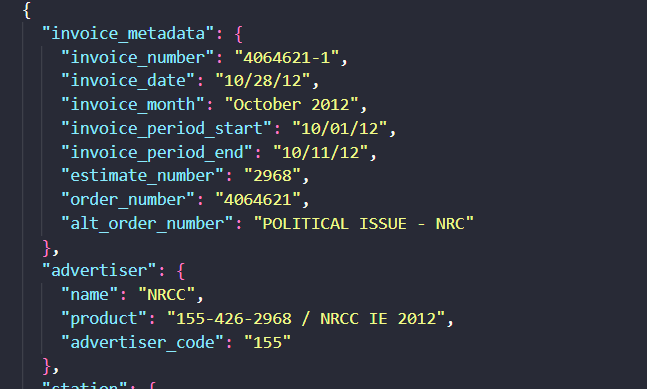
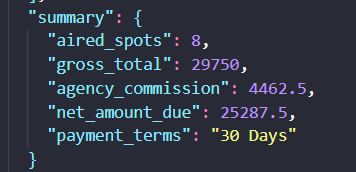
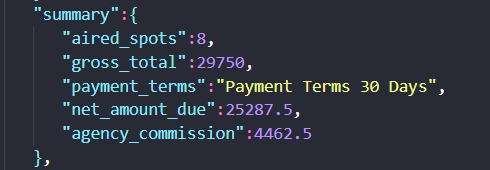
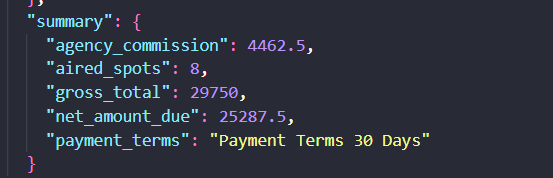
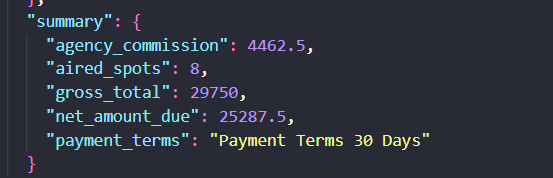
Matches the reported invoice totals and summary figures exactly, including aired_spots 8, gross_total 29750, agency_commission 4462.5, net_amount_due 25287.5, and payment_terms "30 Days".

Worked wellwhen we tried: Bank Statement PDFlink to this finding

Extracts statement metadata, account details, branch codes, and balances with precise values such as bank_name "Standard Chartered", account number "42710540422", IFSC "SCBL0036078", opening_balance 114453.65, and closing_balance 116149.46.

Schema Adherence5/52 findings

It consistently respected the requested hierarchy on both documents, so this is a top score rather than merely a pass. The outputs were built as the expected nested objects instead of being flattened or rearranged.

Worked wellwhen we tried: Invoice PDFlink to this finding

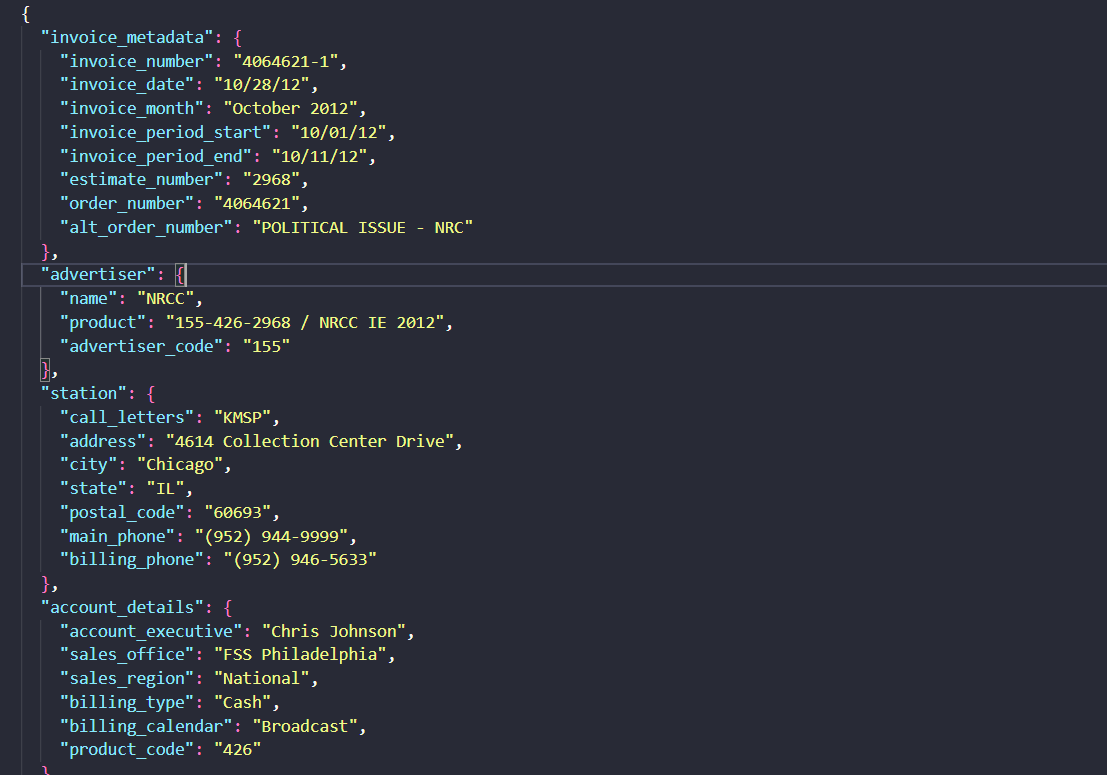
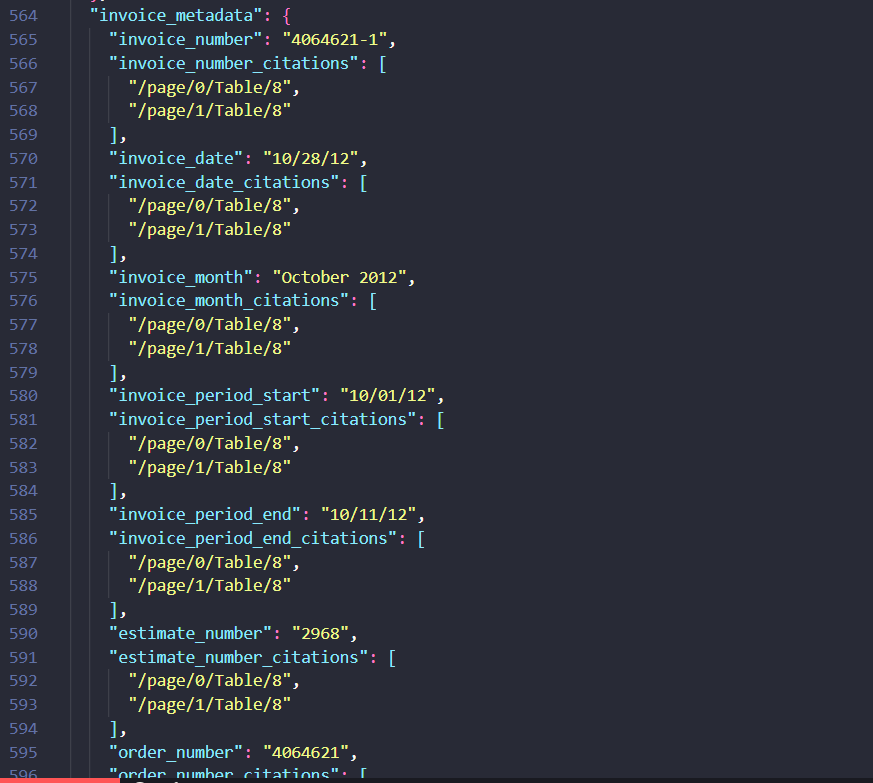
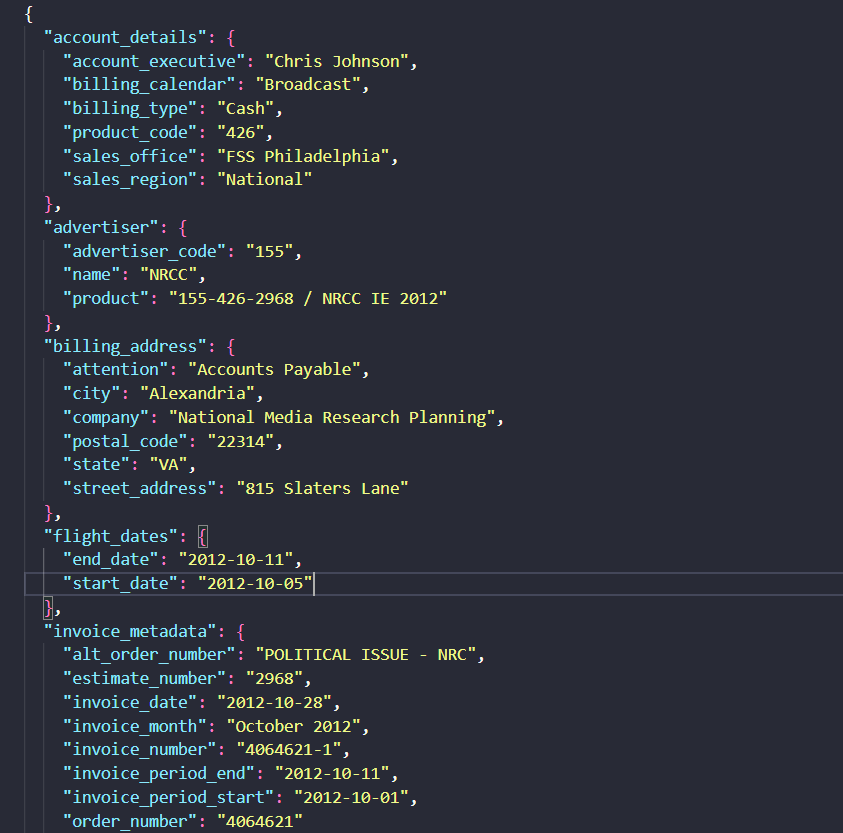
Reconstructs the invoice into the requested nested schema, populating invoice_metadata, advertiser, station, account_details, billing_address, remit_address, flight_dates, line_items, and summary objects.

Tool input

Tool output

Worked wellwhen we tried: Bank Statement PDFlink to this finding

Reconstructs the bank-statement schema as nested JSON objects rather than flat OCR, populating statement.metadata, account_holder.address, account, branch, statement_period, and balances in the requested hierarchy.

Semantic Field Enrichment3/54 findings

It does enrich the raw text with useful derived fields, but the quality is uneven because each scenario also shows a key semantic identifier problem. The result is better than a weak pass, but not strong enough for a 4 since the derived IDs are not consistently trustworthy.

Worked wellwhen we tried: Invoice PDFlink to this finding

Populates derived ad fields such as ad_id, day_of_week, days_pattern, flight_period_start/end, and time_slot in the line-item objects.

Tool input

Tool output

Worked wellwhen we tried: Bank Statement PDFlink to this finding

Infers semantic transaction_type labels such as Withdrawal and Deposit on statement rows instead of leaving only raw descriptions.

Tool input

Tool output

Structural Clean Output5/51 finding

The output is already in a downstream-ready JSON form, so no cleanup or reshaping step is needed after extraction. Because the evidence explicitly says the result is directly downloadable and usable as-is, this earns a top score.

Worked wellacross all testslink to this finding

Returns downloadable JSON directly from the interface and makes the result immediately usable for integration or analysis, with no extra export or transformation layer required.

Table & Record Completeness5/52 findings

Both document types kept their repeated records intact instead of collapsing or inventing rows. That makes this a full-strength result for completeness, because the extracted sets match the expected record structure on both inputs.

Worked wellwhen we tried: Invoice PDFlink to this finding

Extracts all 8 advertising line items as individual records and preserves schedule fields without row merging.

Tool input

Tool output

Worked wellwhen we tried: Bank Statement PDFlink to this finding

Keeps transaction rows as separate records and, according to the report, returns all 51 statement entries without merging, duplicating, or omitting rows.

Tool input

Tool output

landing-ai-landingai-bank-statement-output-d3ff94f60bcb.json
Loading file...

Retab

Usable#2 of 7

Strong at nested schema reconstruction and semantic field labeling, with a few cleanup issues in record counts and final formatting.

Extraction Accuracy4/51 finding

The invoice run showed numerically consistent totals, but we only saw that accuracy check clearly on the invoice side, so this looks strong but not fully proven across both document types.

Worked wellwhen we tried: Invoice PDFlink to this finding

The financial summary is internally consistent and matches the source values reported in the test: agency_commission 4462.5, aired_spots 8, gross_total 29750, and net_amount_due 25287.5.

Schema Adherence5/52 findings

It consistently rebuilt both documents into the requested object-and-array structure, so the schema was followed end to end rather than approximated with flat text.

Worked wellwhen we tried: Bank Statement PDFlink to this finding

The extractor reconstructs the bank statement as nested JSON in the requested hierarchy, with separate statement, metadata, account_holder, account, branch, statement_period, balances, transactions, summary, rewards, and disclaimers objects rather than flat OCR text.

retab-retab-bank-statement-output-f54c1f51f37d.json
Loading file...
Worked wellwhen we tried: Invoice PDFlink to this finding

The invoice output follows the supplied nested schema, populating invoice_metadata, advertiser, station, account_details, billing_address, remit_address, flight_dates, line_items, and summary as separate objects/arrays.

retab-retab-invoice-output-f9a8e57e98e8.json
Loading file...
Semantic Field Enrichment5/52 findings

It reliably added useful derived fields on both inputs, turning raw document text into higher-level labels and scheduling metadata.

Worked wellwhen we tried: Invoice PDFlink to this finding

The line-item extractor fills derived scheduling fields beyond raw OCR, including day_of_week ('Su'), days_pattern ('------S'), time_slot, air_time, and ad_id.

Worked wellwhen we tried: Bank Statement PDFlink to this finding

The tool derives semantic transaction labels instead of leaving raw descriptions only; it classifies entries with transaction_type values such as UPI and transaction_id values such as 917615251879.

Structural Clean Output4/53 findings

The output is already usable as JSON, but a couple of formatting quirks remain, so it is clean enough for pipelines with light cleanup rather than perfectly presentation-ready.

Worked wellacross all testslink to this finding

The tool returns JSON that is immediately copyable from the interface and directly usable for downstream processing without a structural transformation layer.

retab-retab-bank-statement-output-f54c1f51f37d.json
Loading file...
retab-retab-invoice-output-f9a8e57e98e8.json
Loading file...
Mixedwhen we tried: Invoice PDFlink to this finding

The output keeps the source label inside payment_terms, returning 'Payment Terms 30 Days' instead of only the requested value, so a minor post-processing cleanup is needed.

Table & Record Completeness3/52 findings

It fully captured the invoice line items, but the bank statement count was off, so completeness was good in one case and genuinely wrong in the other.

Worked wellwhen we tried: Invoice PDFlink to this finding

All 8 advertising line items were extracted as separate structured records without duplication or omission.

Struggledwhen we tried: Bank Statement PDFlink to this finding

The transaction summary overcounts the statement: total_transactions is 43 even though the report says the expected count is 40, so the aggregation includes 3 extra or incorrectly counted records.

Extend AI

Usable#3 of 7

Strong structured extraction with a few cleanup gaps in ordering and field normalization.

Extraction Accuracy3/53 findings

The invoice numbers were largely right, but the bank statement had a clear summary-count error and the invoice kept extra label text in one field. That makes the overall accuracy genuinely mixed rather than consistently correct.

Worked wellwhen we tried: Invoice PDFlink to this finding

Gets the invoice financial summary right, including aired_spots 8, gross_total 29750, agency_commission 4462.5, and net_amount_due 25287.5.

Mixedwhen we tried: Invoice PDFlink to this finding

Leaves source label text in at least one field value, returning "Payment Terms 30 Days" where the schema expects the value text only.

Schema Adherence5/52 findings

It followed the requested JSON shape in both tests, building the right nested objects rather than dumping plain text. Because the structure held up across both documents, this scores at the top of the scale.

Worked wellwhen we tried: Invoice PDFlink to this finding

Reconstructs the invoice into nested schema objects for invoice_metadata, advertiser, station, addresses, line_items, and summary instead of returning raw OCR.

Tool input

Tool output

Worked wellwhen we tried: Bank Statement PDFlink to this finding

Reconstructs the bank statement as nested JSON objects for branch, account, rewards, balances, summary, and metadata instead of flattening the document into raw OCR text.

Semantic Field Enrichment4/53 findings

The tool reliably added useful derived fields, especially for invoice line items and bank transaction types. The missing bank transaction IDs keep it from a perfect score, but the enrichment is still strong overall.

Worked wellwhen we tried: Invoice PDFlink to this finding

Derives broadcast-specific line-item fields such as ad_id, day_of_week, days_pattern, time_slot, and flight_period dates instead of only copying source text; item 6 shows ad_id NRCCWI070928 and days_pattern -T----.

Failedwhen we tried: Bank Statement PDFlink to this finding

Fails to populate transaction_id across the extracted transactions even when reference identifiers are embedded in the descriptions.

Structural Clean Output4/53 findings

The output is structurally usable JSON and already ready for downstream review or export, but the section order shifts enough that some consumers may still need a light post-processing step. That is a minor cleanliness issue, not a broken output.

Worked wellacross all testslink to this finding

Provides structured JSON output with confidence metadata for review/export, making the result directly consumable without a raw-OCR cleanup layer.

Mixedwhen we tried: Bank Statement PDFlink to this finding

Does not preserve the requested top-level schema order, so downstream consumers expecting the original sequence need a transformation layer.

Tool input

Tool output

Table & Record Completeness5/52 findings

It kept the repeating records intact in both documents: every bank transaction row and every invoice line item appeared as its own entry. With no merging or missing rows called out, this is a full-strength result.

Worked wellwhen we tried: Invoice PDFlink to this finding

Extracts all 8 advertising line items as separate records, preserving the row-level details without merging adjacent entries.

Worked wellwhen we tried: Bank Statement PDFlink to this finding

Extracts all 51 transaction rows as separate records without merging adjacent rows.

LlamaParse

Usable#4 of 7

Strong at producing clean, schema-shaped JSON, but it slips on record counts and derived transaction fields.

Extraction Accuracy4/53 findings

Most checked values came through correctly, but the missing value dates show it is not fully reliable on every field, so this lands below perfect.

Worked wellwhen we tried: Bank Statement PDFlink to this finding

Extracts key bank metadata and account fields with the displayed values intact, including bank_name "Standard Chartered", statement_date "16 Jul 2019", currency "INR", account number "42710540422", and IFSC "SCBL0036078".

Struggledwhen we tried: Bank Statement PDFlink to this finding

Misses value-date data on some rows, returning empty value_date fields even where the statement visibly shows a value date.

Schema Adherence5/52 findings

It kept both documents in the requested nested shape on both runs, so the schema was followed reliably rather than only approximately.

Worked wellwhen we tried: Bank Statement PDFlink to this finding

Maps the bank statement into the requested nested JSON hierarchy, including separate statement.metadata, account_holder.address, account, branch, statement_period, balances, transactions, summary, rewards, and disclaimers objects rather than flattening the document.

Worked wellwhen we tried: Invoice PDFlink to this finding

Follows the invoice schema closely by returning nested invoice_metadata, advertiser, station, remit_address, flight_dates, line_items, and summary objects instead of unstructured OCR text.

Semantic Field Enrichment3/52 findings

It did a good job adding schedule-style fields on the invoice, but the bank run left the key derived transaction fields blank, so enrichment was uneven overall.

Failedwhen we tried: Bank Statement PDFlink to this finding

Leaves derived transaction fields blank, with transaction_id and transaction_type returned as empty strings even when the description contains embedded identifiers and transaction-category cues.

Worked wellwhen we tried: Invoice PDFlink to this finding

Derives scheduling fields beyond raw OCR, including day_of_week, days_pattern, flight_period_start, flight_period_end, reference_number, and air_time on line items.

Structural Clean Output5/51 finding

The output was already in a downstream-ready JSON form, so no reshaping step was needed before use.

Worked wellacross all testslink to this finding

Returns directly usable structured JSON from the Extract workflow, and the report says the results can be downloaded in JSON format for downstream workflows without an extra transformation layer.

llamaparse-llama-extract-output-1-790fdeaa33c5.json
Loading file...
llamaparse-llamaparse-invoice-output-016245cc28c0.json
Loading file...
llamaparse-llamaparse-bank-statement-output-b4ce57b89587.json
Loading file...
Table & Record Completeness3/54 findings

It generally kept rows separate, but both documents show count mismatches, which means the tables were usable yet not fully trustworthy as complete record sets.

Failedwhen we tried: Invoice PDFlink to this finding

Introduces an off-by-one table inconsistency by labeling the final extracted advertising record with line_number 9 even though the source invoice contains only 8 records.

Failedwhen we tried: Bank Statement PDFlink to this finding

Over-segments the bank statement transaction table, with the extracted transactions array showing 54 records even though the source statement contains 51 transaction rows.

Datalab

Usable#5 of 7

Strong on schema-shaped invoice output and cited metadata, but bank-statement transaction handling breaks down on row boundaries and derived transaction fields.

Extraction Accuracy4/54 findings

Core header, account, and invoice totals came through correctly, so the tool was usually precise on document-level facts and numbers. I held it below perfect because the bank-statement transaction layer later shows wrong classifications and merged-row confusion, which means accuracy was not uniformly reliable end to end.

Worked wellwhen we tried: Bank Statement PDFlink to this finding

It extracted the account and branch details correctly, including account number 42710540422, SMART BANKING SAVINGS ACCOUNT, branch Rajaji Salai, MICR 600036005, IFSC SCBL0036078, and phone 25349005.

Worked wellwhen we tried: Bank Statement PDFlink to this finding

It extracted the statement header fields correctly as State Bank of India, 16 Jul 2019, INR, and account holder MR SEENIVASAN.

Schema Adherence5/51 finding

It consistently returned the requested nested objects instead of flattening the document into plain text, and both demos accepted pasted schemas without compatibility trouble. The one invoice ordering issue affects presentation, not whether the tool matched the schema structure and field names.

Worked wellacross all testslink to this finding

The tool can apply a pasted JSON schema and return nested structured output in the requested hierarchy instead of generic OCR text.

Semantic Field Enrichment2.5/53 findings

The invoice line item shows the tool can infer useful derived fields when the row is clean, but the bank statement lost that advantage on the harder cases. It failed to lift transaction IDs from the description and was inconsistent about transaction type, so the enrichment was present but not dependable.

Struggledwhen we tried: Bank Statement PDFlink to this finding

It classified some bank transactions inconsistently, including a 28 Jun 19 row marked Deposit despite an extracted withdrawal amount of 399, and a merged 19 Jun 19 row marked Deposit/Withdrawal.

Tool input

Tool output

Failedwhen we tried: Bank Statement PDFlink to this finding

It left transaction_id as null on extracted bank-statement rows, even where the source description visibly contained identifiers such as 916910098754.

Tool input

Tool output

Structural Clean Output4/52 findings

The output was directly usable JSON with field-level citations, so a downstream system would not need a cleanup layer just to read it. I kept it short of perfect because the invoice output reordered top-level sections, which is still consumable but not fully faithful to the supplied layout.

Worked wellacross all testslink to this finding

The tool exposes structured JSON directly in the UI and attaches citation paths to extracted fields, so the output is usable for downstream verification without a transformation layer.

Mixedwhen we tried: Invoice PDFlink to this finding

The invoice JSON did not preserve the supplied schema's property order, placing line_items ahead of earlier top-level sections such as invoice_metadata and advertiser.

Tool input

Tool output

Table & Record Completeness2/54 findings

The invoice side kept all eight line items separate, but the bank statement side showed clear record-boundary failures: extra phantom rows, merged transactions, and a date slip from one day into the next. Because completeness is about getting every row once and only once, those bank-statement errors pull the score down sharply.

Struggledwhen we tried: Bank Statement PDFlink to this finding

It merged adjacent bank transactions into a single record description, producing incorrect transaction boundaries and overly long description fields.

Tool input

Tool output

Failedwhen we tried: Bank Statement PDFlink to this finding

It over-extracted 54 transaction records when the statement had 51, so the extraction introduced 3 extra records from continuation or segmentation errors.

Tool input

Tool output

Reducto

Usable#6 of 7

Strong at reconstructing invoices and structured JSON, but the bank statement shows reliability gaps in reconciliation fields and derived transaction metadata.

Extraction Accuracy3/53 findings

The invoice values are reported accurately, but the bank statement has a serious reconciliation error in the transaction totals. That makes the tool mixed overall: good on some fields, but not dependable enough on the financial aggregates to earn a higher score.

Worked wellwhen we tried: Bank Statement PDFlink to this finding

Extracts the currency field as INR and attaches a source citation with high confidence.

Worked wellwhen we tried: Invoice PDFlink to this finding

Carries over the invoice summary values accurately, including aired_spots 8 and the reported financial totals such as gross_total, agency_commission, and net_amount_due.

Schema Adherence4/53 findings

It usually follows the requested nested layout, so the core shape is right. The one drag on the score is that the invoice output leaks schema-extra fields, which means the result is close to the target but not fully schema-closed.

Worked wellwhen we tried: Bank Statement PDFlink to this finding

Reconstructs the bank-statement response as nested JSON objects for metadata, account_holder, account, branch, statement_period, transactions, summary, and rewards rather than emitting flat OCR text.

Struggledwhen we tried: Invoice PDFlink to this finding

Introduces extra fields such as idb_number that are present in the PDF but absent from the requested schema, so the output is not schema-closed.

Semantic Field Enrichment2/52 findings

The bank statement misses key derived transaction fields like transaction_type and transaction_id, and some rows also lose date details. The invoice does better with derived line-item metadata, but the weak transaction enrichment keeps this in the low range overall.

Struggledwhen we tried: Bank Statement PDFlink to this finding

Leaves derived transaction fields such as transaction_type and transaction_id unfilled across the transaction set, and some rows also drop date and value_date.

Worked wellwhen we tried: Invoice PDFlink to this finding

Extracts derived line-item metadata such as frequency="1x" together with citation and confidence metadata.

Structural Clean Output5/51 finding

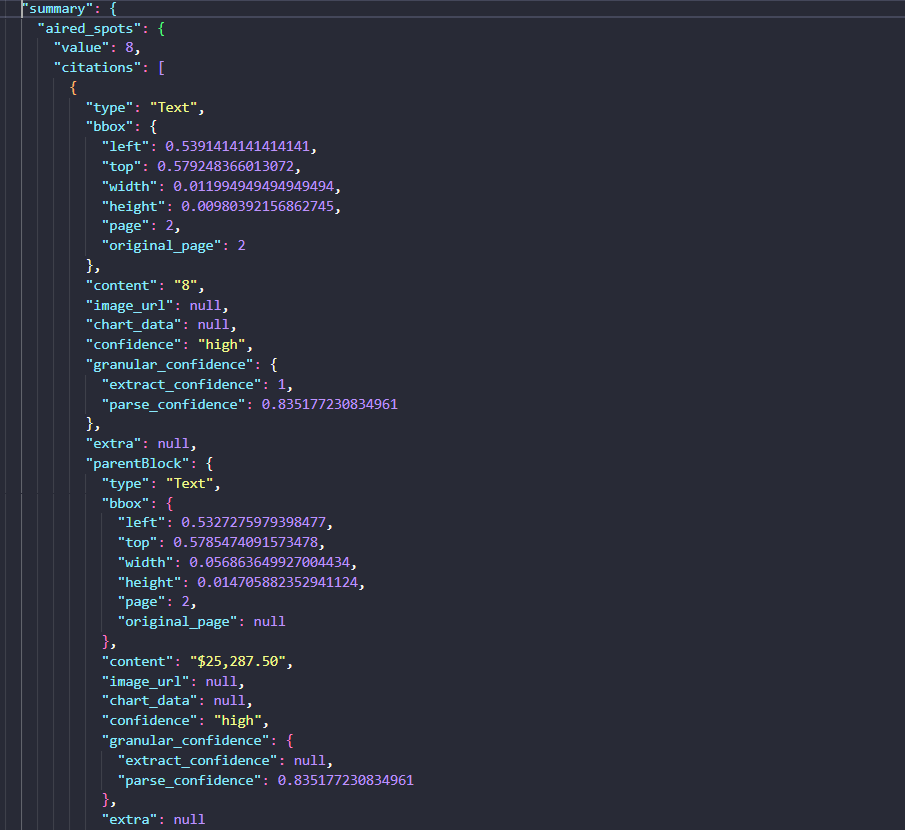
The invoice JSON keeps values, citations, bounding boxes, and confidence together in one directly usable structure, so it can feed a review or verification pipeline without a reshaping step. Nothing in the observed output suggests extra cleanup is needed before downstream use.

Worked wellwhen we tried: Invoice PDFlink to this finding

Embeds values, citations, bounding boxes, and confidence scores directly in the JSON, making the output immediately usable for verification and review workflows without a separate transformation layer.

Table & Record Completeness3/52 findings

It preserves the invoice line items cleanly, which is the main sign of strength here. The bank statement, however, does not keep the transaction table perfectly count-safe, so the overall result is only middling rather than consistently complete.

Struggledwhen we tried: Bank Statement PDFlink to this finding

Returns 53 transaction records even though the statement contains 51 rows, so the repeating table is not perfectly count-preserving.

Worked wellwhen we tried: Invoice PDFlink to this finding

Preserves all eight advertising line items as separate records without row-merging or adjacency collapse.

Nanonets

Usable#7 of 7

Strong schema and export handling, but weaker on bank-statement accuracy and derived-field enrichment.

Extraction Accuracy2/53 findings

It got the invoice amounts right, but the bank statement had major missing dates and the invoice descriptions were not cleanly separated, so accuracy was only partly reliable overall.

Struggledwhen we tried: Invoice PDFlink to this finding

It concatenated adjacent text inside invoice descriptions, appending the rate-category label directly to the program name instead of preserving clean separation.

Tool input

Tool output

Failedwhen we tried: Bank Statement PDFlink to this finding

It omitted date and value_date on at least 15 bank-statement transactions and can emit rows with null date, value_date, and description even when the source row is present.

Tool input

Tool output

nanonets-docstrange-nanonets-bank-statement-outpu-e65996ec6ef1.json
Loading file...
Schema Adherence5/51 finding

It stayed inside the requested object tree on both documents and did not collapse the content into flat OCR text, so this is a clear top score.

Worked wellacross all testslink to this finding

The tool accepted the custom JSON schema on the first pass and returned nested JSON that matched the requested hierarchy instead of flattening the documents into raw OCR text.

Tool input

Tool output

nanonets-docstrange-nanonets-bank-statement-outpu-e65996ec6ef1.json
Loading file...
nanonets-docstrange-nanonets-invoice-output-9dc0f476da4c.json
Loading file...
Semantic Field Enrichment2/52 findings

It consistently struggled to fill in derived fields: the bank transactions never got a type, and the invoice still had missing scheduling fields on one line item.

Struggledwhen we tried: Invoice PDFlink to this finding

The tool only partially populated a line item's derived scheduling fields, leaving flight_period_start, flight_period_end, frequency, and days_pattern null on line 8.

Tool input

Tool output

Failedwhen we tried: Bank Statement PDFlink to this finding

The tool failed to enrich bank transactions with a derived transaction_type field, leaving transaction_type null throughout the transaction array.

Tool input

Tool output

nanonets-docstrange-nanonets-bank-statement-outpu-e65996ec6ef1.json
Loading file...
Structural Clean Output5/51 finding

The outputs were ready for downstream use without extra reshaping, and the multiple export formats reinforced that the structure was clean and usable.

Worked wellacross all testslink to this finding

The tool produced directly consumable structured outputs and the report says JSON, CSV, HTML, and Markdown exports were available, so no structural transformation layer was needed.

Tool input

Tool output

nanonets-docstrange-nanonets-bank-statement-outpu-e65996ec6ef1.json
Loading file...
nanonets-docstrange-nanonets-bank-statement-outpu-d110f330afaa.csv
Loading file...
nanonets-docstrange-nanonets-invoice-output-9dc0f476da4c.json
Loading file...
nanonets-docstrange-nanonets-invoice-output-de26bbf8b091.csv
Loading file...
Table & Record Completeness3/52 findings

One document kept every row, the other dropped a few through merged descriptions, so the result was genuinely mixed rather than clearly strong or weak.

Failedwhen we tried: Bank Statement PDFlink to this finding

The bank-statement extractor lost row-level completeness, returning 47 extracted transactions for a source that contained 51 rows, with four transactions effectively collapsed through merged descriptions.

Worked wellwhen we tried: Invoice PDFlink to this finding

The invoice extractor returned all eight advertising line items as separate records without row merging or duplication.

Tool input

Tool output

Final Take

Landing AI is the overall winner here, and the scorecards support that: it combines perfect schema adherence, extraction accuracy, table-and-record completeness, and clean output, making it the strongest all-around choice for schema-faithful record extraction. The main caveat is that its semantic field enrichment is weaker than some rivals, so it is less compelling when identifier interpretation or field labeling is the priority. If you need the best cleanup and completeness balance, Landing AI is the safest pick; if you need stronger semantic labeling, Retab is the more specialized option, though it gives up record completeness and final formatting. LlamaParse and Extend AI are also credible for structured output, but both show more trade-offs than Landing AI: LlamaParse is very clean but slips on record counts and derived transaction fields, while Extend AI has strong structure but lower extraction accuracy and some normalization/ordering cleanup gaps. Datalab, Nanonets, and Reducto trail the top group because their transaction handling, enrichment, or accuracy is less consistent in the scorecards.

Tested as of June 2026 · Will be re-verified monthly

Similar Tools

The tools we tested for this use case — each card opens its full tested review.

Comments (0)

Please Log in to join the discussion.