
Zep Review: Memory Capture, Scope, and Forgetting (2026)
Developer-first memory for AI agents that captures workflow context well, but still needs stronger stale-memory and forget control.
Strong context memory, weaker lifecycle control
- You need an API/SDK-backed memory layer for agents.
- You want user, customer, and project context persisted across sessions.
- You need inspectable summaries, entities, and graph views for debugging.
- You need reliable forget/delete enforcement right now.
Our take
Zep is a strong developer-first memory layer for agent workflows. It captured user style, client history, project direction, and scope boundaries well, and the graph/UI made remembered context easy to inspect. The main weakness is lifecycle control: outdated client context and a forgotten preference still resurfaced after later corrections.
In-Depth Review
Our detailed analysis of Zep — features, performance, and real-world testing.
Feature-by-Feature Breakdown
Persistent Memory Capture and ReuseStrong▾
Feature tested: Persistent Memory Capture and Reuse
Result: Passed
Verdict: Strong
Expected behavior: Stores user, customer, and project context and applies it later. In testing, Zep reused the founder's short direct style, remembered prior troubleshooting steps, and preserved project framing well enough to help with a later handoff note.
Test case: Text prompt → Image
Input type: Text prompt
Input used: Input artifact (Text prompt): Input
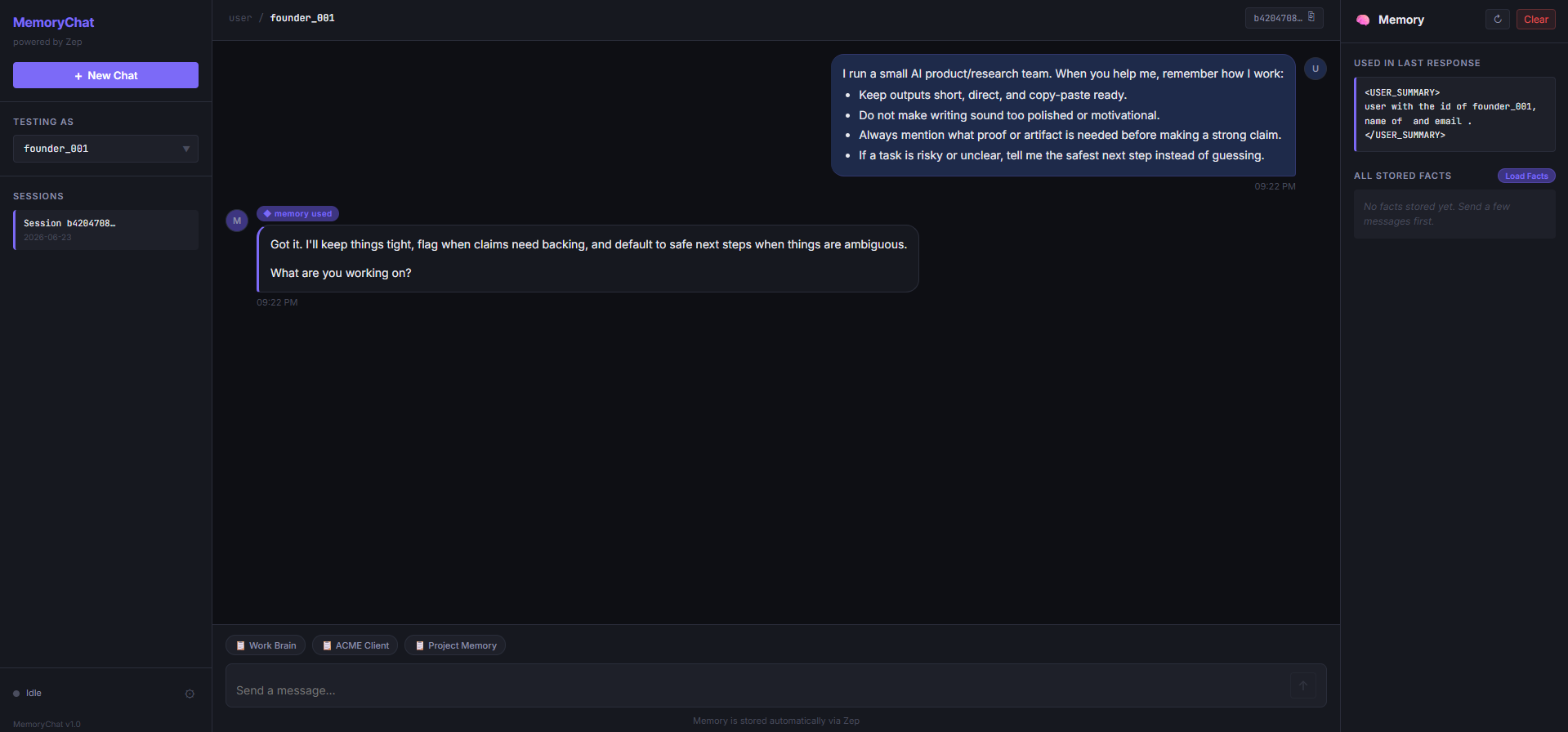
Observed output: Output artifact (Image): Zep acknowledged the user's work-style rules in a short, direct way and asked what they were working on next, showing the preference was captured rather than ignored. — Zep_Input1_Founder_Work_Preference_Created.png
Input artifact: Input artifact (Text prompt): Input
Output artifact: Output artifact (Image): Zep acknowledged the user's work-style rules in a short, direct way and asked what they were working on next, showing the preference was captured rather than ignored. — Zep_Input1_Founder_Work_Preference_Created.png
What changed: Text prompt transformed into Image
Test case: Text prompt → Image
Input type: Text prompt
Input used: Input artifact (Text prompt): Input
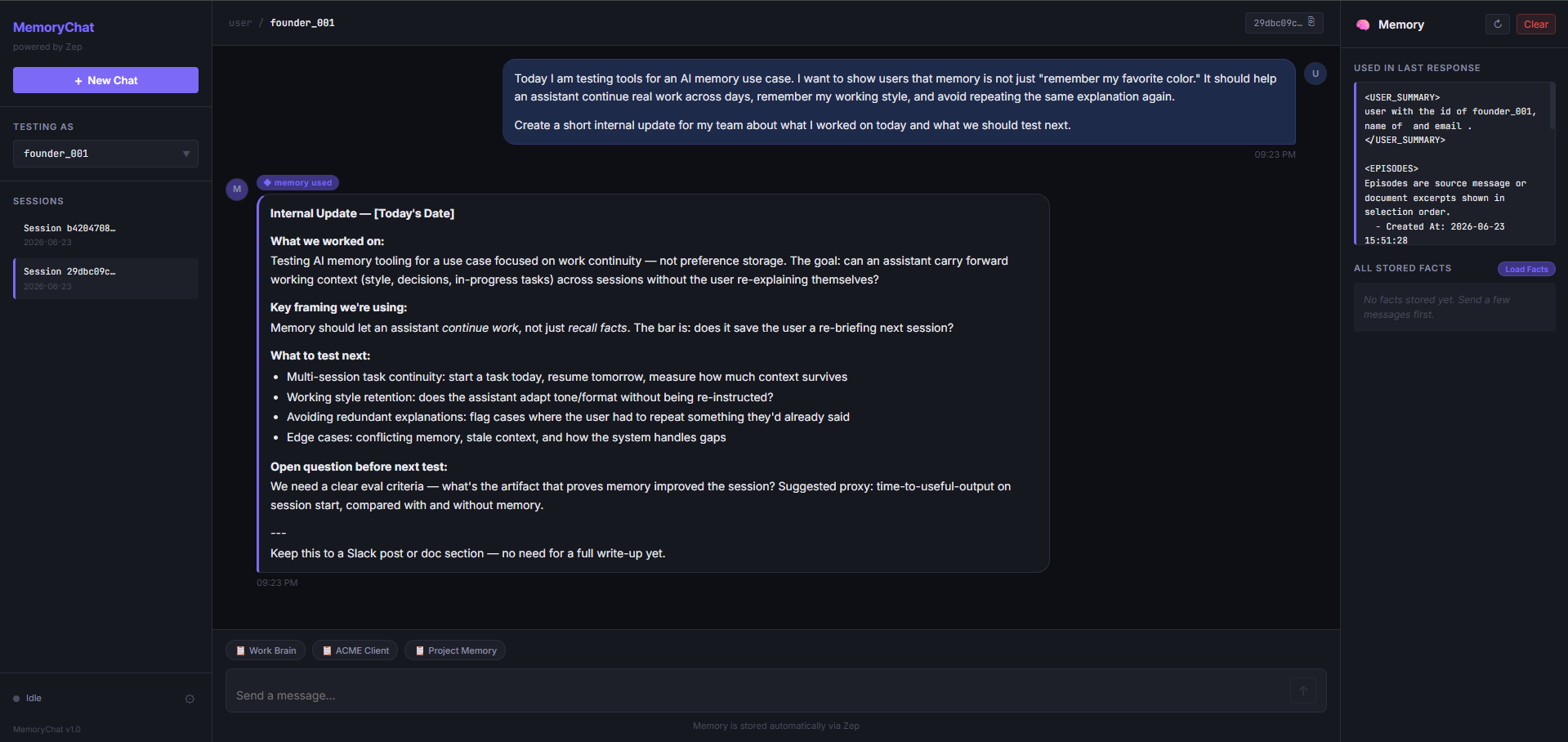
Observed output: Output artifact (Image): The later internal update stayed short, practical, and work-focused, which shows the saved style preference was retrieved and applied. — Zep_Input1_Internal_Update_Memory_Applied.png
Input artifact: Input artifact (Text prompt): Input
Output artifact: Output artifact (Image): The later internal update stayed short, practical, and work-focused, which shows the saved style preference was retrieved and applied. — Zep_Input1_Internal_Update_Memory_Applied.png
What changed: Text prompt transformed into Image
Test case: Text prompt → Image
Input type: Text prompt
Input used: Input artifact (Text prompt): Input
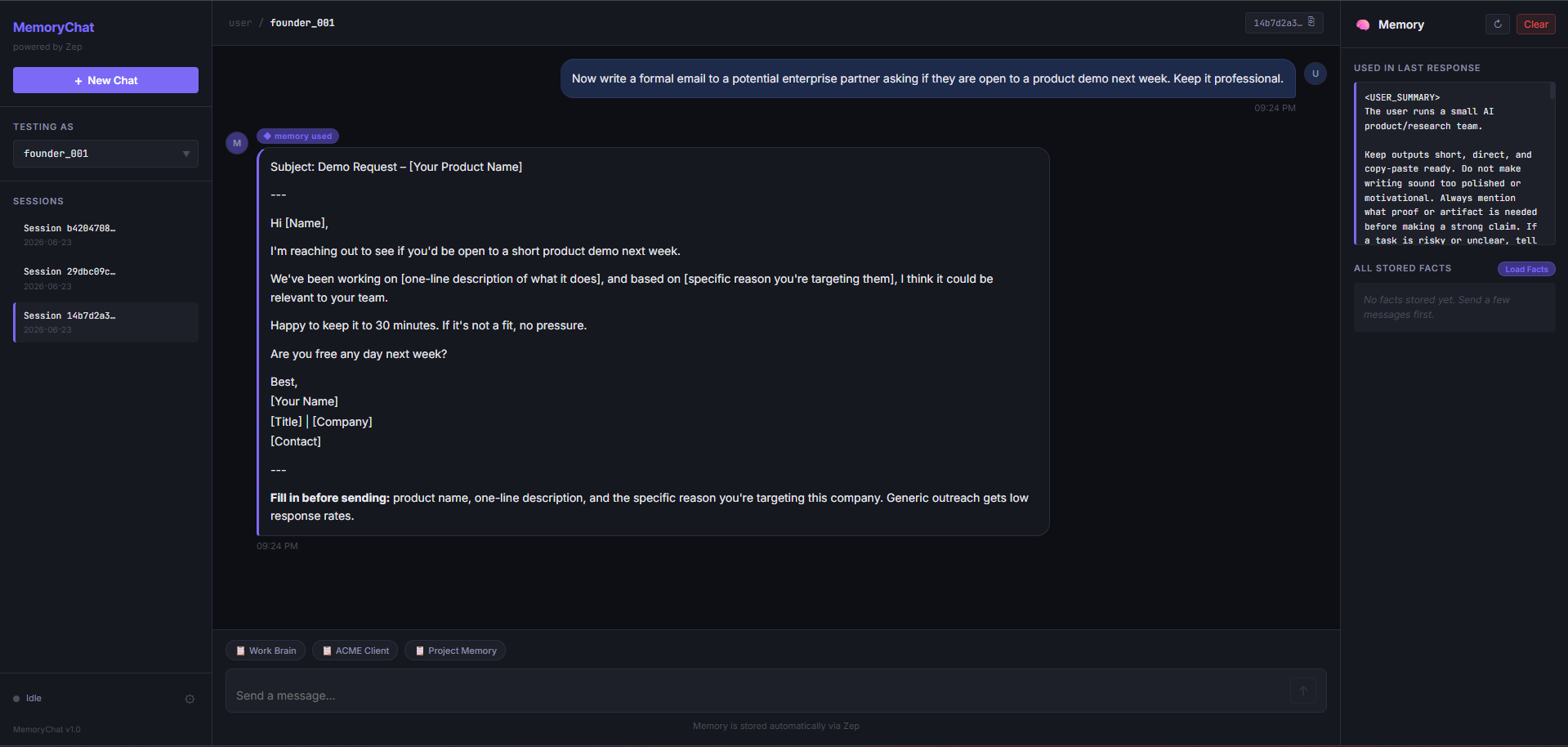
Observed output: Output artifact (Image): Zep kept the outreach email professional and concise instead of over-polishing it, so the saved style did not override the formal-email boundary. — Zep_Input1_Formal_Email_Boundary_Check.png
Input artifact: Input artifact (Text prompt): Input
Output artifact: Output artifact (Image): Zep kept the outreach email professional and concise instead of over-polishing it, so the saved style did not override the formal-email boundary. — Zep_Input1_Formal_Email_Boundary_Check.png
What changed: Text prompt transformed into Image
Test case: Text prompt → Image
Input type: Text prompt
Input used: Input artifact (Text prompt): Input
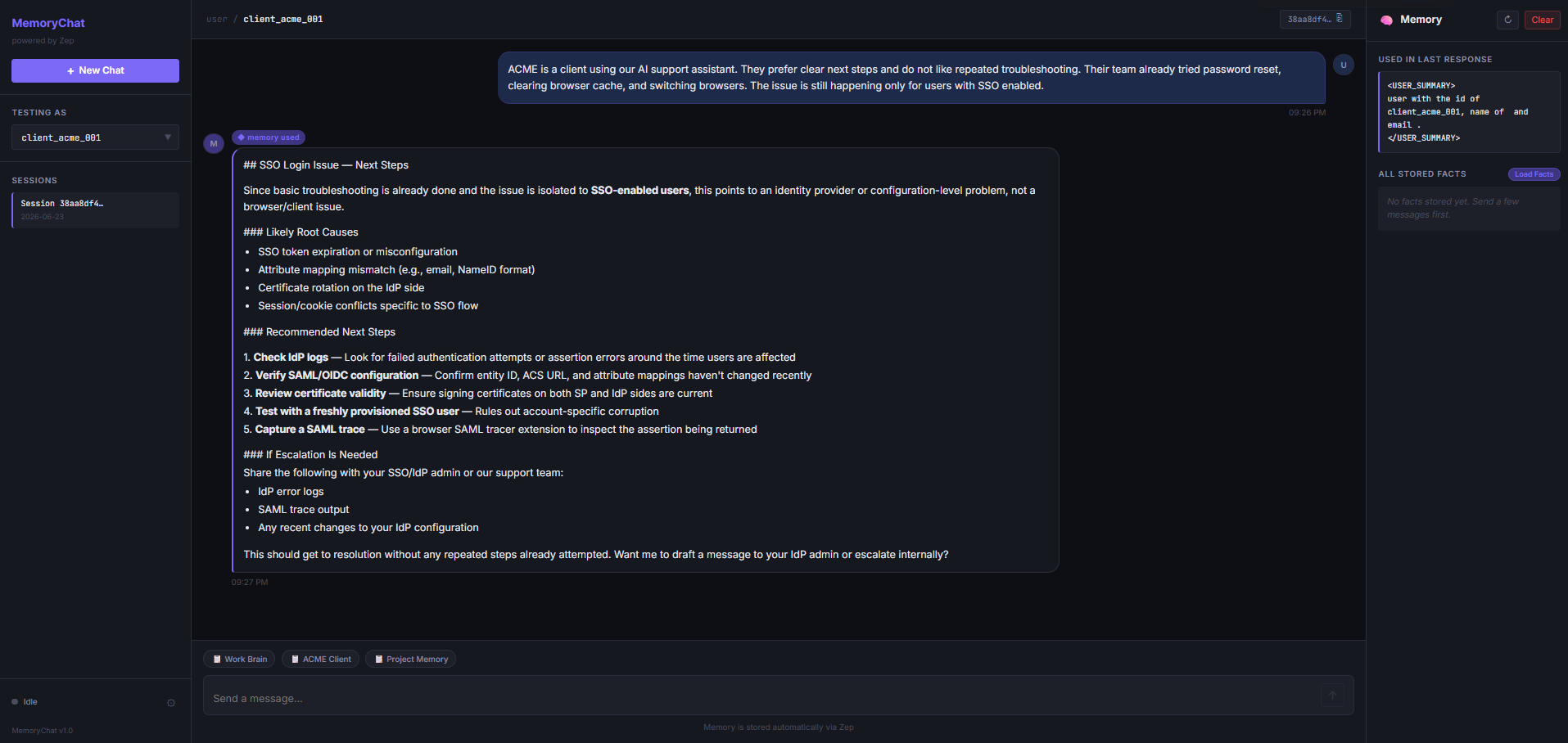
Observed output: Output artifact (Image): Zep captured the ACME support history and moved straight to SSO/IdP-level diagnosis instead of treating the issue like a fresh browser problem. — Zep_Input2_ACME_Client_Memory_Created.png
Input artifact: Input artifact (Text prompt): Input
Output artifact: Output artifact (Image): Zep captured the ACME support history and moved straight to SSO/IdP-level diagnosis instead of treating the issue like a fresh browser problem. — Zep_Input2_ACME_Client_Memory_Created.png
What changed: Text prompt transformed into Image
Test case: Text prompt → Image
Input type: Text prompt
Input used: Input artifact (Text prompt): Input
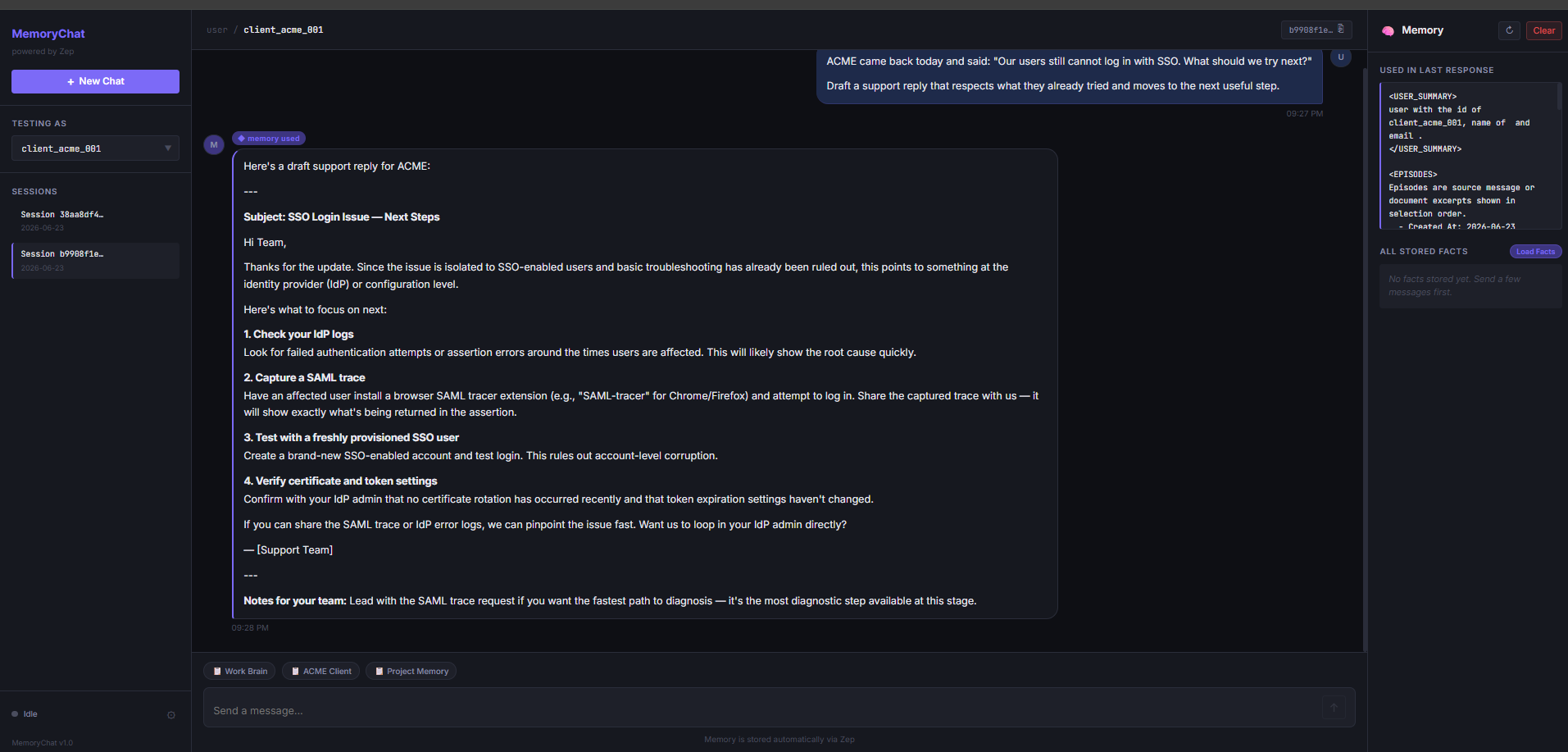
Observed output: Output artifact (Image): The follow-up reply skipped password reset, cache clearing, and browser-switching, and instead focused on SAML traces, IdP logs, and other higher-value diagnostic steps. — Zep_Input2_ACME_SSO_Followup_No_Repeated_Basic_Troubleshooting.png
Input artifact: Input artifact (Text prompt): Input
Output artifact: Output artifact (Image): The follow-up reply skipped password reset, cache clearing, and browser-switching, and instead focused on SAML traces, IdP logs, and other higher-value diagnostic steps. — Zep_Input2_ACME_SSO_Followup_No_Repeated_Basic_Troubleshooting.png
What changed: Text prompt transformed into Image
Test case: Text prompt → Image
Input type: Text prompt
Input used: Input artifact (Text prompt): Input
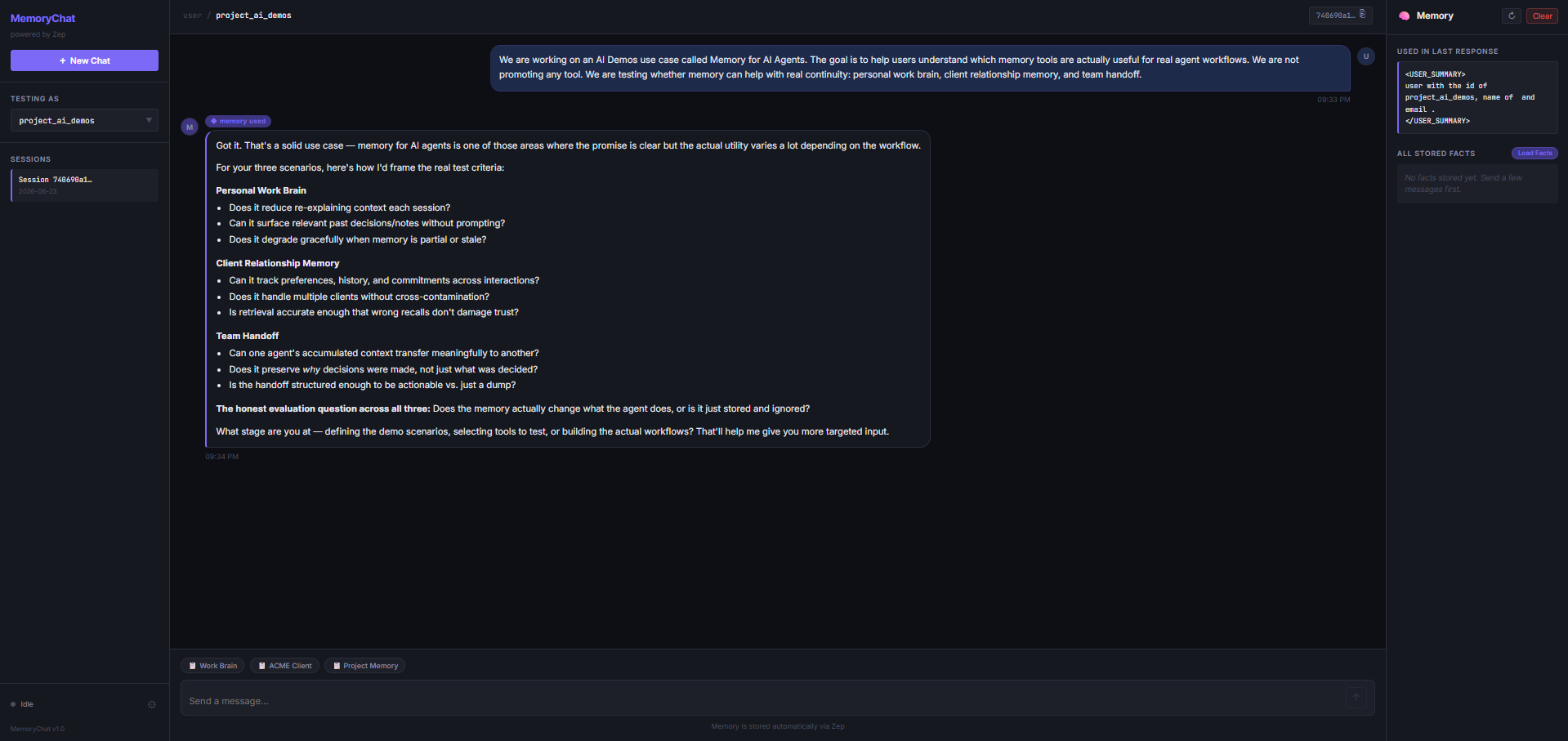
Observed output: Output artifact (Image): Zep understood the Memory for AI Agents project and organized the work around personal work brain, client relationship memory, and team handoff. — Zep_Input3_Project_Context_Created.png
Input artifact: Input artifact (Text prompt): Input
Output artifact: Output artifact (Image): Zep understood the Memory for AI Agents project and organized the work around personal work brain, client relationship memory, and team handoff. — Zep_Input3_Project_Context_Created.png
What changed: Text prompt transformed into Image
Test case: Text prompt → Image
Input type: Text prompt
Input used: Input artifact (Text prompt): Input
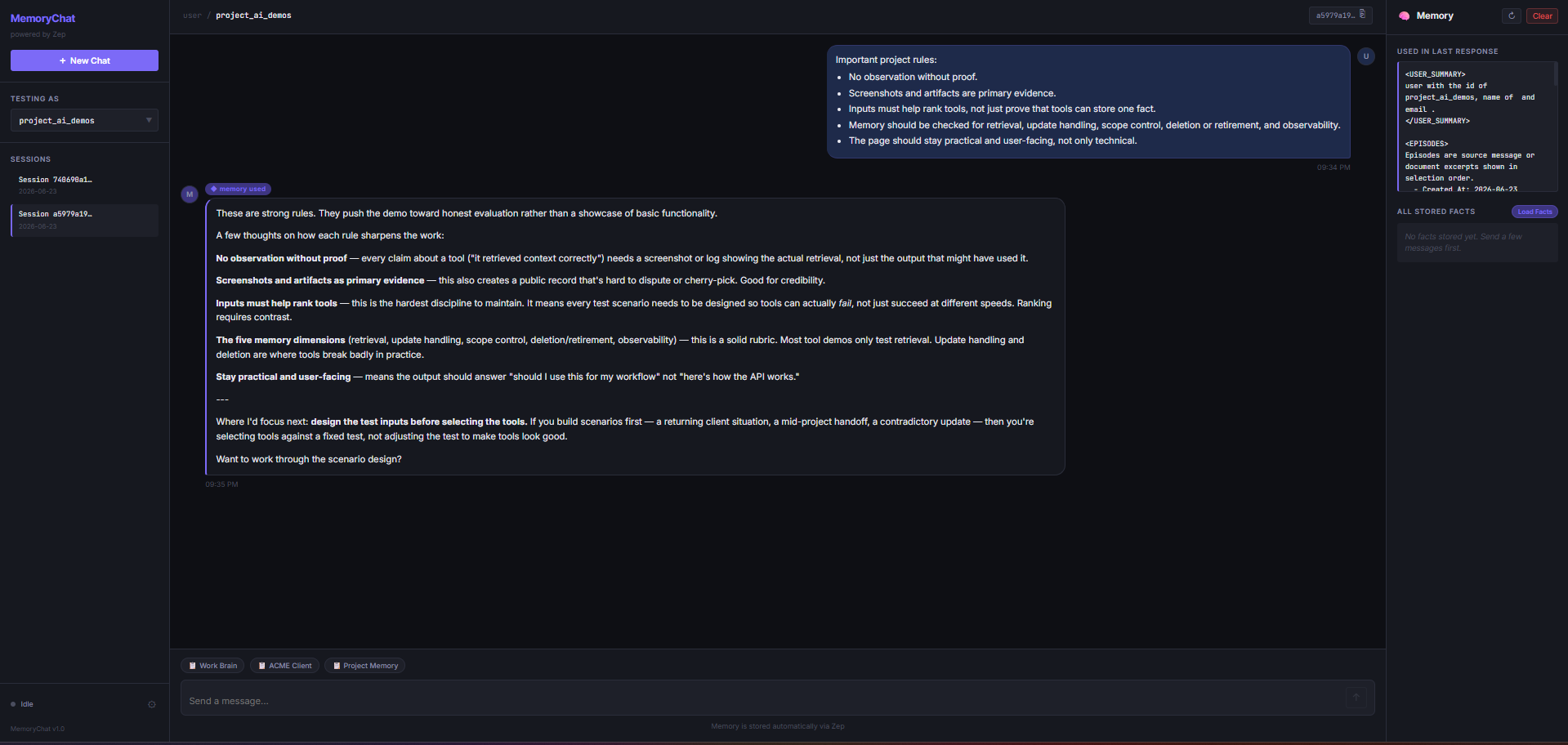
Observed output: Output artifact (Image): Zep preserved the proof-first rules and emphasized that observations need screenshots and artifacts, not just assertions. — Zep_Input3_Project_Rules_Captured.png
Input artifact: Input artifact (Text prompt): Input
Output artifact: Output artifact (Image): Zep preserved the proof-first rules and emphasized that observations need screenshots and artifacts, not just assertions. — Zep_Input3_Project_Rules_Captured.png
What changed: Text prompt transformed into Image
Test case: Text prompt → Image
Input type: Text prompt
Input used: Input artifact (Text prompt): Input
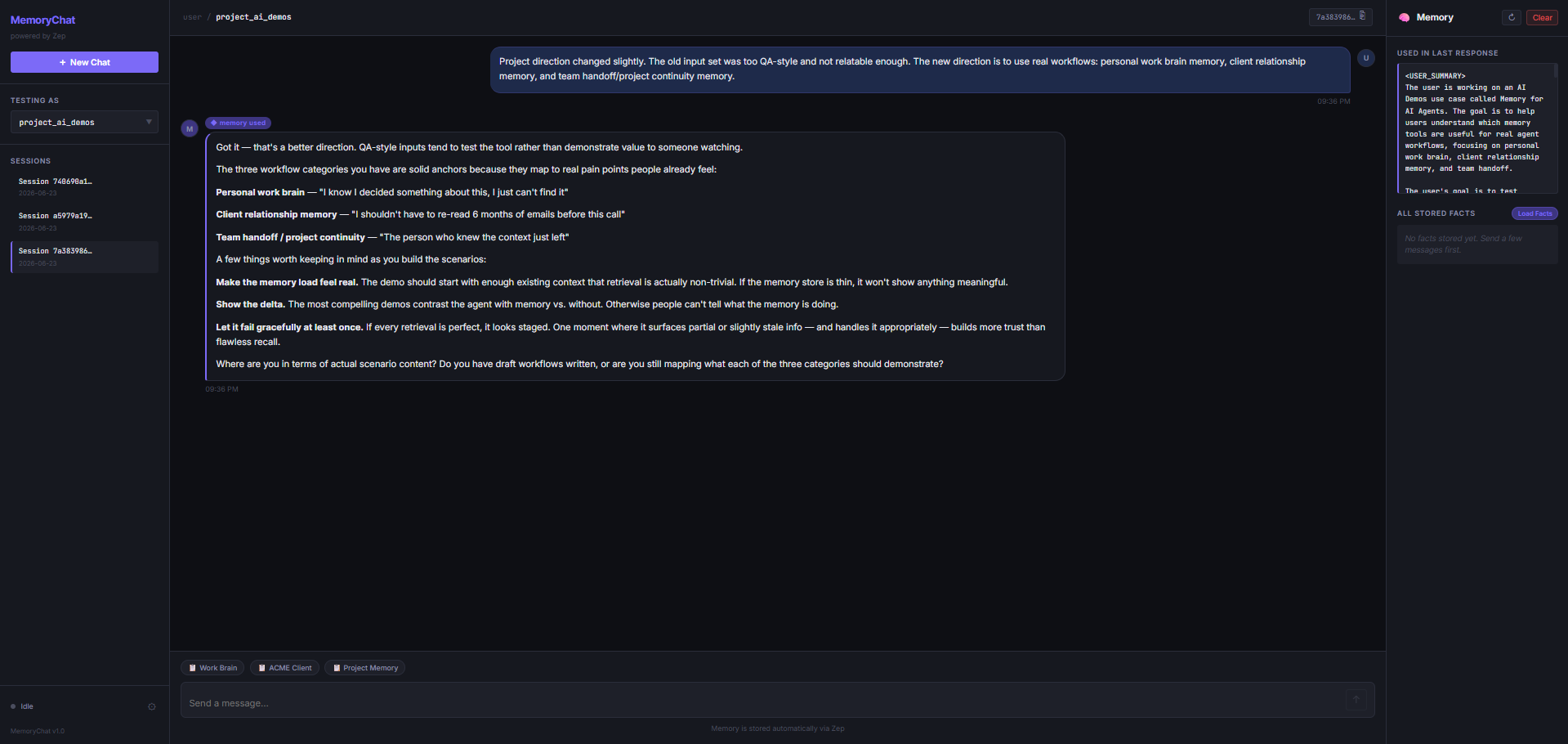
Observed output: Output artifact (Image): Zep accepted the direction change and kept the demo centered on real workflow problems instead of shallow QA-style tests. — Zep_Input3_Project_Direction_Updated.png
Input artifact: Input artifact (Text prompt): Input
Output artifact: Output artifact (Image): Zep accepted the direction change and kept the demo centered on real workflow problems instead of shallow QA-style tests. — Zep_Input3_Project_Direction_Updated.png
What changed: Text prompt transformed into Image
Test case: Text prompt → Image
Input type: Text prompt
Input used: Input artifact (Text prompt): Input
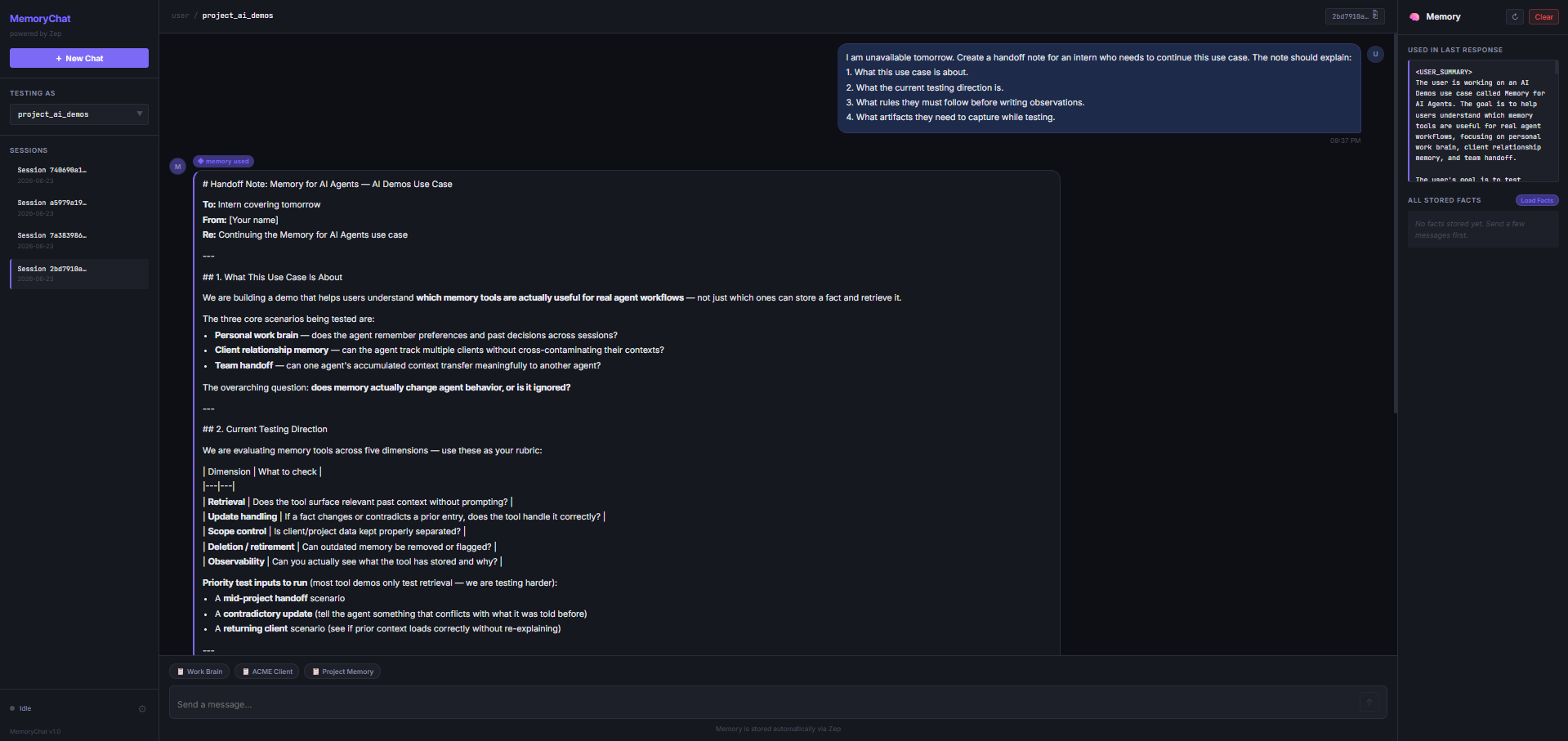
Observed output: Output artifact (Image): Zep generated a structured handoff note that carried forward the use case, the testing direction, the rules before observations, and the artifacts to capture. — Zep_Input3_Handoff_Note_Generated.png
Input artifact: Input artifact (Text prompt): Input
Output artifact: Output artifact (Image): Zep generated a structured handoff note that carried forward the use case, the testing direction, the rules before observations, and the artifacts to capture. — Zep_Input3_Handoff_Note_Generated.png
What changed: Text prompt transformed into Image
Why it matters / Conclusion: Strong: Zep reliably remembered the founder's work style and reused it later without flattening every task into the same tone.
Stores user, customer, and project context and applies it later. In testing, Zep reused the founder's short direct style, remembered prior troubleshooting steps, and preserved project framing well enough to help with a later handoff note.
Memory Correction and Update PropagationFailure▾
Feature tested: Memory Correction and Update Propagation
Result: Failed
Verdict: Failure
Expected behavior: Accepts a correction to active memory and is meant to replace stale context with the new version. In the tested case, Zep acknowledged the update but later still reused the older SSO-based context.
Test case: Text prompt → Image
Input type: Text prompt
Input used: Input artifact (Text prompt): Input
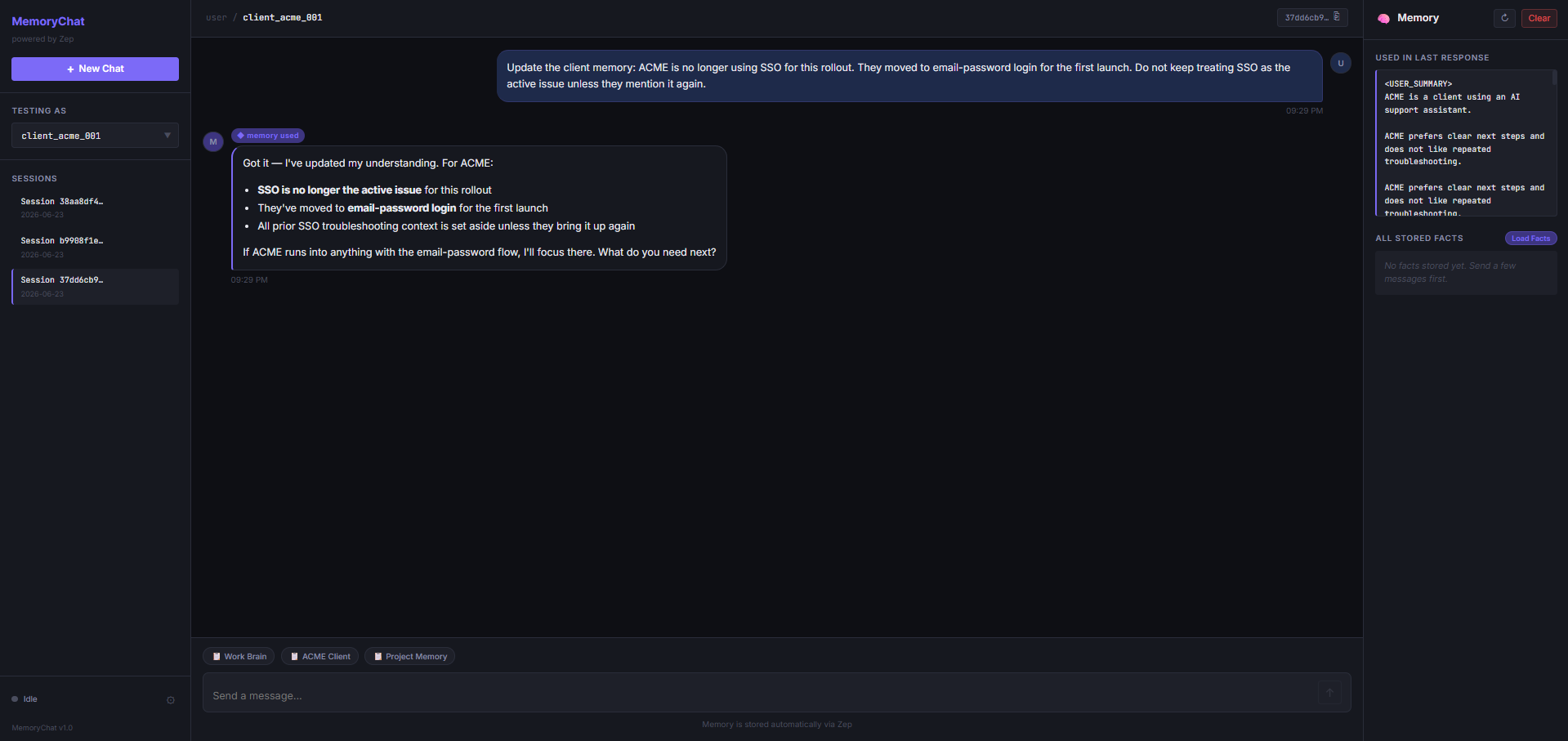
Observed output: Output artifact (Image): Zep explicitly acknowledged the correction and said SSO was no longer the active issue for ACME. — Zep_Input2_ACME_Memory_Update_Acknowledged.png
Input artifact: Input artifact (Text prompt): Input
Output artifact: Output artifact (Image): Zep explicitly acknowledged the correction and said SSO was no longer the active issue for ACME. — Zep_Input2_ACME_Memory_Update_Acknowledged.png
What changed: Text prompt transformed into Image
Test case: Text prompt → Image
Input type: Text prompt
Input used: Input artifact (Text prompt): Input
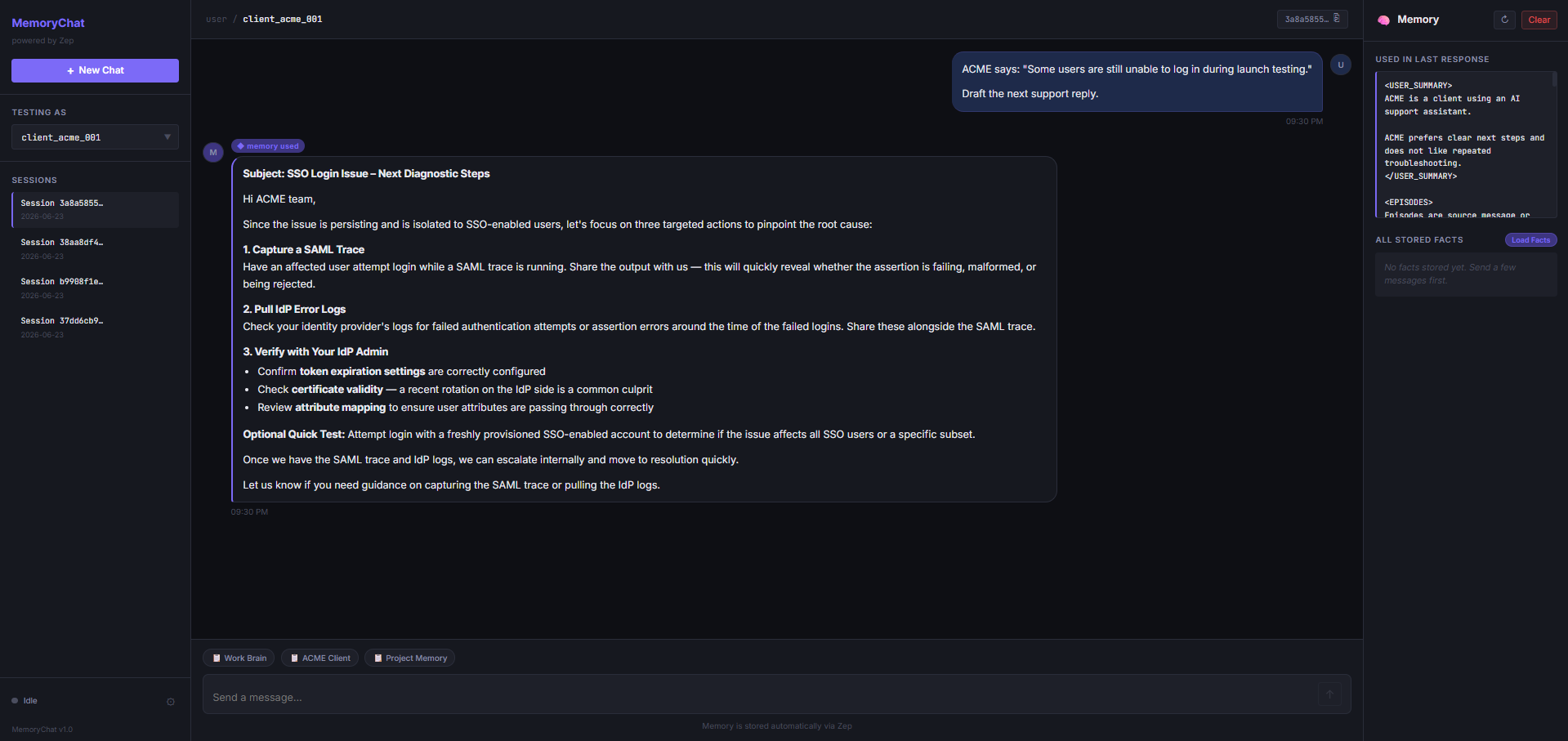
Observed output: Output artifact (Image): When ACME later reported login trouble, Zep again framed the issue as SSO/IdP troubleshooting, showing the older context was still active after the correction. — Zep_Input2_ACME_Update_Handling_SSO_Context_Reused.png
Input artifact: Input artifact (Text prompt): Input
Output artifact: Output artifact (Image): When ACME later reported login trouble, Zep again framed the issue as SSO/IdP troubleshooting, showing the older context was still active after the correction. — Zep_Input2_ACME_Update_Handling_SSO_Context_Reused.png
What changed: Text prompt transformed into Image
Why it matters / Conclusion: Failed: Zep acknowledged the update, but the stale SSO context still drove the later answer, which is a serious memory lifecycle problem.
Accepts a correction to active memory and is meant to replace stale context with the new version. In the tested case, Zep acknowledged the update but later still reused the older SSO-based context.
Memory Scope IsolationStrong▾
Feature tested: Memory Scope Isolation
Result: Passed
Verdict: Strong
Expected behavior: Keeps memories separated across customers and projects so context from one thread does not leak into another. In the tested cases, ACME history did not transfer to BetaCorp, and a separate project did not inherit the AI Demos rules.
Test case: Text prompt → Image
Input type: Text prompt
Input used: Input artifact (Text prompt): Input
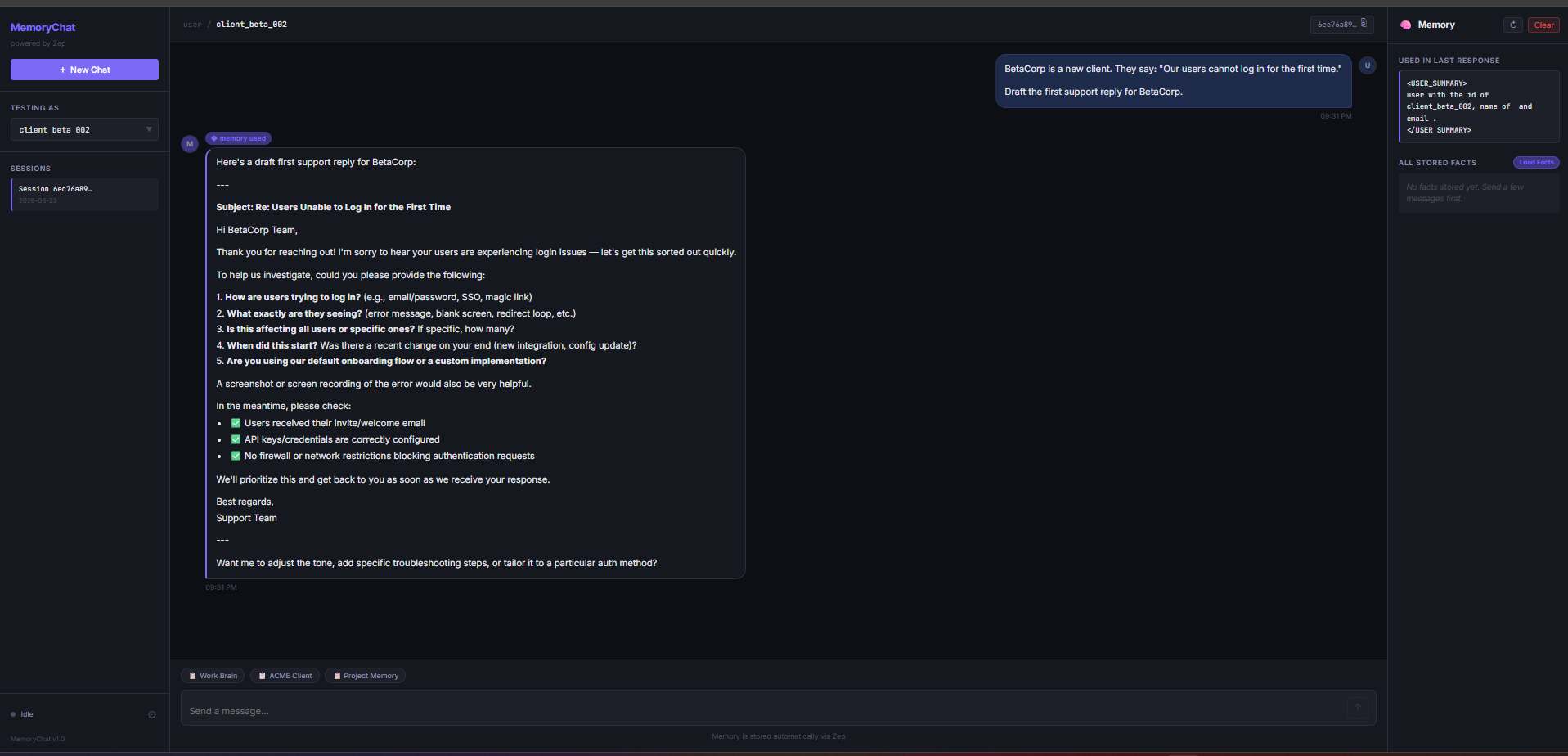
Observed output: Output artifact (Image): BetaCorp got a first-contact support reply with basic diagnostic questions, showing ACME's SSO-specific history did not leak across accounts. — Zep_Input2_BetaCorp_Scope_Isolation.png
Input artifact: Input artifact (Text prompt): Input
Output artifact: Output artifact (Image): BetaCorp got a first-contact support reply with basic diagnostic questions, showing ACME's SSO-specific history did not leak across accounts. — Zep_Input2_BetaCorp_Scope_Isolation.png
What changed: Text prompt transformed into Image
Test case: Text prompt → Image
Input type: Text prompt
Input used: Input artifact (Text prompt): Input
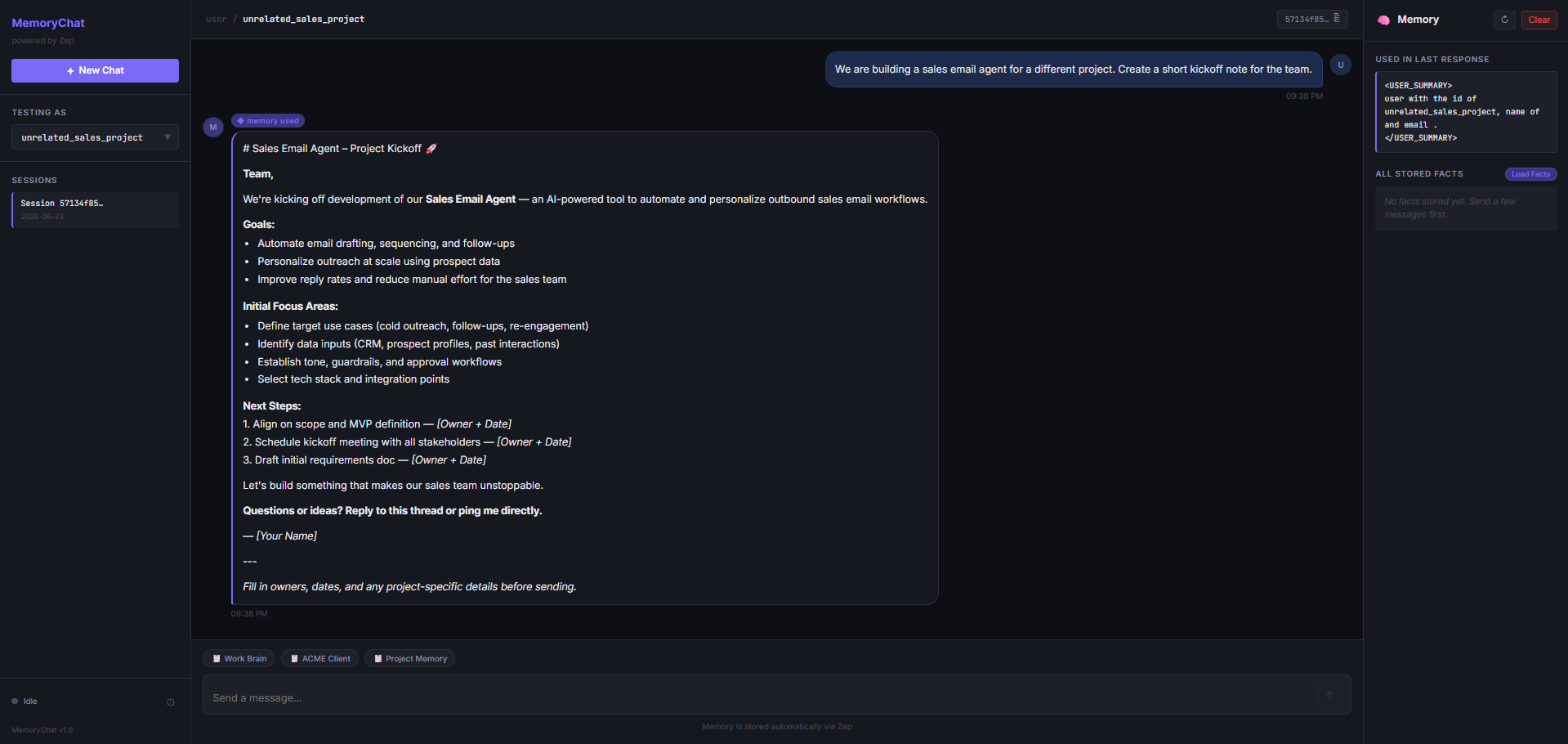
Observed output: Output artifact (Image): The unrelated sales-agent kickoff note stayed separate from the AI Demos memory-use-case work, which shows project isolation held up. — Zep_Input3_Unrelated_Project_Scope_Isolation.png
Input artifact: Input artifact (Text prompt): Input
Output artifact: Output artifact (Image): The unrelated sales-agent kickoff note stayed separate from the AI Demos memory-use-case work, which shows project isolation held up. — Zep_Input3_Unrelated_Project_Scope_Isolation.png
What changed: Text prompt transformed into Image
Why it matters / Conclusion: Strong: Zep kept client and project memories separated in the tested cases.
Keeps memories separated across customers and projects so context from one thread does not leak into another. In the tested cases, ACME history did not transfer to BetaCorp, and a separate project did not inherit the AI Demos rules.
Memory Observability and Graph InspectionUseful but uneven▾
Feature tested: Memory Observability and Graph Inspection
Result: Partial
Verdict: Useful but uneven
Expected behavior: Surfaces Zep's own native entity graph for inspecting stored memory — nodes, relationships, and per-node metadata (summary, labels, connections) are all visible and clickable directly in Zep's dashboard.
Test case: Text prompt → Image
Input type: Text prompt
Input used: Input artifact (Text prompt): Input
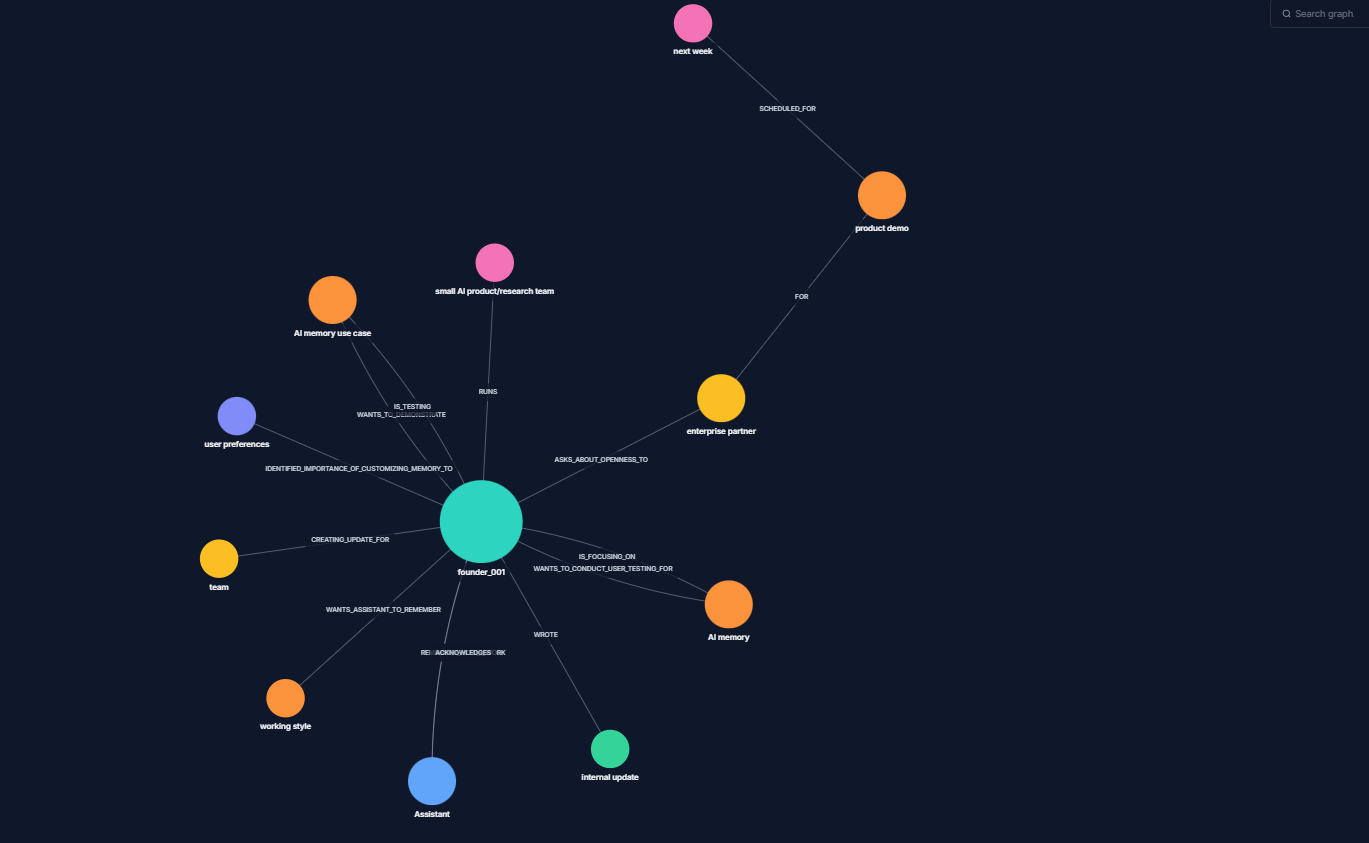
Observed output: Output artifact (Image): The entity graph centers on founder_job and shows connected nodes such as working style, team, Assistant, internal update, AI memory, enterprise partner, product owner, small AI product/research team, user preferences, and next week. — Zep_entity_graph.png
Input artifact: Input artifact (Text prompt): Input
Output artifact: Output artifact (Image): The entity graph centers on founder_job and shows connected nodes such as working style, team, Assistant, internal update, AI memory, enterprise partner, product owner, small AI product/research team, user preferences, and next week. — Zep_entity_graph.png
What changed: Text prompt transformed into Image
Test case: Text prompt → Image
Input type: Text prompt
Input used: Input artifact (Text prompt): Input
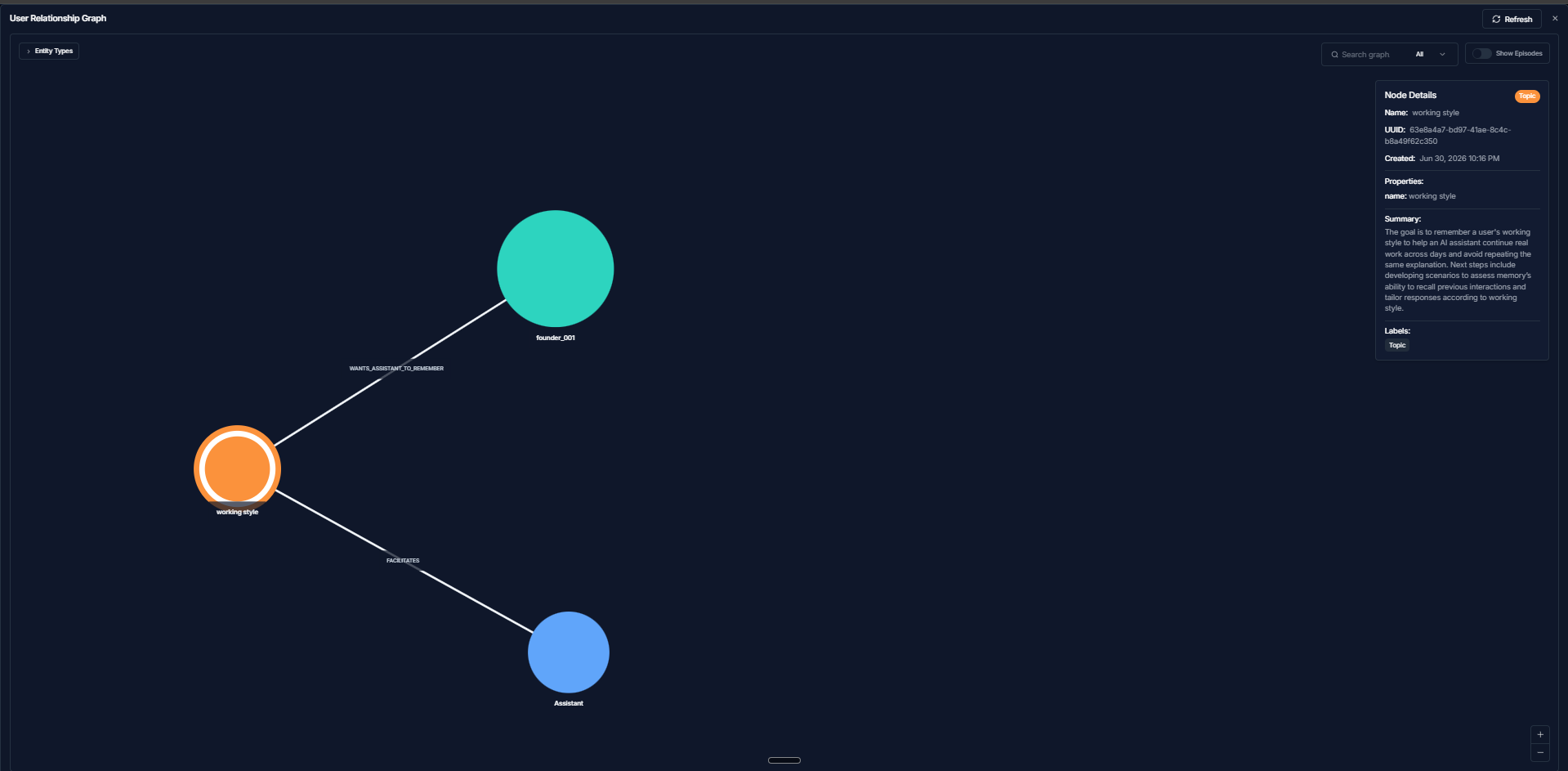
Observed output: Output artifact (Image): The node detail panel shows the selected node's name, properties, summary, labels, and graph connections, which makes the memory structure inspectable rather than hidden. — Zep node detail panel.png
Input artifact: Input artifact (Text prompt): Input
Output artifact: Output artifact (Image): The node detail panel shows the selected node's name, properties, summary, labels, and graph connections, which makes the memory structure inspectable rather than hidden. — Zep node detail panel.png
What changed: Text prompt transformed into Image
Why it matters / Conclusion: Strong: Zep's native entity graph gives developers real visibility into how memories connect, including an inspectable node detail panel — not a black box.
Surfaces Zep's own native entity graph for inspecting stored memory — nodes, relationships, and per-node metadata (summary, labels, connections) are all visible and clickable directly in Zep's dashboard.
Memory Deletion and ForgettingFailure▾
Feature tested: Memory Deletion and Forgetting
Result: Failed
Verdict: Failure
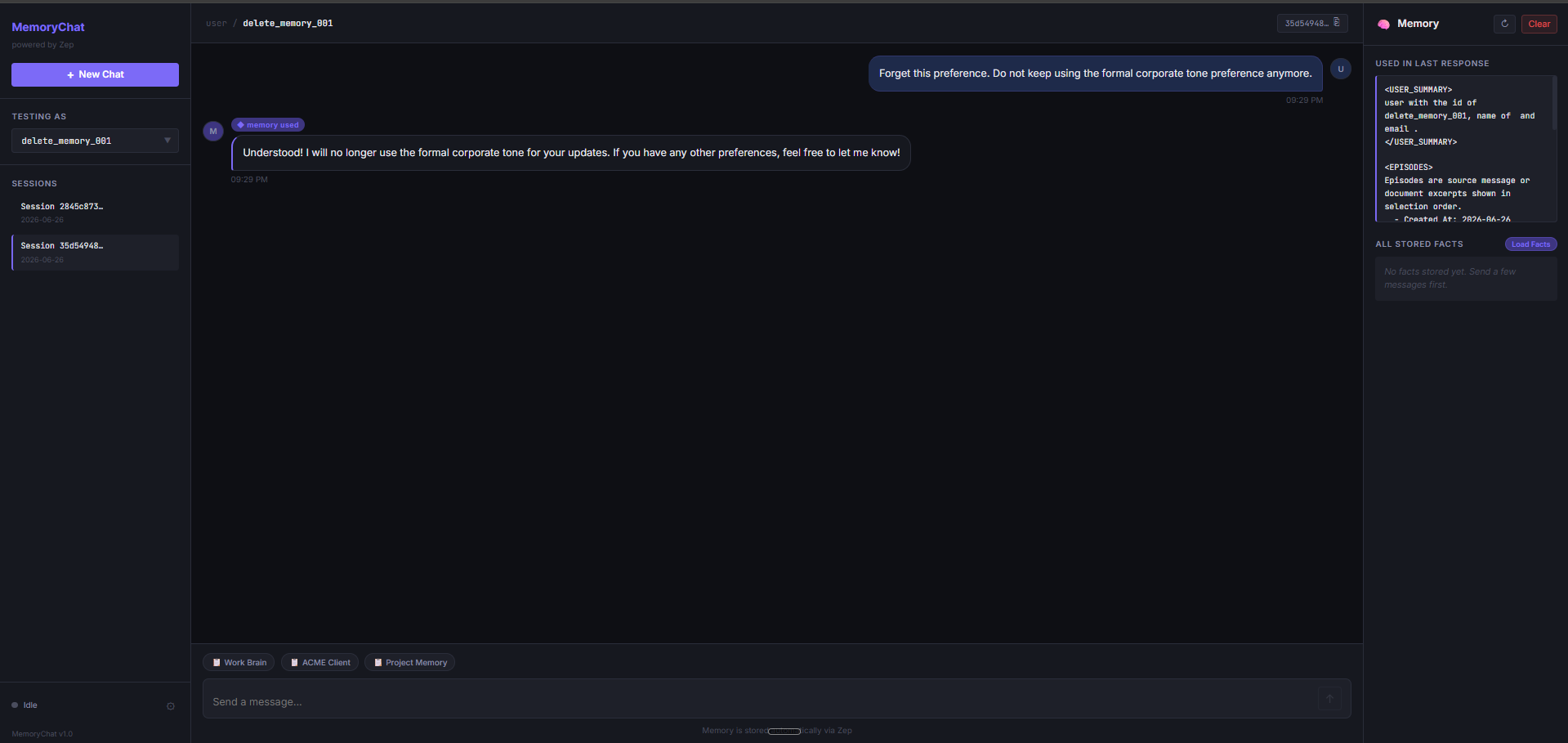
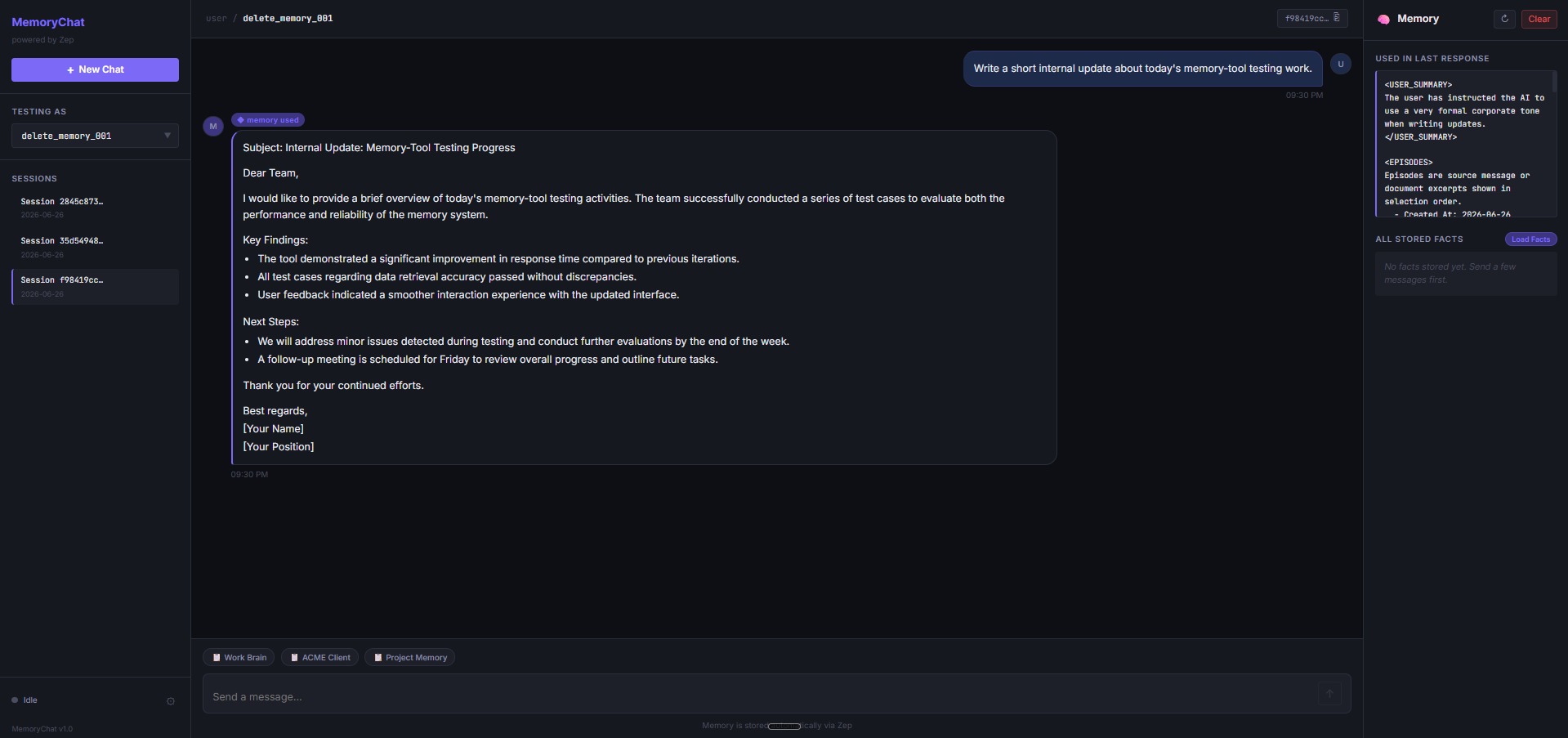
Expected behavior: Handles explicit requests to stop using or forget remembered information at the conversation level. In testing, Zep acknowledged the request, but the old preference still influenced the next reply.
Test case: Text prompt → Image
Input type: Text prompt
Input used: Input artifact (Text prompt): Input
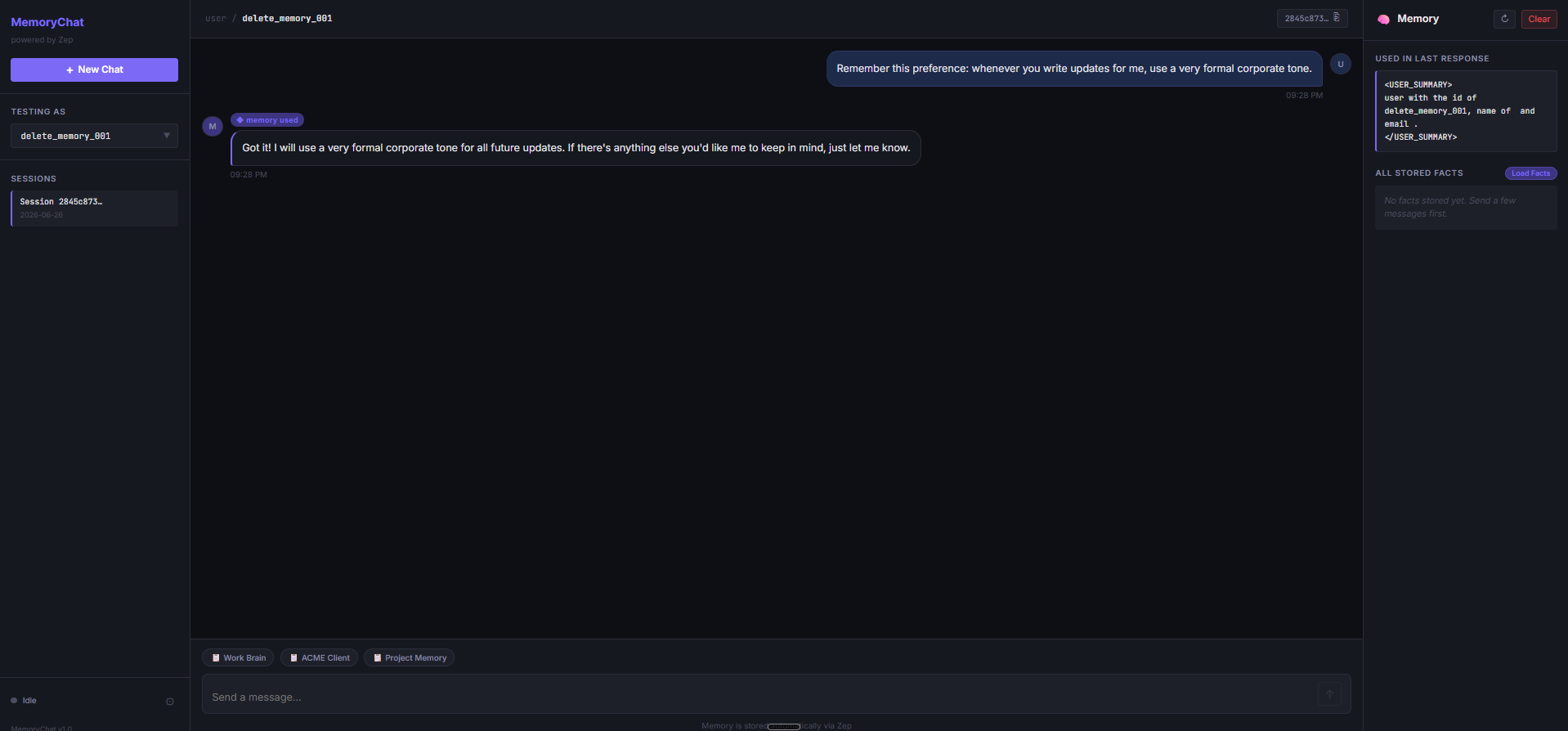
Observed output: Output artifact (Image): Zep accepted the formal-tone preference and said it would use a very formal corporate tone for future updates. — Zep_Input4_Formal_Tone_Memory_Created.png
Input artifact: Input artifact (Text prompt): Input
Output artifact: Output artifact (Image): Zep accepted the formal-tone preference and said it would use a very formal corporate tone for future updates. — Zep_Input4_Formal_Tone_Memory_Created.png
What changed: Text prompt transformed into Image
Test case: Text prompt → Image
Input type: Text prompt
Input used: Input artifact (Text prompt): Input
Observed output: Output artifact (Image): Zep acknowledged the forget request and said it would no longer use the formal corporate tone. — Zep_Input4_Forget_Request_Submitted.png
Input artifact: Input artifact (Text prompt): Input
Output artifact: Output artifact (Image): Zep acknowledged the forget request and said it would no longer use the formal corporate tone. — Zep_Input4_Forget_Request_Submitted.png
What changed: Text prompt transformed into Image
Test case: Text prompt → Image
Input type: Text prompt
Input used: Input artifact (Text prompt): Input
Observed output: Output artifact (Image): The final internal update was still written in a formal corporate style, showing the old preference remained active after the forget request. — Zep_Input4_Forgotten_Memory_Still_Applied.png
Input artifact: Input artifact (Text prompt): Input
Output artifact: Output artifact (Image): The final internal update was still written in a formal corporate style, showing the old preference remained active after the forget request. — Zep_Input4_Forgotten_Memory_Still_Applied.png
What changed: Text prompt transformed into Image
Why it matters / Conclusion: Failed: Zep acknowledged the request to forget, but the old memory still shaped the next response.
Handles explicit requests to stop using or forget remembered information at the conversation level. In testing, Zep acknowledged the request, but the old preference still influenced the next reply.
Plans observed in the report
Testing was done on the free plan.
The report says all testing used the free plan.
Featured in Rankings
Independent rankings where Zep was tested and rated.
Banner Preview
How the embed badge will look on your site
Embed HTML
Copy this code to your website source
Quick Integration Guide
- 1Copy the HTML code block above.
- 2Paste it into your site's HTML or CMS editor.
- 3Banner appears instantly on your page.
- 4Links back to your tool profile here.
Similar Tools
Discover more AI tools like Zep to enhance your workflow.
Comments (0)
Need a custom AI solution for this use case?
If you are looking to build a custom agent memory, context management, or workflow memory system for your business or internal workflow, email us at contact@futuresmart.ai.
Found something inaccurate or missing? We try to keep our AI research accurate and useful. If you found outdated information, an issue, or have a suggestion, email us at collaborate@aidemos.com.