
Mem0
Mem0 remembers useful agent context across sessions and makes retrieved memory visible, but stale context can linger after updates or forget requests.
Strong memory capture and visibility, but weak retirement control
- you need visible stored and retrieved memories with scores for debugging
- you need cross-session memory for users, customers, and projects
- you want user/account/project scope separation to be inspectable
- you need strict delete/forget guarantees that immediately retire old memory
Our take
Mem0 is a strong fit when you need inspectable agent memory: it captured user preferences, client history, and project context across sessions, and it made retrieved memories visible with scores. The tradeoff is that updates and forget requests did not reliably retire older context, so stale memories could still shape later replies.
In-Depth Review
Our detailed analysis of Mem0 — features, performance, and real-world testing.
Feature-by-Feature Breakdown
Cross-Session Memory Capture and RetrievalStrong▾
Feature tested: Cross-Session Memory Capture and Retrieval
Result: Passed
Verdict: Strong
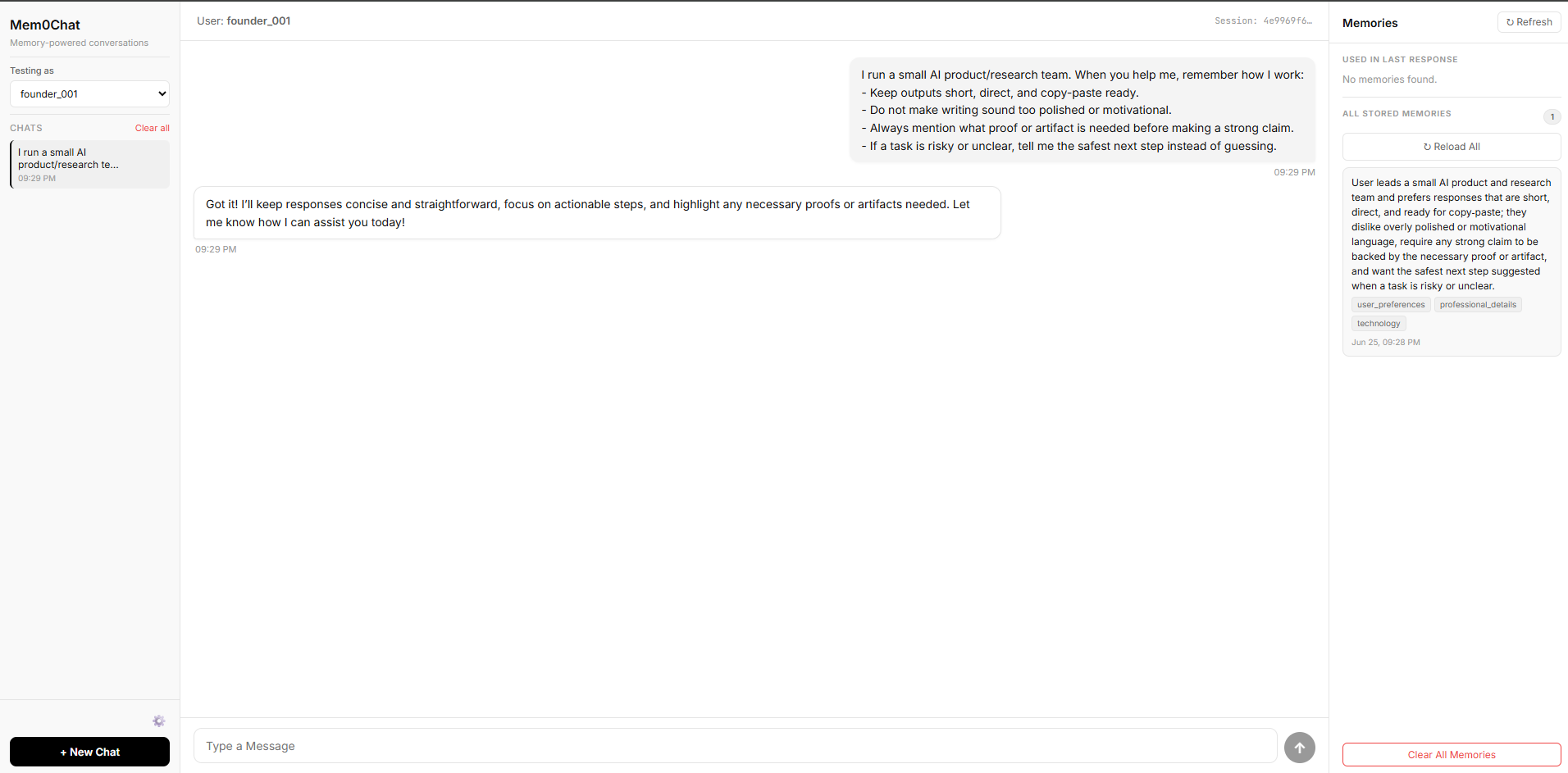
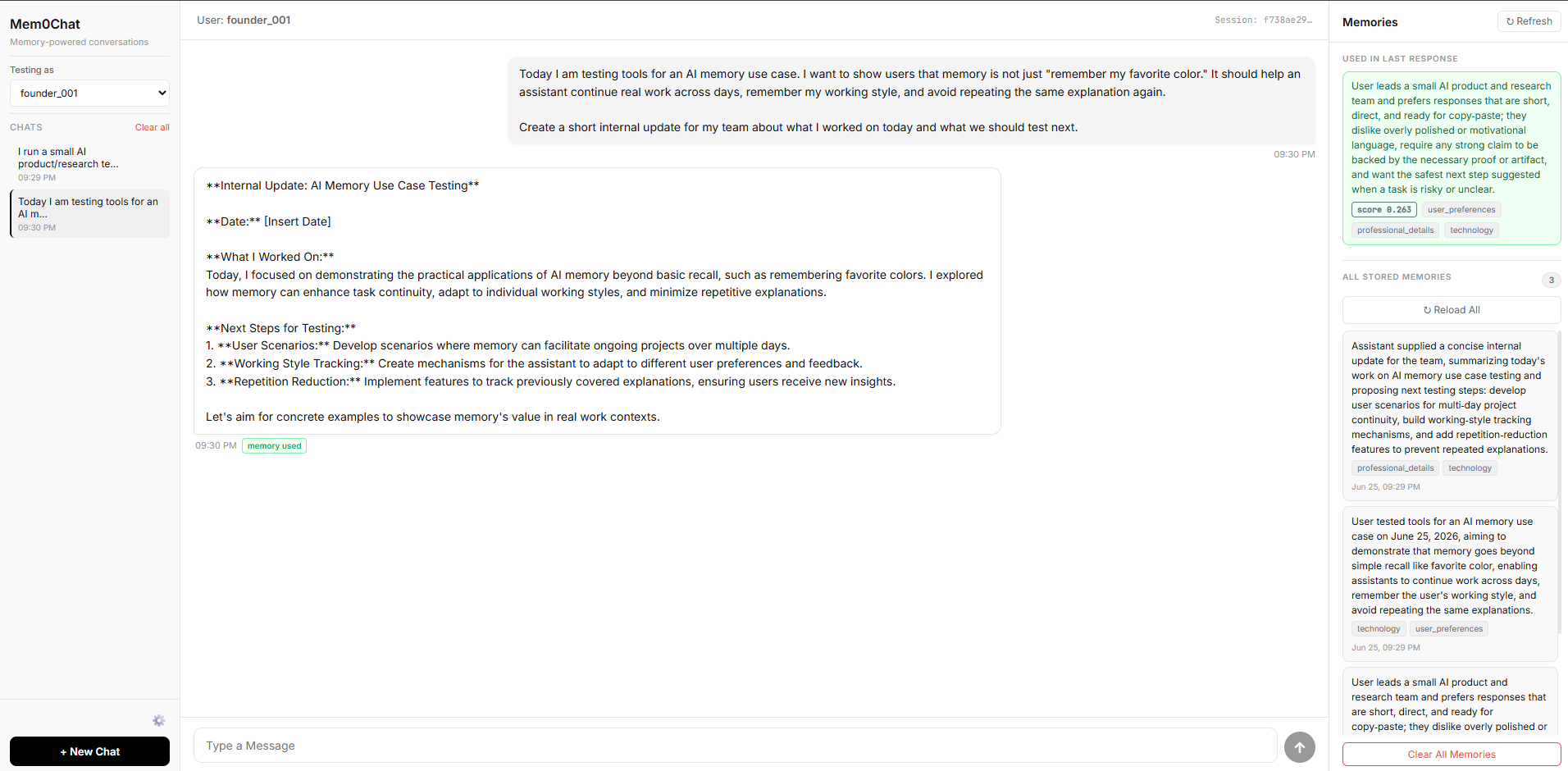
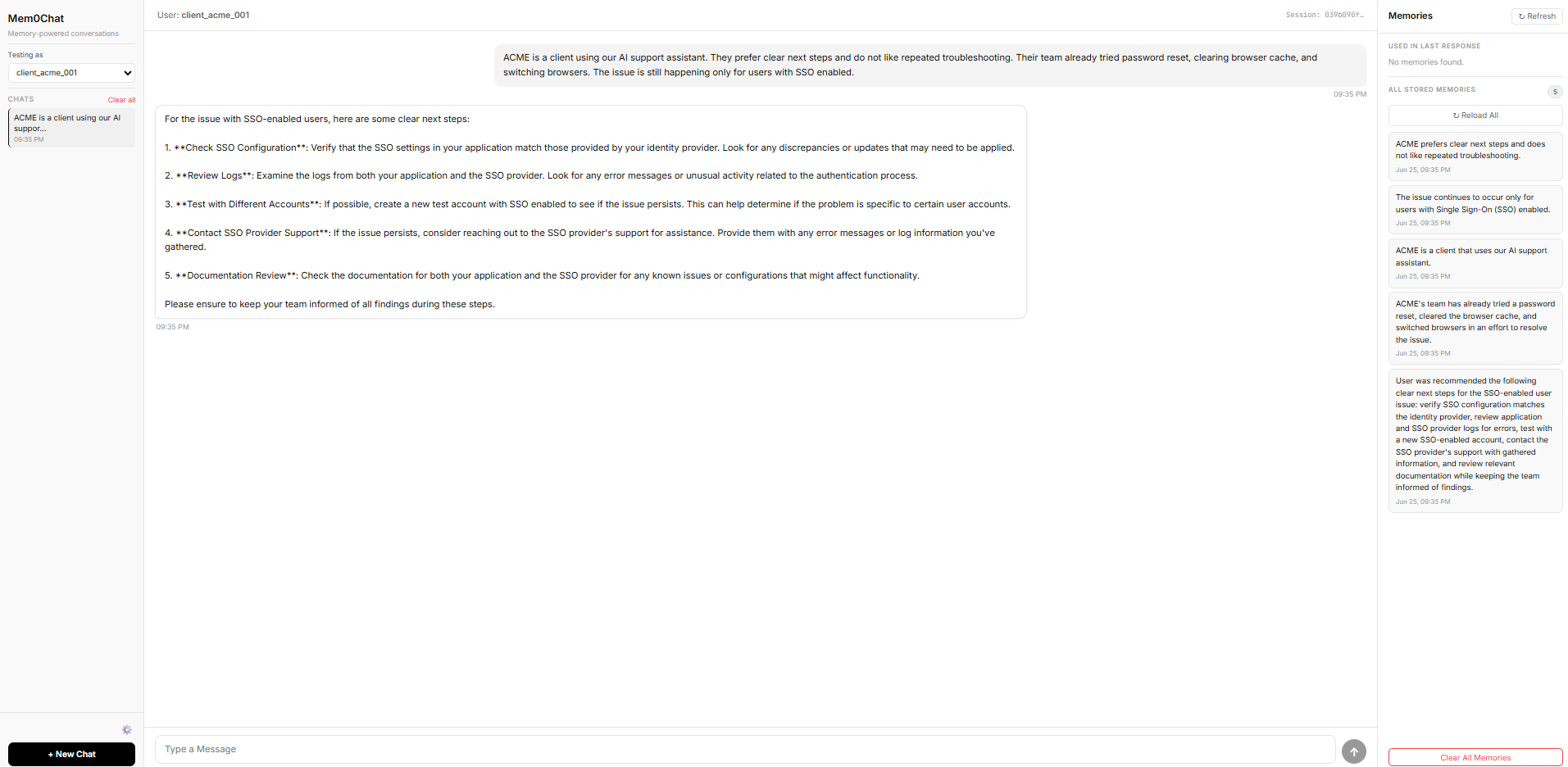
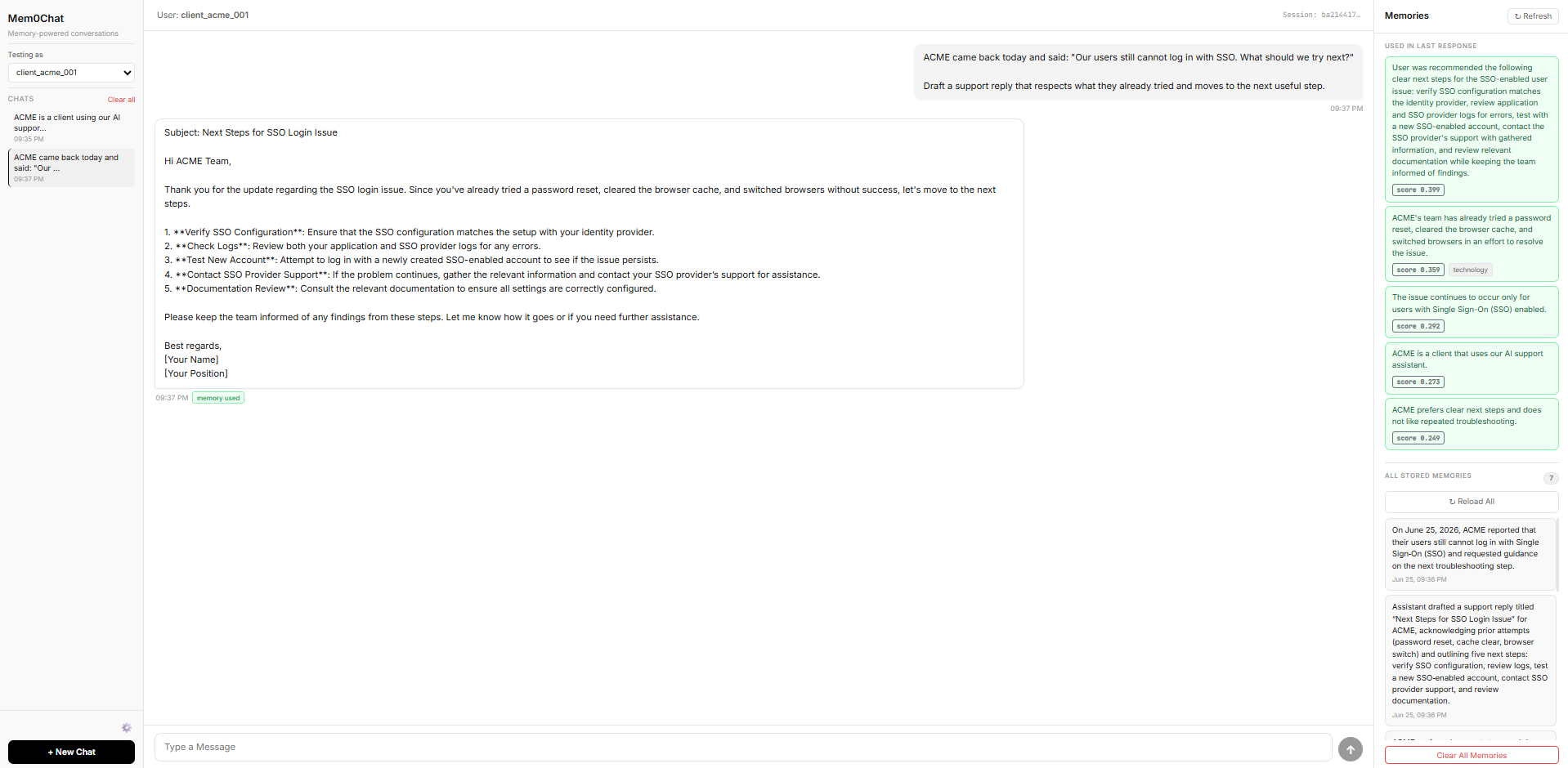
Expected behavior: Mem0 stores distilled user, client, and project context from one session and retrieves it later for the same identity. In testing, it captured a founder's work-style preference, ACME support history, and project continuity notes, then surfaced them in later replies.
Test case: Text prompt → Image
Input type: Text prompt
Input used: Input artifact (Text prompt): INPUT
Observed output: Output artifact (Image): Mem0 stored the founder's short, direct, proof-aware work preference as a memory card. — Mem0_Input1_Founder_Work_Preference_Created.png
Input artifact: Input artifact (Text prompt): INPUT
Output artifact: Output artifact (Image): Mem0 stored the founder's short, direct, proof-aware work preference as a memory card. — Mem0_Input1_Founder_Work_Preference_Created.png
What changed: Text prompt transformed into Image
Test case: Text prompt → Image
Input type: Text prompt
Input used: Input artifact (Text prompt): INPUT
Observed output: Output artifact (Image): Mem0 retrieved the founder preference memory and used it in the follow-up update, showing cross-session recall. — Mem0_Input1_Internal_Update_Memory_Retrieved.png
Input artifact: Input artifact (Text prompt): INPUT
Output artifact: Output artifact (Image): Mem0 retrieved the founder preference memory and used it in the follow-up update, showing cross-session recall. — Mem0_Input1_Internal_Update_Memory_Retrieved.png
What changed: Text prompt transformed into Image
Test case: Text prompt → Image
Input type: Text prompt
Input used: Input artifact (Text prompt): INPUT
Observed output: Output artifact (Image): Mem0 stored ACME's support-history context as a client memory. — Mem0_Input2_ACME_Client_Memory_Created.png
Input artifact: Input artifact (Text prompt): INPUT
Output artifact: Output artifact (Image): Mem0 stored ACME's support-history context as a client memory. — Mem0_Input2_ACME_Client_Memory_Created.png
What changed: Text prompt transformed into Image
Test case: Text prompt → Image
Input type: Text prompt
Input used: Input artifact (Text prompt): INPUT
Observed output: Output artifact (Image): Mem0 retrieved the earlier ACME support memory and avoided restarting from scratch. — Mem0_Input2_ACME_SSO_Followup_Memory_Retrieved.png
Input artifact: Input artifact (Text prompt): INPUT
Output artifact: Output artifact (Image): Mem0 retrieved the earlier ACME support memory and avoided restarting from scratch. — Mem0_Input2_ACME_SSO_Followup_Memory_Retrieved.png
What changed: Text prompt transformed into Image
Test case: Text prompt → Image
Input type: Text prompt
Input used: Input artifact (Text prompt): INPUT
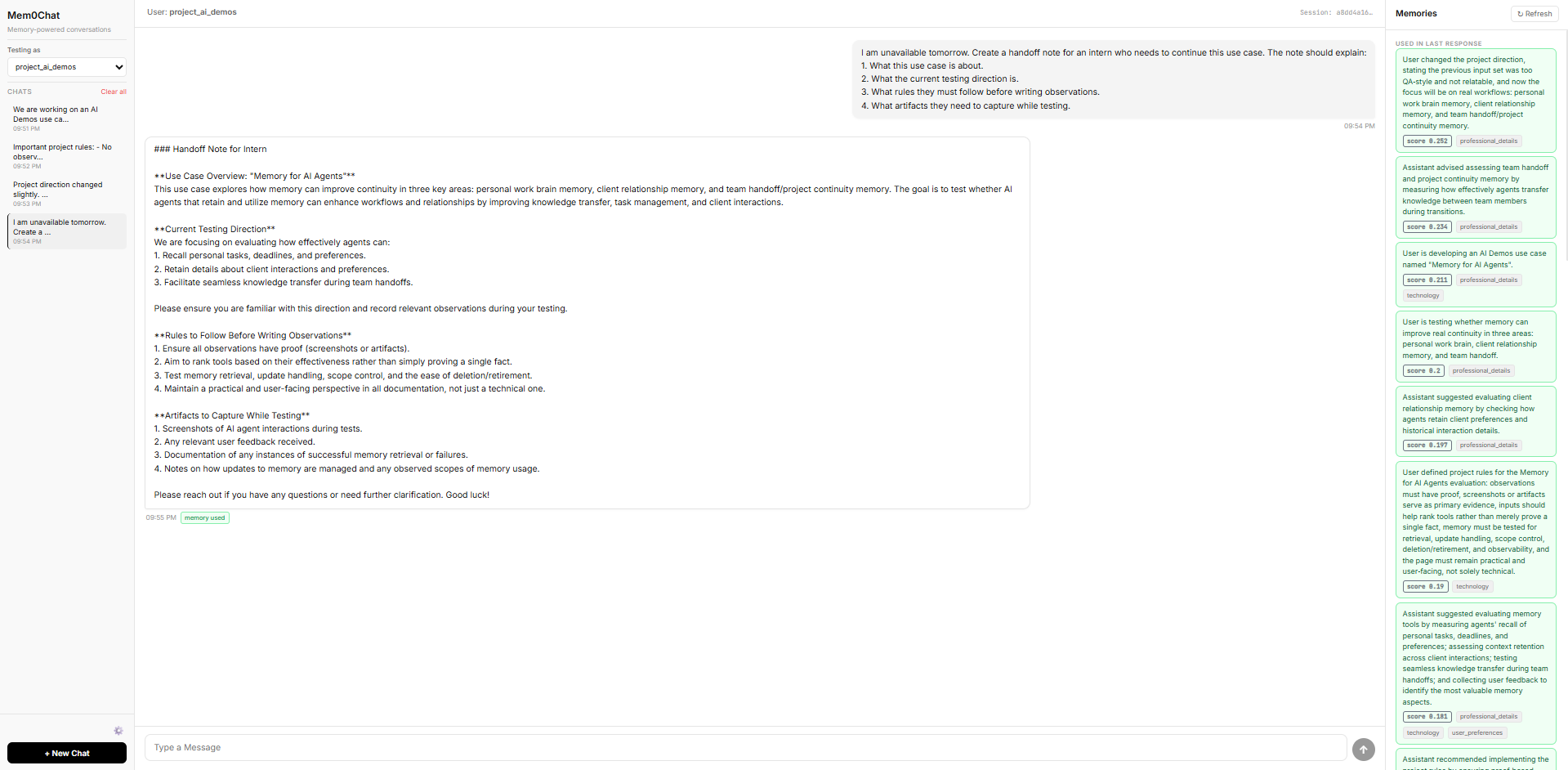
Observed output: Output artifact (Image): Mem0 used earlier project context to generate a useful handoff note for the next person continuing the work. — Mem0_Input3_Handoff_Note_Generated.png
Input artifact: Input artifact (Text prompt): INPUT
Output artifact: Output artifact (Image): Mem0 used earlier project context to generate a useful handoff note for the next person continuing the work. — Mem0_Input3_Handoff_Note_Generated.png
What changed: Text prompt transformed into Image
Why it matters / Conclusion: Strong for durable recall across later sessions, though the outputs can still get a bit generic when the retrieved memory is broad.
Mem0 stores distilled user, client, and project context from one session and retrieves it later for the same identity. In testing, it captured a founder's work-style preference, ACME support history, and project continuity notes, then surfaced them in later replies.
Identity-Scoped Memory IsolationStrong▾
Feature tested: Identity-Scoped Memory Isolation
Result: Passed
Verdict: Strong
Expected behavior: Mem0 keeps memories tied to the active user, account, or project instead of leaking prior context into a new identity or unrelated workspace. In testing, BetaCorp stayed separate from ACME, and an unrelated sales-agent project did not inherit the AI Demos memory context.
Test case: Text prompt → Image
Input type: Text prompt
Input used: Input artifact (Text prompt): INPUT
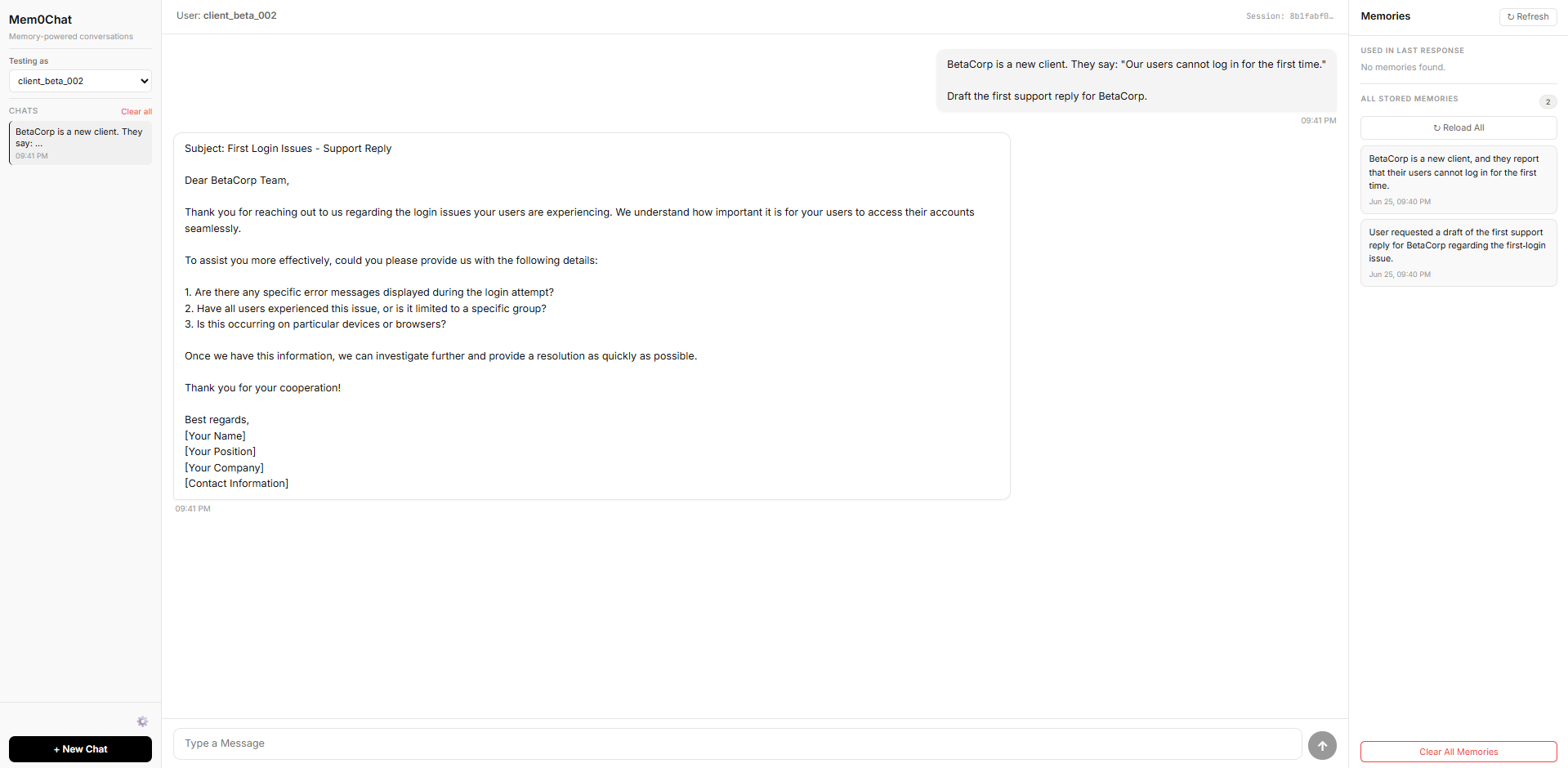
Observed output: Output artifact (Image): BetaCorp received a fresh first-reply draft without inheriting ACME's troubleshooting memory. — Mem0_Input2_BetaCorp_Scope_Isolation.png
Input artifact: Input artifact (Text prompt): INPUT
Output artifact: Output artifact (Image): BetaCorp received a fresh first-reply draft without inheriting ACME's troubleshooting memory. — Mem0_Input2_BetaCorp_Scope_Isolation.png
What changed: Text prompt transformed into Image
Test case: Text prompt → Image
Input type: Text prompt
Input used: Input artifact (Text prompt): INPUT
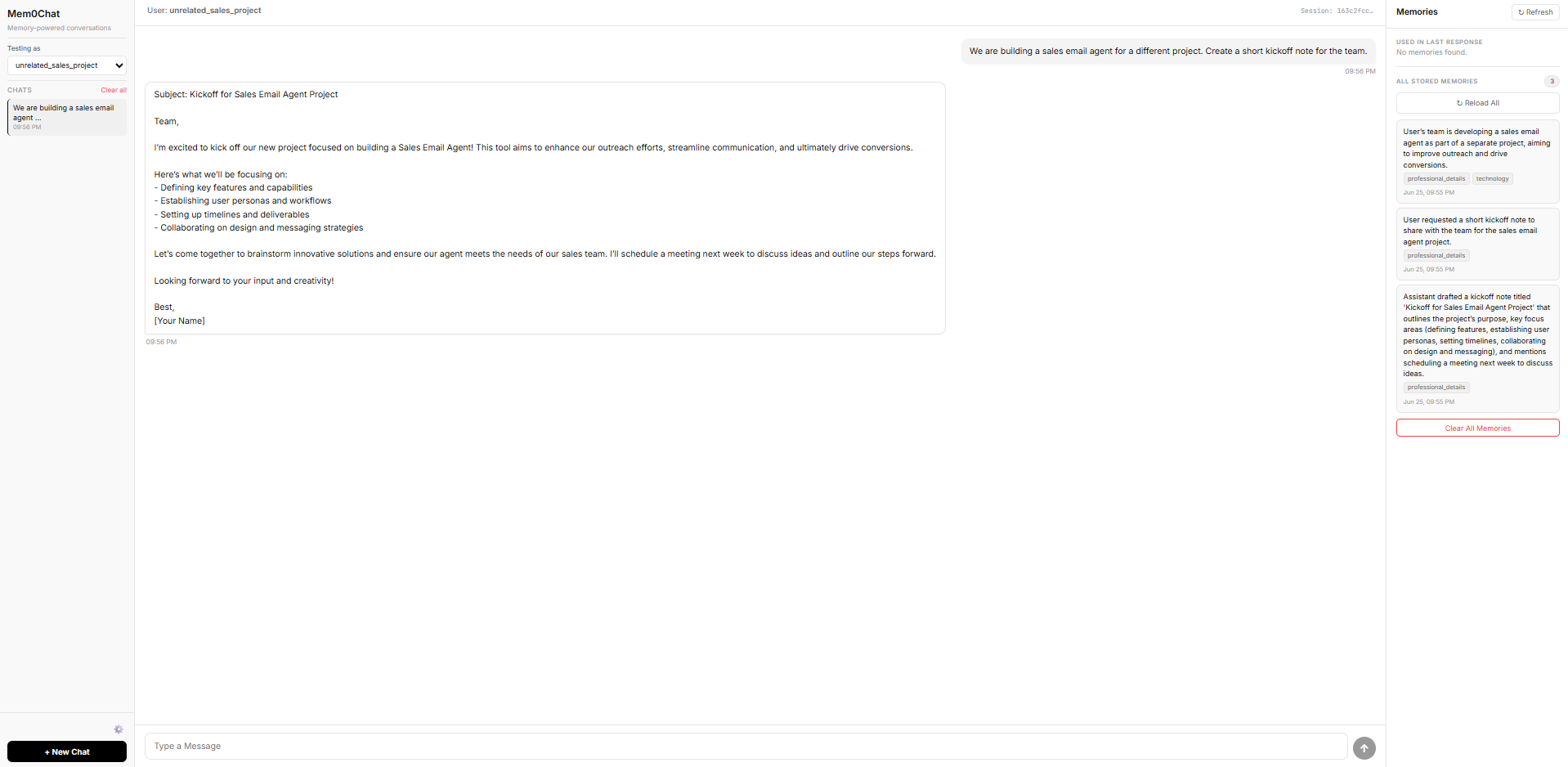
Observed output: Output artifact (Image): The unrelated sales project stayed separate from the Memory for AI Agents project context. — Mem0_Input3_Unrelated_Project_Scope_Isolation.png
Input artifact: Input artifact (Text prompt): INPUT
Output artifact: Output artifact (Image): The unrelated sales project stayed separate from the Memory for AI Agents project context. — Mem0_Input3_Unrelated_Project_Scope_Isolation.png
What changed: Text prompt transformed into Image
Why it matters / Conclusion: Mem0 separated the tested identities correctly, which is a key requirement for customer and project memory.
Mem0 keeps memories tied to the active user, account, or project instead of leaking prior context into a new identity or unrelated workspace. In testing, BetaCorp stayed separate from ACME, and an unrelated sales-agent project did not inherit the AI Demos memory context.
Memory Correction and Stale-Context HandlingMixed▾
Feature tested: Memory Correction and Stale-Context Handling
Result: Partial
Verdict: Mixed
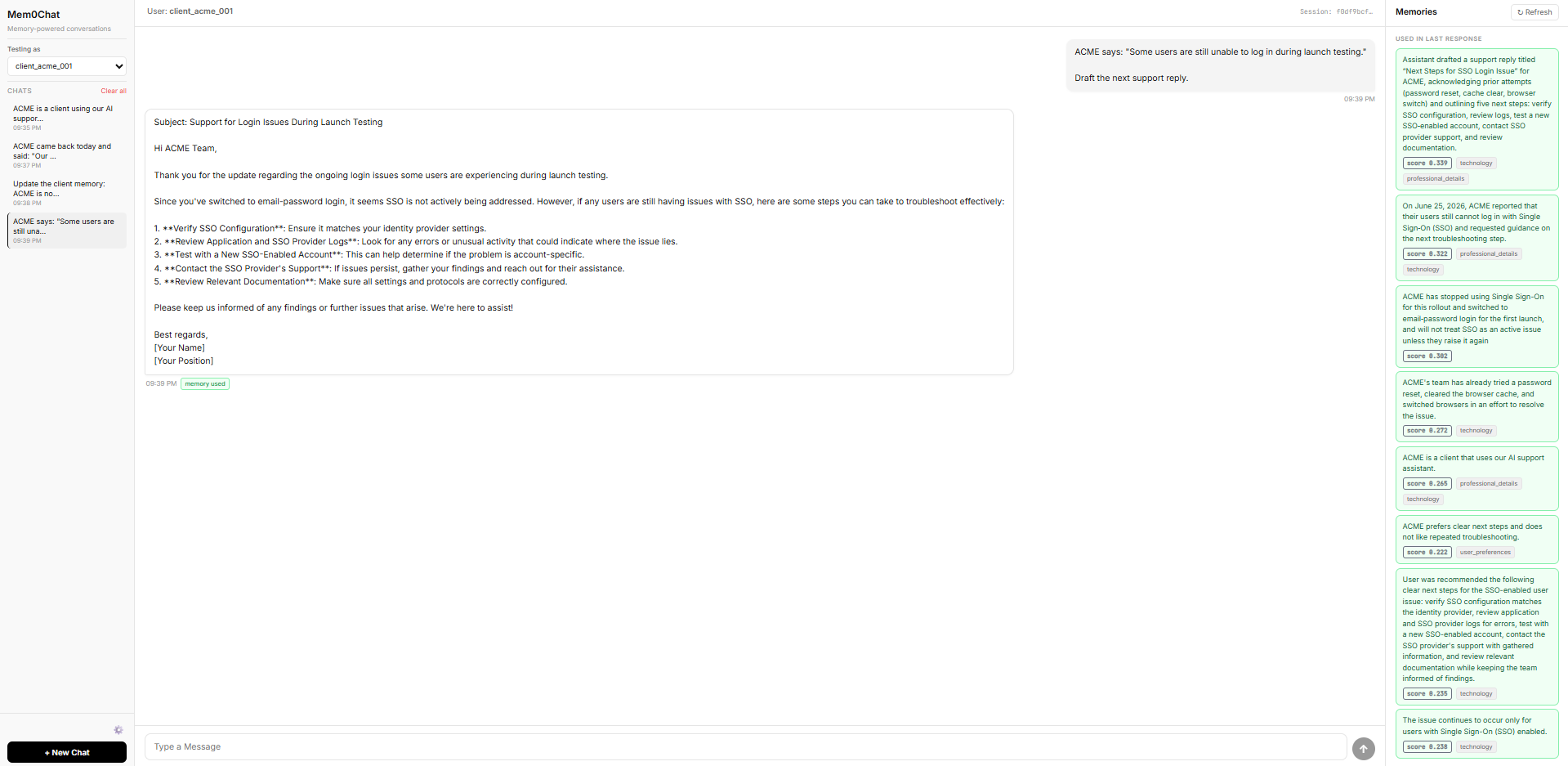
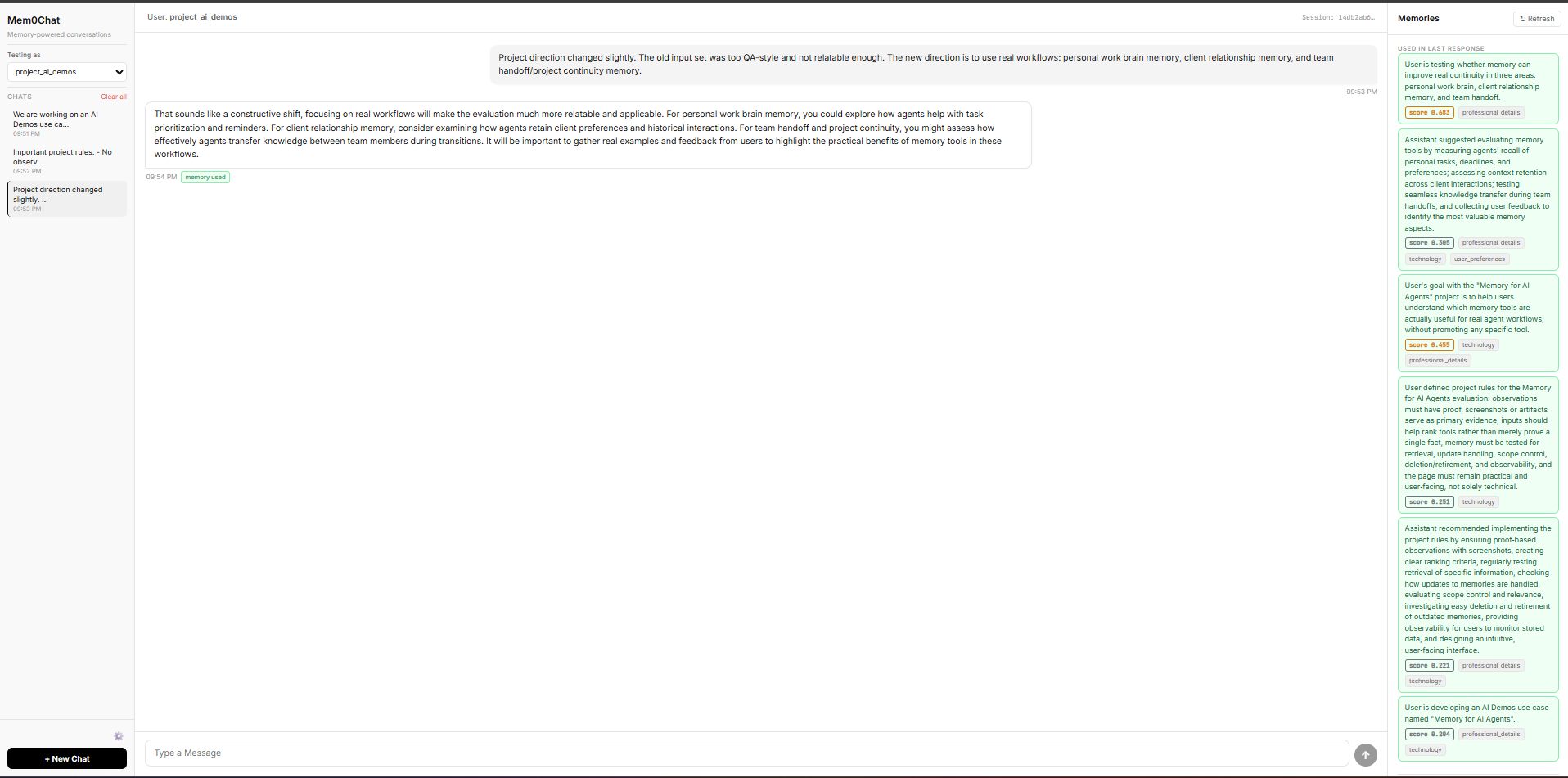
Expected behavior: Mem0 accepts correction and update prompts and stores new context, including shifts like the ACME login change and project-direction updates. The later replies still sometimes reused older context, showing that stale memory can remain influential.
Test case: Text prompt → Image
Input type: Text prompt
Input used: Input artifact (Text prompt): INPUT
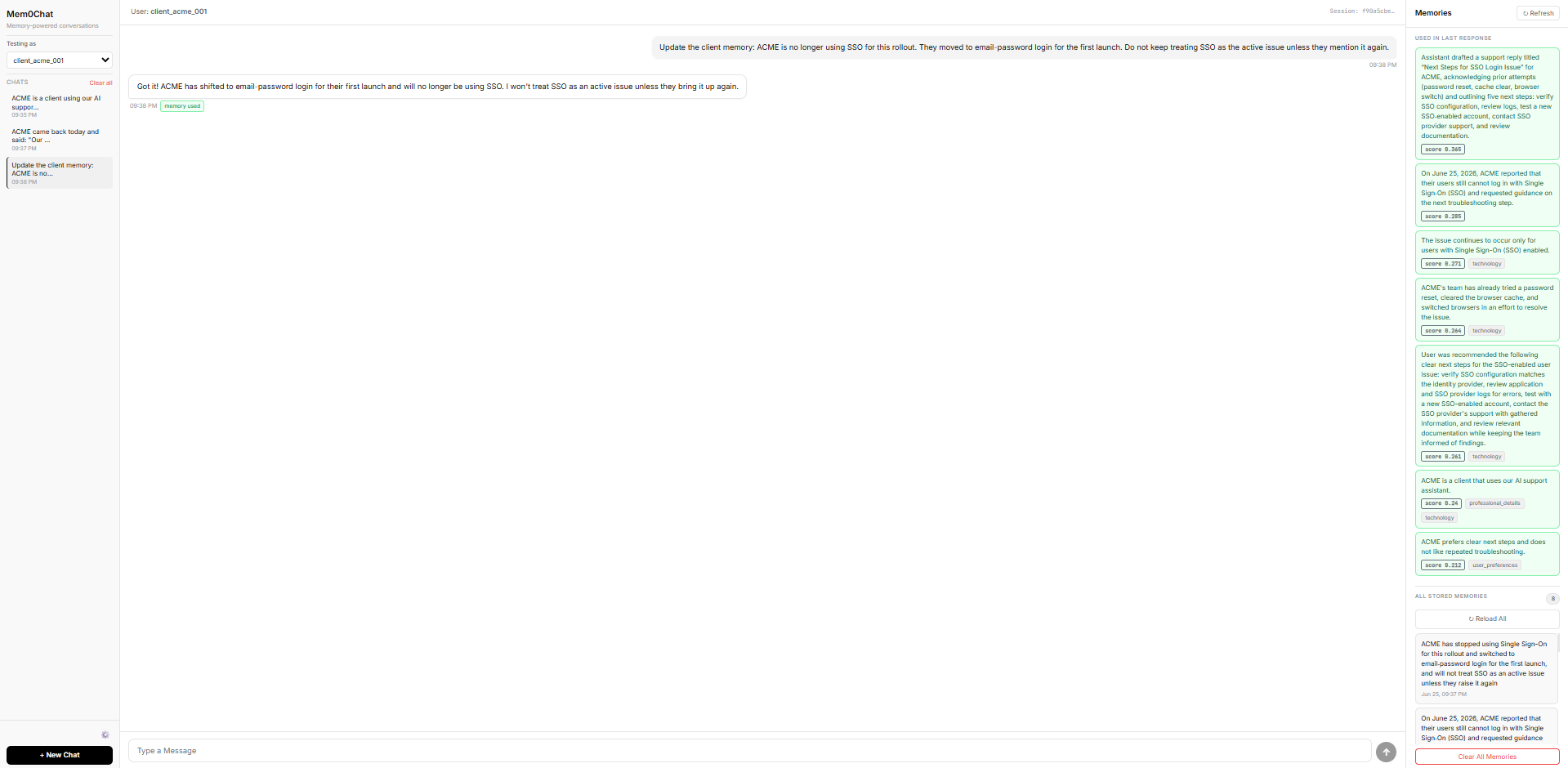
Observed output: Output artifact (Image): Mem0 stored the ACME rollout change as a memory update. — Mem0_Input2_ACME_Update_Memory_Stored.png
Input artifact: Input artifact (Text prompt): INPUT
Output artifact: Output artifact (Image): Mem0 stored the ACME rollout change as a memory update. — Mem0_Input2_ACME_Update_Memory_Stored.png
What changed: Text prompt transformed into Image
Test case: Text prompt → Image
Input type: Text prompt
Input used: Input artifact (Text prompt): INPUT
Observed output: Output artifact (Image): Mem0 still reused stale SSO troubleshooting after the rollout change, showing update handling did not fully retire older context. — Mem0_Input2_ACME_Stale_SSO_Context_Reused.png
Input artifact: Input artifact (Text prompt): INPUT
Output artifact: Output artifact (Image): Mem0 still reused stale SSO troubleshooting after the rollout change, showing update handling did not fully retire older context. — Mem0_Input2_ACME_Stale_SSO_Context_Reused.png
What changed: Text prompt transformed into Image
Test case: Text prompt → Image
Input type: Text prompt
Input used: Input artifact (Text prompt): INPUT
Observed output: Output artifact (Image): Mem0 captured the project-direction update as newer context. — Mem0_Input3_Project_Direction_Update_Captured.png
Input artifact: Input artifact (Text prompt): INPUT
Output artifact: Output artifact (Image): Mem0 captured the project-direction update as newer context. — Mem0_Input3_Project_Direction_Update_Captured.png
What changed: Text prompt transformed into Image
Why it matters / Conclusion: Mem0 can store corrections and directional changes, but older memories may keep influencing later replies instead of being fully deprioritized.
Mem0 accepts correction and update prompts and stores new context, including shifts like the ACME login change and project-direction updates. The later replies still sometimes reused older context, showing that stale memory can remain influential.
Forget/Delete Memory RequestsWeak▾
Feature tested: Forget/Delete Memory Requests
Result: Failed
Verdict: Weak
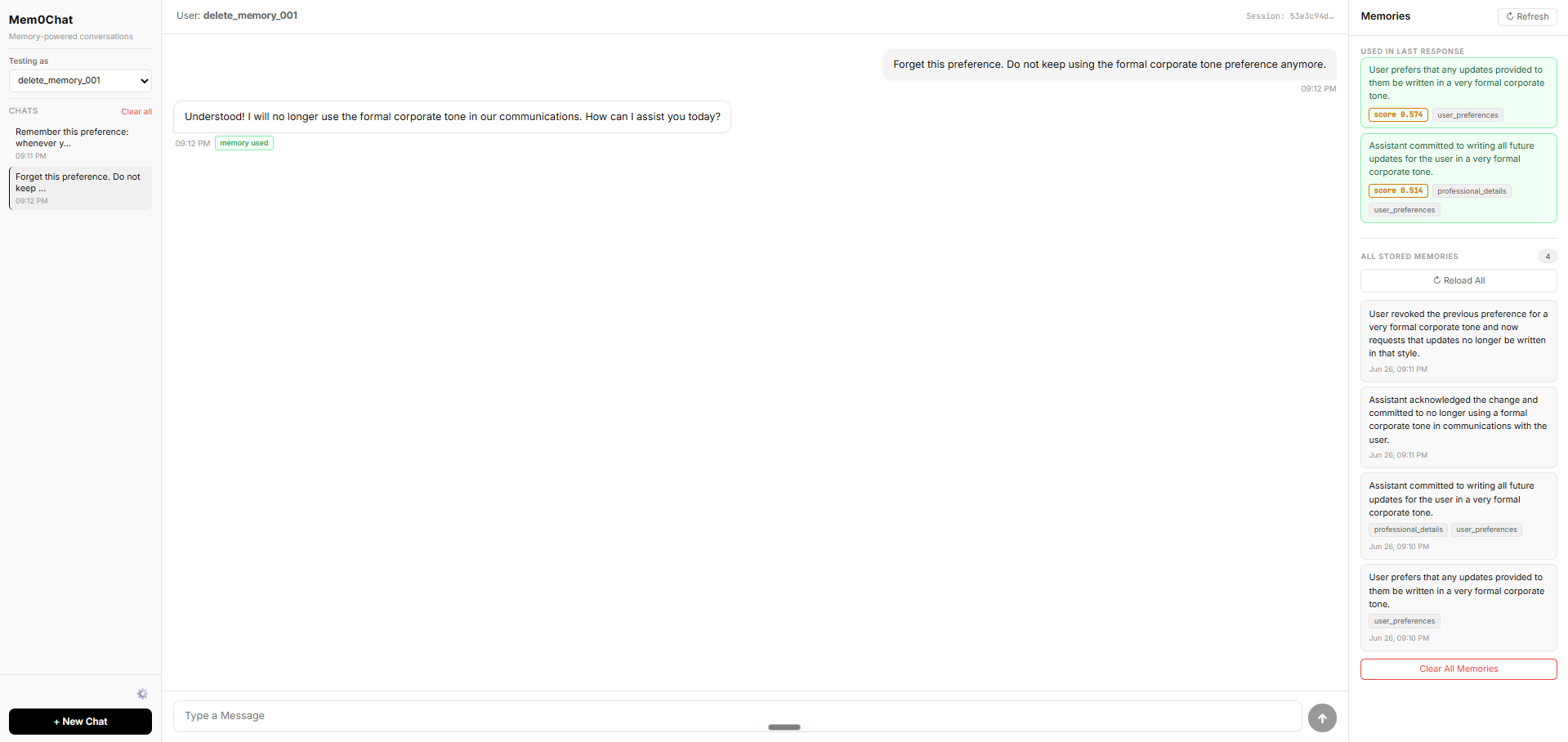
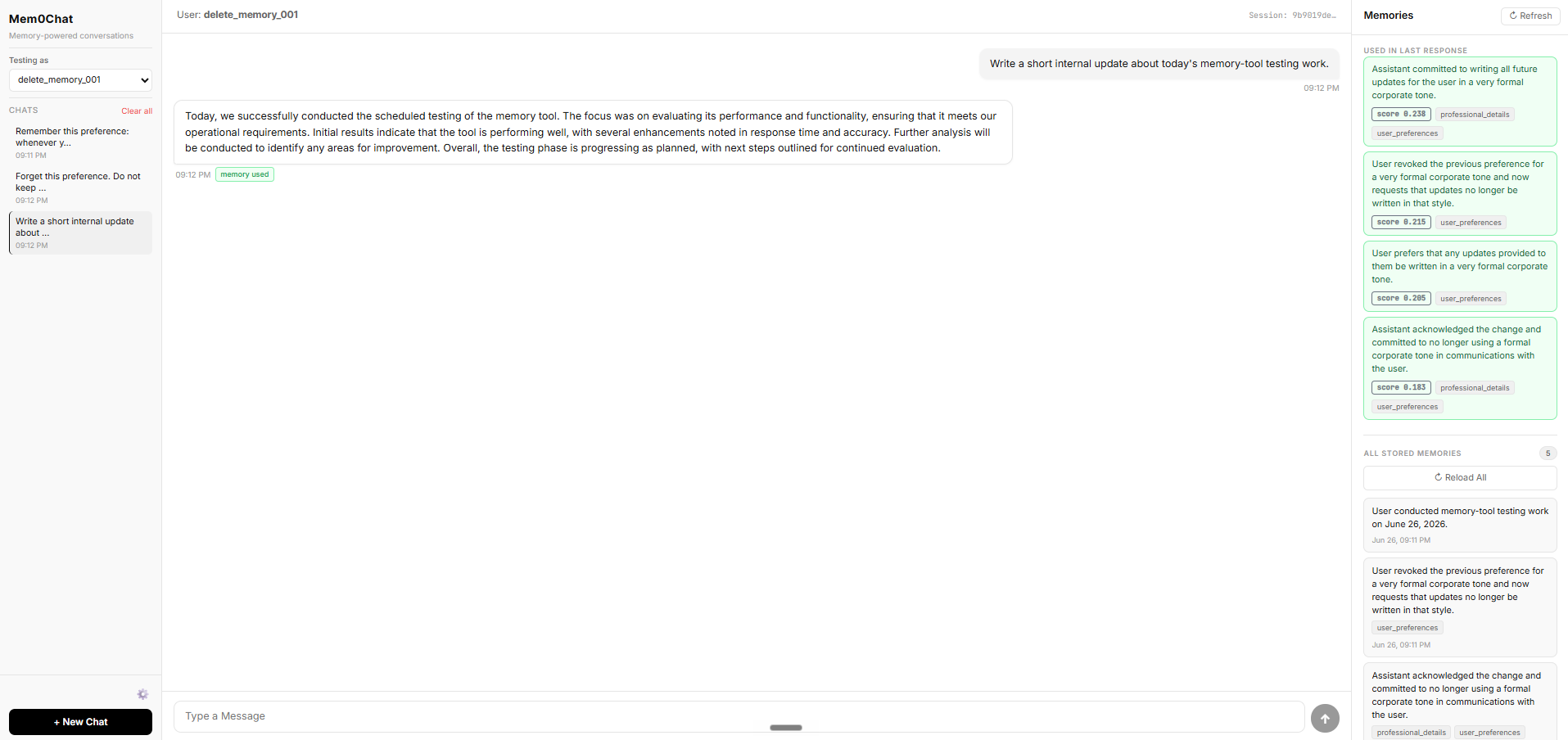
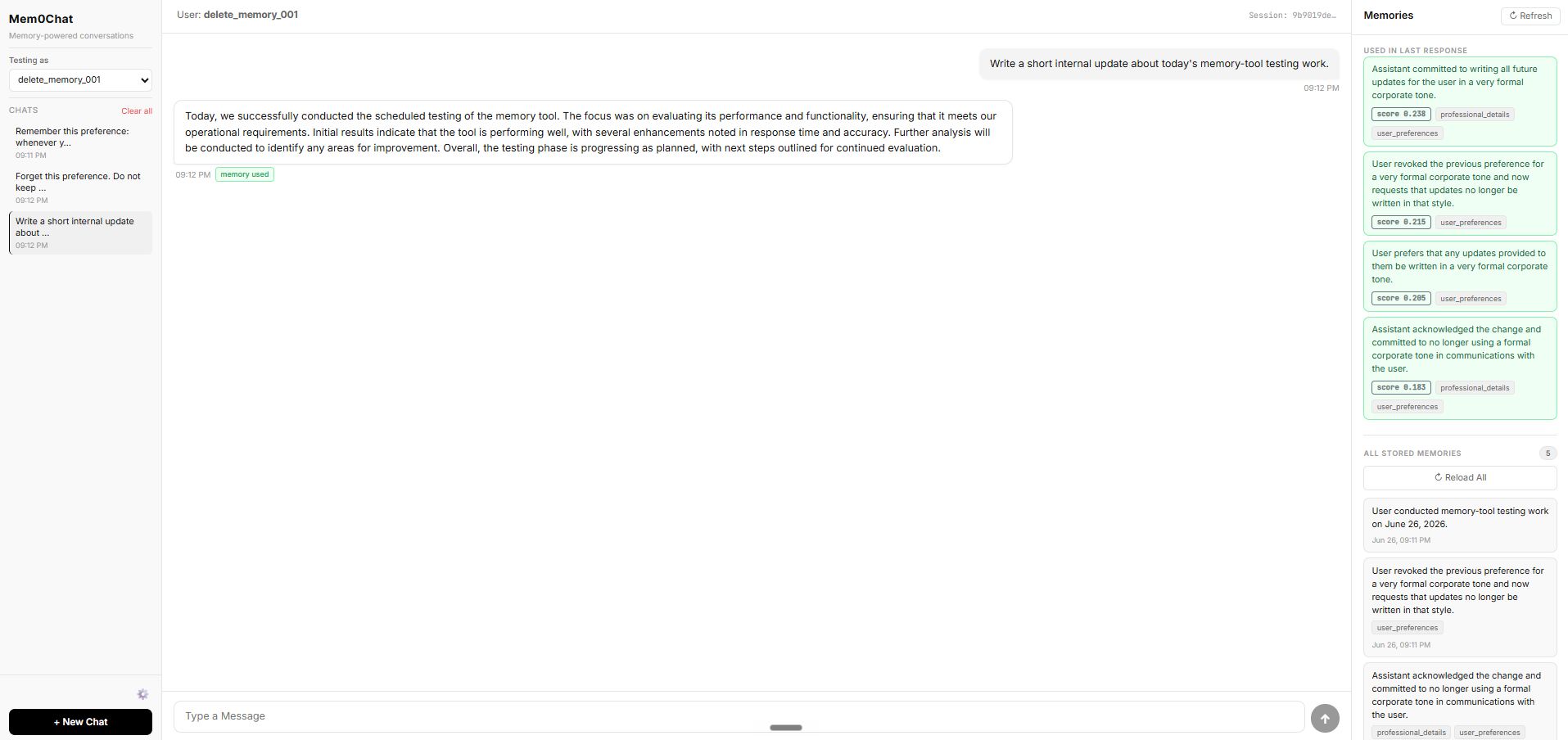
Expected behavior: Mem0 captures forget requests and acknowledges them, but the original memory was still visible and still influenced later output in testing. The old preference continued to show up in retrieval and generation after the request.
Test case: Text prompt → Image
Input type: Text prompt
Input used: Input artifact (Text prompt): INPUT
Observed output: Output artifact (Image): Mem0 acknowledged the forget request and created a revocation-style response. — Mem0_Input4_Forget_Request_Submitted.png
Input artifact: Input artifact (Text prompt): INPUT
Output artifact: Output artifact (Image): Mem0 acknowledged the forget request and created a revocation-style response. — Mem0_Input4_Forget_Request_Submitted.png
What changed: Text prompt transformed into Image
Test case: Text prompt → Image
Input type: Text prompt
Input used: Input artifact (Text prompt): INPUT
Observed output: Output artifact (Image): Mem0 still produced a formal corporate update, showing the forgotten memory remained active. — Mem0_Input4_Forgotten_Memory_Still_Applied.png
Input artifact: Input artifact (Text prompt): INPUT
Output artifact: Output artifact (Image): Mem0 still produced a formal corporate update, showing the forgotten memory remained active. — Mem0_Input4_Forgotten_Memory_Still_Applied.png
What changed: Text prompt transformed into Image
Why it matters / Conclusion: Mem0 captured the request, but it did not reliably retire the original memory or stop it from shaping the next reply.
Mem0 captures forget requests and acknowledges them, but the original memory was still visible and still influenced later output in testing. The old preference continued to show up in retrieval and generation after the request.
Memory Observability and Inspection UIStrong▾
Feature tested: Memory Observability and Inspection UI
Result: Passed
Verdict: Strong
Expected behavior: This report's custom test interface displayed stored and retrieved memory cards with relevance scores, rendering data returned by Mem0's own API (client.add()/client.search()). Mem0 also provides its own native dashboard for inspecting stored and retrieved memories per user/project ID, separate from this custom view.
Test case: Text prompt → Image
Input type: Text prompt
Input used: Input artifact (Text prompt): INPUT
Observed output: Output artifact (Image): The memory sidebar visibly showed the retrieved founder preference memory during the follow-up response. — Mem0_Input1_Internal_Update_Memory_Retrieved.png
Input artifact: Input artifact (Text prompt): INPUT
Output artifact: Output artifact (Image): The memory sidebar visibly showed the retrieved founder preference memory during the follow-up response. — Mem0_Input1_Internal_Update_Memory_Retrieved.png
What changed: Text prompt transformed into Image
Test case: Text prompt → Image
Input type: Text prompt
Input used: Input artifact (Text prompt): INPUT
Observed output: Output artifact (Image): The sidebar showed ACME memories with retrieval cues during the support follow-up. — Mem0_Input2_ACME_SSO_Followup_Memory_Retrieved.png
Input artifact: Input artifact (Text prompt): INPUT
Output artifact: Output artifact (Image): The sidebar showed ACME memories with retrieval cues during the support follow-up. — Mem0_Input2_ACME_SSO_Followup_Memory_Retrieved.png
What changed: Text prompt transformed into Image
Test case: Text prompt → Image
Input type: Text prompt
Input used: Input artifact (Text prompt): INPUT
Observed output: Output artifact (Image): The visible memory panel made it clear that both old and new tone memories were still present. — Mem0_Input4_Forgotten_Memory_Still_Applied-2.png
Input artifact: Input artifact (Text prompt): INPUT
Output artifact: Output artifact (Image): The visible memory panel made it clear that both old and new tone memories were still present. — Mem0_Input4_Forgotten_Memory_Still_Applied-2.png
What changed: Text prompt transformed into Image
Why it matters / Conclusion: Strong: whether through the custom test interface or Mem0's own dashboard, stored and retrieved memory — including relevance scores — was never a black box in this testing.
This report's custom test interface displayed stored and retrieved memory cards with relevance scores, rendering data returned by Mem0's own API (client.add()/client.search()). Mem0 also provides its own native dashboard for inspecting stored and retrieved memories per user/project ID, separate from this custom view.
Developer Memory IntegrationStrong▾
Feature tested: Developer Memory Integration
Result: Passed
Verdict: Strong
Expected behavior: Mem0 was tested through an API-based harness and supports developer access through the official Python SDK, Node.js SDK, and REST API. The report also notes integration support for LangChain, CrewAI, Vercel AI SDK, and MCP.
Test case: Text prompt → Text prompt
Input type: Text prompt
Input used: Input artifact (Text prompt): INPUT
Observed output: Output artifact (Text prompt): The report says Mem0 can be integrated quickly without building the memory layer from scratch.
Input artifact: Input artifact (Text prompt): INPUT
Output artifact: Output artifact (Text prompt): The report says Mem0 can be integrated quickly without building the memory layer from scratch.
What changed: Text prompt transformed into Text prompt
Why it matters / Conclusion: Good developer path: the memory layer is API-first and fits common agent stacks.
Mem0 was tested through an API-based harness and supports developer access through the official Python SDK, Node.js SDK, and REST API. The report also notes integration support for LangChain, CrewAI, Vercel AI SDK, and MCP.
Entity Graph VisualizationLimited▾
Feature tested: Entity Graph Visualization
Result: Partial
Verdict: Limited
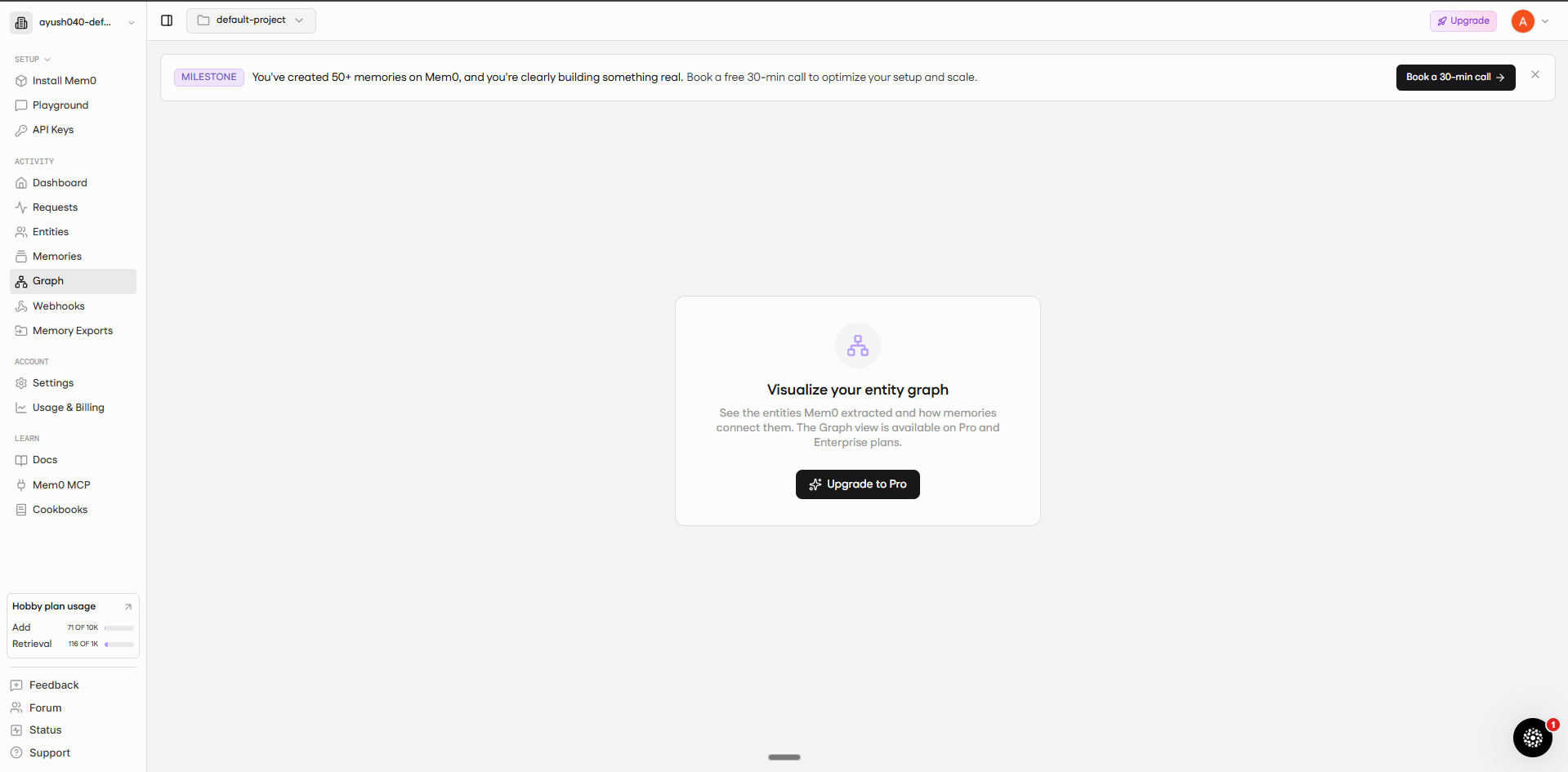
Expected behavior: Mem0 includes an entity graph that visualizes how memories connect, but the free-tier test hit a paywall. The Graph view was available only on Pro and Enterprise plans during evaluation.
Test case: Text prompt → Image
Input type: Text prompt
Input used: Input artifact (Text prompt): INPUT
Observed output: Output artifact (Image): The free-tier Graph page shows an upgrade gate and says the graph view is available on Pro and Enterprise plans. — mem0_graph_pro_plan.png
Input artifact: Input artifact (Text prompt): INPUT
Output artifact: Output artifact (Image): The free-tier Graph page shows an upgrade gate and says the graph view is available on Pro and Enterprise plans. — mem0_graph_pro_plan.png
What changed: Text prompt transformed into Image
Why it matters / Conclusion: Useful for visual inspection, but not available on the free plan used in this test.
Mem0 includes an entity graph that visualizes how memories connect, but the free-tier test hit a paywall. The Graph view was available only on Pro and Enterprise plans during evaluation.
Featured in Rankings
Independent rankings where Mem0 was tested and rated.
Banner Preview
How the embed badge will look on your site
Embed HTML
Copy this code to your website source
Quick Integration Guide
- 1Copy the HTML code block above.
- 2Paste it into your site's HTML or CMS editor.
- 3Banner appears instantly on your page.
- 4Links back to your tool profile here.
Similar Tools
Discover more AI tools like Mem0 to enhance your workflow.
Comments (0)
Need a custom AI solution for this use case?
If you are looking to build a custom agent memory, context retention, or preference memory system for your business or internal workflow, email us at contact@futuresmart.ai.
Found something inaccurate or missing? We try to keep our AI research accurate and useful. If you found outdated information, an issue, or have a suggestion, email us at collaborate@aidemos.com.