
Definite Review: NL2SQL Dashboard Builder Tested (2026)
AI Data Platform · NL2SQL · AI Analyst · Dashboard Builder · June 2026
Our take
- You want chat results to become reusable dashboards.
- You need KPI cards, charts, filters, and multiple dashboard views.
- You want business commentary around order pipeline and operational metrics.
- You want every visualization to appear directly inside chat.
Feature scores on this page: 7.9/10 (5 scored features)
Our take
Definite is strongest when a chat result needs to become a reusable dashboard. It can create dashboard-style outputs with KPI cards, charts, multiple views, and filters instead of keeping the result only inside the chat. The trade-off is speed and simplicity. The flow feels heavier than AskYourDatabase and Basedash because visualizations are not shown directly inside the chat. Definite also missed part of the intent in the best-customer query by ranking only on spend instead of balancing spend and order frequency.
Benchmark participation
Benchmark participation is temporarily unavailable.
In-Depth Review
Our detailed analysis of Definite — features, performance, and real-world testing.
Feature-by-Feature Breakdown
Natural Language Database QueryingGood — accepts plain English database questions and returns structured answers, but can miss part of a multi-intent query.7.2/10▾
Feature tested: Natural Language Database Querying
Result: Partial (7.2/10)
Verdict: Good — accepts plain English database questions and returns structured answers, but can miss part of a multi-intent query.
Expected behavior: Definite lets users ask database questions in plain English and get table-based answers without writing SQL manually.
Test case: Text prompt → Image
Input type: Text prompt
Input used: Input artifact (Text prompt): Input
Observed output: Output artifact (Image): Definite correctly understood the natural language query and returned a customer acquisition comparison. It showed: * Last 90 Days: 13 customers * Previous — definite-natural-language-database-querying-1.png
Input artifact: Input artifact (Text prompt): Input
Output artifact: Output artifact (Image): Definite correctly understood the natural language query and returned a customer acquisition comparison. It showed: * Last 90 Days: 13 customers * Previous — definite-natural-language-database-querying-1.png
What changed: Text prompt transformed into Image
Test case: Text prompt → Image
Input type: Text prompt
Input used: Input artifact (Text prompt): Input
Observed output: Output artifact (Image): Definite accepted the question and returned a readable customer table, but the interpretation was incomplete. The query asked for customers who: * order the m — definite-natural-language-database-querying-2.png
Input artifact: Input artifact (Text prompt): Input
Output artifact: Output artifact (Image): Definite accepted the question and returned a readable customer table, but the interpretation was incomplete. The query asked for customers who: * order the m — definite-natural-language-database-querying-2.png
What changed: Text prompt transformed into Image
Why it matters / Conclusion: Definite can answer plain English database questions, but the artifact is worth checking because it shows both sides: simple queries are handled clearly, while multi-intent questions can be narrowed without clarification.
Definite lets users ask database questions in plain English and get table-based answers without writing SQL manually.
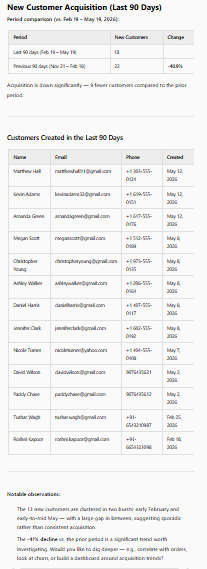
Definite correctly understood the natural language query and returned a customer acquisition comparison. It showed: * Last 90 Days: 13 customers * Previous 90 Days: 22 customers * Change: -40.9% It also listed customers created in the last 90 days with name, email, phone, and created date.
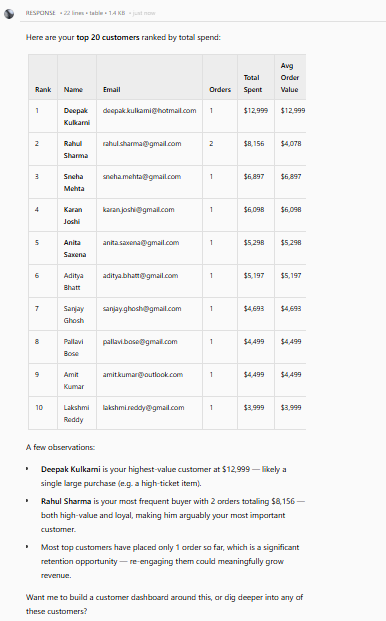
Definite accepted the question and returned a readable customer table, but the interpretation was incomplete. The query asked for customers who: * order the most * spend the most Definite ranked customers mainly by total spend. Order count appeared as a column, but it was not used as a real ranking factor.
AI Business CommentaryStrong — adds business-friendly observations that make outputs easier to understand.8/10▾
Feature tested: AI Business Commentary
Result: Passed (8/10)
Verdict: Strong — adds business-friendly observations that make outputs easier to understand.
Expected behavior: Definite adds natural language commentary around database results, including observations, caveats, and business meaning.
Test case: Text prompt → Image
Input type: Text prompt
Input used: Input artifact (Text prompt): Input
Observed output: Output artifact (Image): Definite found that Rahul Sharma had one unpaid order worth $2,199. It also added useful business commentary that the unpaid order had been sitting confirmed bu — definite-ai-business-commentary.png
Input artifact: Input artifact (Text prompt): Input
Output artifact: Output artifact (Image): Definite found that Rahul Sharma had one unpaid order worth $2,199. It also added useful business commentary that the unpaid order had been sitting confirmed bu — definite-ai-business-commentary.png
What changed: Text prompt transformed into Image
Why it matters / Conclusion: Definite does not only return rows. The artifact is worth checking because the commentary gives business context, like acquisition clustering and overdue unpaid-order risk, which a raw SQL table would not explain by itself.
Definite adds natural language commentary around database results, including observations, caveats, and business meaning.
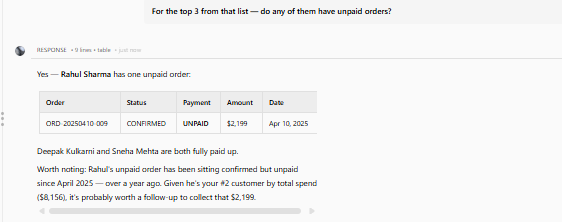
Definite found that Rahul Sharma had one unpaid order worth $2,199. It also added useful business commentary that the unpaid order had been sitting confirmed but unpaid since April 2025 and was worth following up.
Follow-Up Question HandlingMixed — follow-up context is retained, but follow-ups can inherit the first answer’s narrowed interpretation.7.5/10▾
Feature tested: Follow-Up Question Handling
Result: Partial (7.5/10)
Verdict: Mixed — follow-up context is retained, but follow-ups can inherit the first answer’s narrowed interpretation.
Expected behavior: Definite lets users continue analysis through follow-up questions and uses previous context to answer the next query.
Test case: Text prompt → Image
Input type: Text prompt
Input used: Input artifact (Text prompt): Input
Observed output: Output artifact (Image): Definite retained the context from the previous customer list and checked unpaid orders for the selected top customers. It found Rahul Sharma had one unpaid ord — definite-follow-up-question-handling-1.png
Input artifact: Input artifact (Text prompt): Input
Output artifact: Output artifact (Image): Definite retained the context from the previous customer list and checked unpaid orders for the selected top customers. It found Rahul Sharma had one unpaid ord — definite-follow-up-question-handling-1.png
What changed: Text prompt transformed into Image
Test case: Text prompt → Image
Input type: Text prompt
Input used: Input artifact (Text prompt): Input
Observed output: Output artifact (Image): Definite reused the same customer context and returned payment methods for the selected customers. It also connected Rahul Sharma’s unpaid order with his paymen — definite-follow-up-question-handling-2.png
Input artifact: Input artifact (Text prompt): Input
Output artifact: Output artifact (Image): Definite reused the same customer context and returned payment methods for the selected customers. It also connected Rahul Sharma’s unpaid order with his paymen — definite-follow-up-question-handling-2.png
What changed: Text prompt transformed into Image
Why it matters / Conclusion: Definite can maintain follow-up context, but the artifact is worth checking because it shows an important risk: when the first interpretation is narrowed, later follow-ups can continue from that narrowed scope.
Definite lets users continue analysis through follow-up questions and uses previous context to answer the next query.
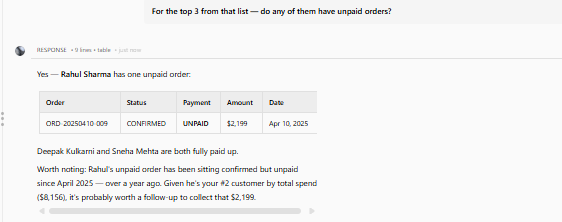
Definite retained the context from the previous customer list and checked unpaid orders for the selected top customers. It found Rahul Sharma had one unpaid order and explained the issue in a business-friendly way.
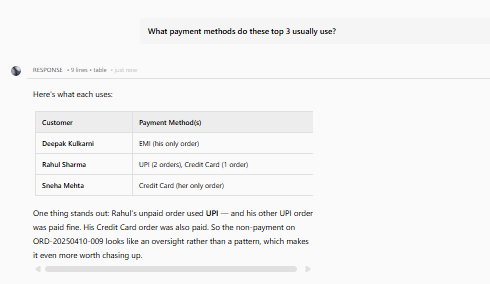
Definite reused the same customer context and returned payment methods for the selected customers. It also connected Rahul Sharma’s unpaid order with his payment method behavior and suggested it may be an oversight rather than a repeated pattern.
Dashboard GenerationStrong — turns chat answers into reusable dashboard-style outputs with multiple views and charts.8.6/10▾
Feature tested: Dashboard Generation
Result: Passed (8.6/10)
Verdict: Strong — turns chat answers into reusable dashboard-style outputs with multiple views and charts.
Expected behavior: Definite lets users generate a separate dashboard/doc from chat results, making the analysis reusable instead of leaving it as a one-time response.
Test case: Text prompt → Image
Input type: Text prompt
Input used: Input artifact (Text prompt): Input
Observed output: Output artifact (Image): Definite created a separate dashboard for the customer acquisition result. The dashboard included: * Trend view * Comparison view * Recent customer list * — definite-dashboard-generation-1.png
Input artifact: Input artifact (Text prompt): Input
Output artifact: Output artifact (Image): Definite created a separate dashboard for the customer acquisition result. The dashboard included: * Trend view * Comparison view * Recent customer list * — definite-dashboard-generation-1.png
What changed: Text prompt transformed into Image
Test case: Text prompt → Image
Input type: Text prompt
Input used: Input artifact (Text prompt): Input
Observed output: Output artifact (Image): Definite created a separate order pipeline dashboard/doc. The dashboard included: * Orders By Stage * Orders By Month * KPI cards * donut/pie chart * — definite-dashboard-generation-2.png
Input artifact: Input artifact (Text prompt): Input
Output artifact: Output artifact (Image): Definite created a separate order pipeline dashboard/doc. The dashboard included: * Orders By Stage * Orders By Month * KPI cards * donut/pie chart * — definite-dashboard-generation-2.png
What changed: Text prompt transformed into Image
Why it matters / Conclusion: This is Definite’s strongest feature. The artifact is worth checking because the output becomes a reusable dashboard with views and filters, not just a temporary chart inside chat.
Definite lets users generate a separate dashboard/doc from chat results, making the analysis reusable instead of leaving it as a one-time response.
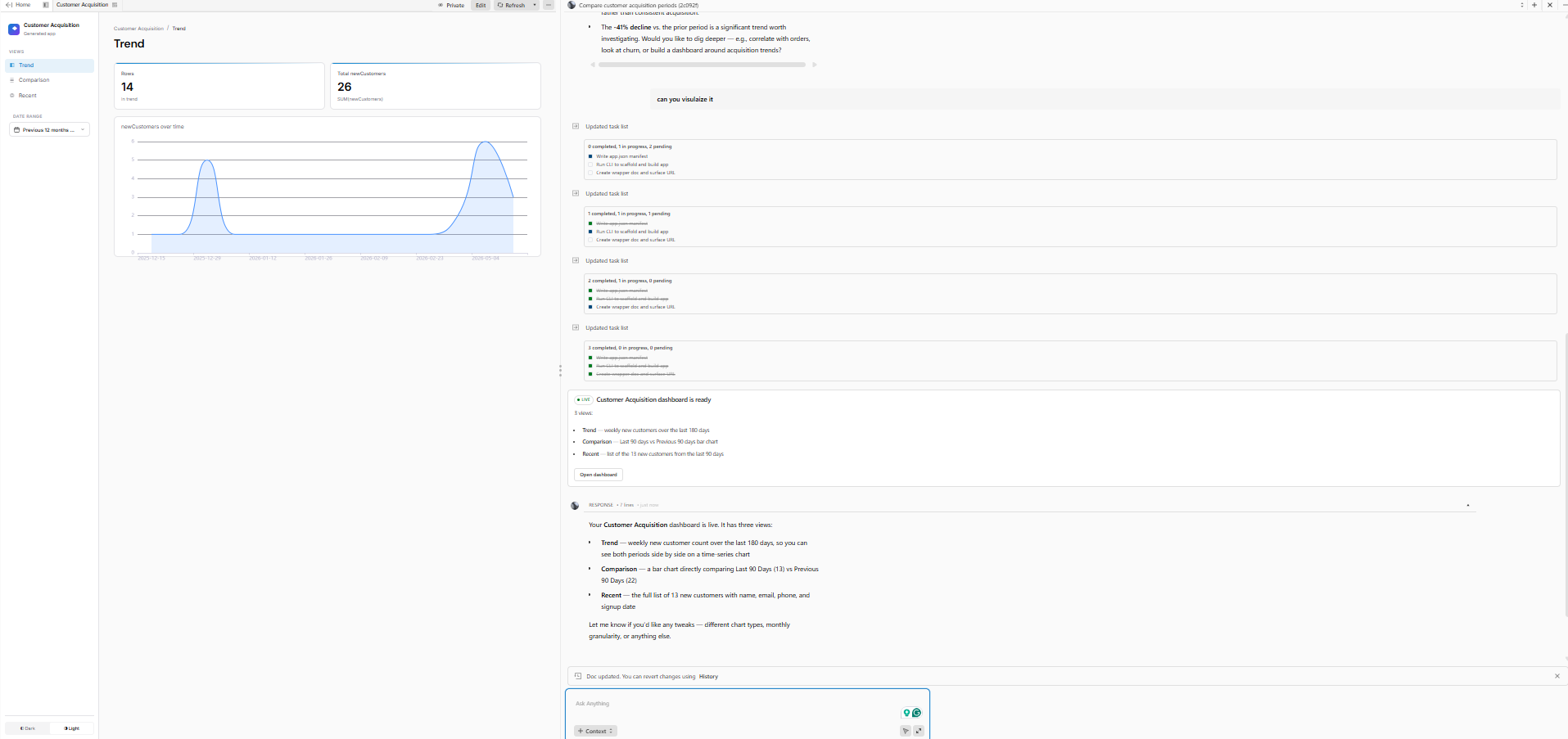
Definite created a separate dashboard for the customer acquisition result. The dashboard included: * Trend view * Comparison view * Recent customer list * KPI-style cards * visual chart area
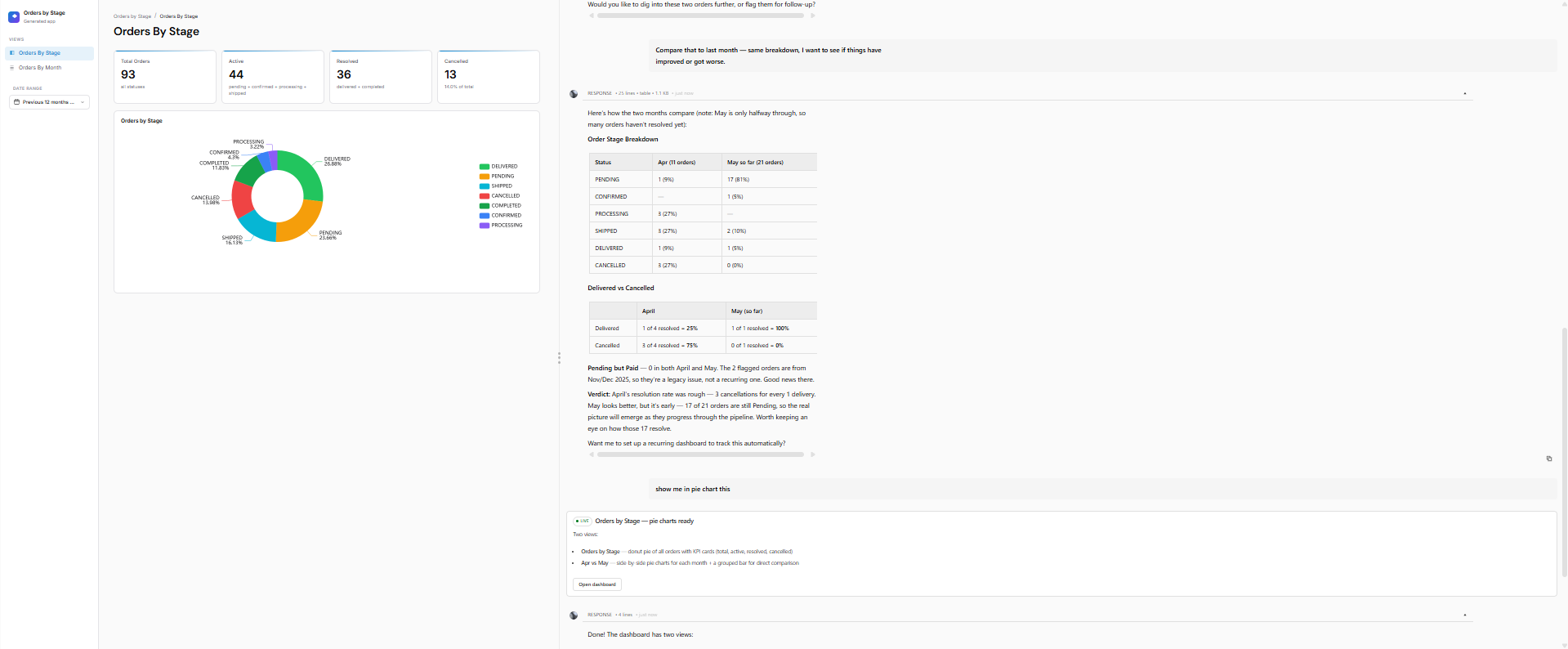
Definite created a separate order pipeline dashboard/doc. The dashboard included: * Orders By Stage * Orders By Month * KPI cards * donut/pie chart * comparison charts * date filter controls
Metric Assumption HandlingStrong — explains assumptions when a metric can be interpreted in more than one way.8.2/10▾
Feature tested: Metric Assumption Handling
Result: Passed (8.2/10)
Verdict: Strong — explains assumptions when a metric can be interpreted in more than one way.
Expected behavior: Definite can explain how it interprets business metrics and show caveats when the result depends on workflow assumptions.
Test case: Text prompt → Image
Input type: Text prompt
Input used: Input artifact (Text prompt): Input
Observed output: Output artifact (Image): Definite returned delivered vs cancelled percentages and separated the result into: * percentage of all orders * percentage of resolved-only orders It also — definite-metric-assumption-handling-1.png
Input artifact: Input artifact (Text prompt): Input
Output artifact: Output artifact (Image): Definite returned delivered vs cancelled percentages and separated the result into: * percentage of all orders * percentage of resolved-only orders It also — definite-metric-assumption-handling-1.png
What changed: Text prompt transformed into Image
Test case: Text prompt → Image
Input type: Text prompt
Input used: Input artifact (Text prompt): Input
Observed output: Output artifact (Image): Definite compared April vs May and added an important caveat that May was only halfway through, so the final picture may change. — definite-metric-assumption-handling-2.png
Input artifact: Input artifact (Text prompt): Input
Output artifact: Output artifact (Image): Definite compared April vs May and added an important caveat that May was only halfway through, so the final picture may change. — definite-metric-assumption-handling-2.png
What changed: Text prompt transformed into Image
Why it matters / Conclusion: This feature is useful for business users because Definite does not silently choose one interpretation. The artifact is worth checking because it shows both the metric output and the assumptions behind it.
Definite can explain how it interprets business metrics and show caveats when the result depends on workflow assumptions.
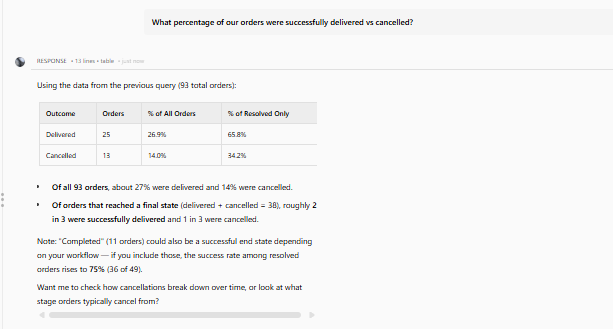
Definite returned delivered vs cancelled percentages and separated the result into: * percentage of all orders * percentage of resolved-only orders It also added a note that “Completed” orders could count as a successful end state depending on the workflow.
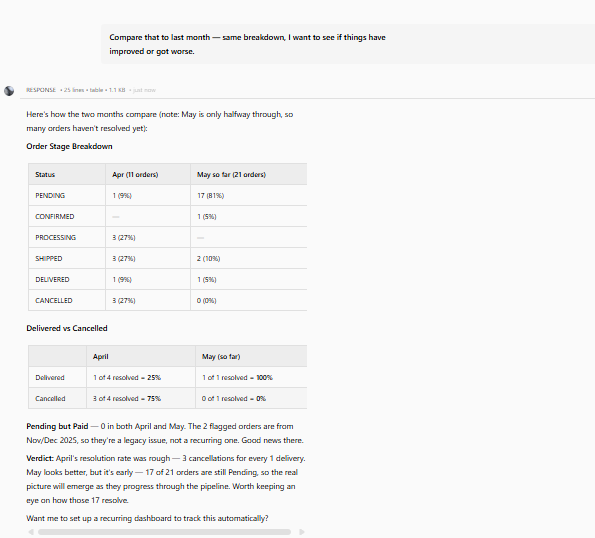
Definite compared April vs May and added an important caveat that May was only halfway through, so the final picture may change.
Pricing & Access
Plans as of June 2026
Testing was completed on Definite’s 14-day free trial. Paid plan limits, credit usage, connector access, and enterprise deployment options should be verified again before publishing.
Is This Right For You?
A side-by-side guide based on our hands-on testing.
Banner Preview
How the embed badge will look on your site

Embed HTML
Copy this code to your website source
Quick Integration Guide
- 1Copy the HTML code block above.
- 2Paste it into your site's HTML or CMS editor.
- 3Banner appears instantly on your page.
- 4Links back to your tool profile here.
Similar Tools
Discover more AI tools like Definite to enhance your workflow.
Comments (0)
Need a custom AI solution for this use case?
If you are looking to build a custom NL2SQL, dashboard generation, or AI analytics assistant for your business or internal workflow, email us at contact@futuresmart.ai.
Found something inaccurate or missing? We try to keep our AI research accurate and useful. If you found outdated information, an issue, or have a suggestion, email us at collaborate@aidemos.com.