CB
Chandresh Bisht
Verified Review
4 Tools Tested3 Live URLsMarkdown ExtractionStructured Data

Best AI Tools to Scrape Web Pages Into Clean Markdown or Structured Data

0
Tested: Skyvern vs Firecrawl vs Spider vs Jina AI Reader · 2026-06-16

We tested four AI web-scraping tools on three live targets—a cluttered recipe blog, a JS-heavy Nike product page, and a protected Glassdoor jobs page—to see which ones return usable Markdown or structured data with zero manual selectors.

How We Tested

Each tool was run zero-shot on the same three public URLs with no custom CSS selectors, no hardcoded waits, no cookies, and no target-specific tuning. The benchmark compared how well each tool stripped boilerplate from a noisy article page, waited for client-side rendering on a Nike product page, and got usable output from a protected Glassdoor jobs page. Important scope note: although the parent use case includes strict schema-driven JSON extraction, the research team explicitly omitted that separate stage from active testing, so these results mostly measure extraction quality, layout cleaning, hydration handling, and protected-page resilience rather than full schema-constrained JSON accuracy.

What We Evaluated
Label
Description
Noise Filtering
How well the tool isolated the main content on the Sally's Baking Addiction recipe page while removing menus, footers, social links, comments, and other boilerplate.
JS DOM Hydration
Whether the tool waited for Nike's client-side rendering and returned the product title, price, and full size list instead of placeholders or global site content.
Proxy Evasion
Whether the tool got usable output from Glassdoor despite Cloudflare-style defenses and sign-in overlays, and how much page noise remained in the result.

The Ranking

4 toolstested head-to-head on the same input. Each card shows the verdict and per-criterion scores. Click "Full breakdown" for the artifact-level evidence.

1
Best for clean extraction and structured outputs
Full breakdown ↓

Highest structural quality across the three live tests, especially on noisy and JS-heavy pages, with slower runs and some recording-sync fragility.

Proxy Evasion
5.0
Noise Filtering
9.0
JS DOM Hydration
8.0
2
FirecrawlUsable
Best raw capture layer for downstream LLM cleanup
Full breakdown ↓

Most reliable text capture on dynamic and protected pages, but its Markdown stayed noisy and usually needed a cleanup step afterward.

Proxy Evasion
8.0
Noise Filtering
4.0
JS DOM Hydration
7.0
3
SpiderNeeds work
Fast static scraper that struggles on modern sites
Full breakdown ↓

It preserved visible text accurately but fell short on boilerplate removal, JS hydration, and anti-bot handling.

Proxy Evasion
1.0
Noise Filtering
3.0
JS DOM Hydration
2.0
4
Low-friction URL reader with inconsistent real-world extraction
Full breakdown ↓

Too unreliable on this benchmark, with a broken first run, missed hydration on Nike, and conflicting evidence on Glassdoor.

Proxy Evasion
1.0
Noise Filtering
1.0
JS DOM Hydration
2.0
Full breakdown · Tool 1 of 4

SkyvernBest

Skyvern is a vision-based web agent that interprets pages spatially instead of flattening the DOM straight into text. In this benchmark, that approach produced the cleanest outputs and the strongest structured results.

What worked
  • Skyvern was the only tool that consistently behaved like an extraction agent instead of a raw page flattener. On the recipe page, it isolated only the requested content and skipped the sitewide navigation, ads, biographies, and long comment sections. On Nike, it reportedly captured the full hydrated size set in structured form rather than missing the dynamic inventory grid. On Glassdoor, the report credits it with returning organized job fields instead of noisy Markdown, giving it the best end-to-end output quality in the benchmark.
Where it struggled
  • Its tradeoff was speed and operational smoothness. The report repeatedly notes visual-validation overhead, and the Nike run's recorder froze even though the backend extraction succeeded, making troubleshooting harder. Glassdoor-style modal walls were also the biggest risk area for Skyvern's agentic approach, because visual interaction loops can add latency and create confusing evidence trails even when the final export is good.
What came out
Recipe result screenshot

The recipe-page result is described as an isolated structured block containing only the requested recipe fields, showing that Skyvern removed navigation, ads, author bio sections, and comment noise more effectively than any other tool in the test.

best-ai-tools-to-scrape-web-pages-into-clean-markd-skyvern1.pages

PAGES
Recipe export

The recipe export was reported to contain only recipe-relevant fields such as the title, author, ingredients, and steps, making it directly usable without a second cleanup pass.

Nike result screenshot

The Nike run evidence shows the visual recorder frozen on a loading view even though the report says the backend saved the complete product data, which highlights a debugging and sync problem rather than a failure to extract the hydrated page.

best-ai-tools-to-scrape-web-pages-into-clean-markd-skyvern2.pages

PAGES
Nike export

The Nike export was described as a clean structured record containing the product title, price, and complete dynamically rendered size list, which means Skyvern successfully waited for hydration.

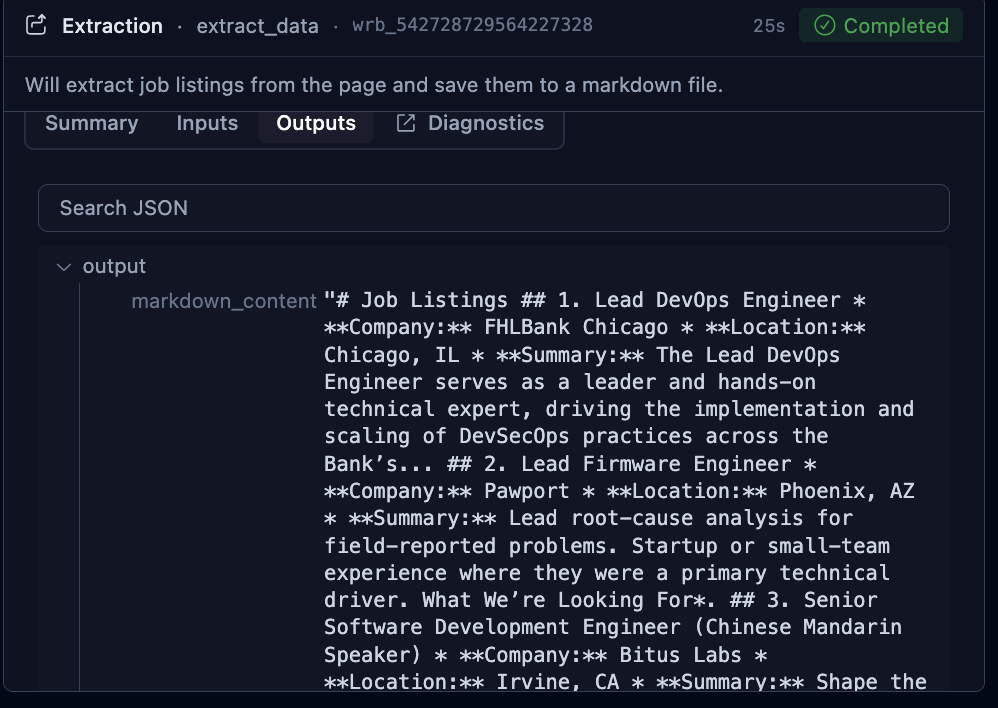
Glassdoor result screenshot

The Glassdoor evidence shows the agent dealing with a full-screen sign-in modal, illustrating the main risk with Skyvern's visual approach: it can handle UI friction, but modal-heavy pages add latency and make runs harder to verify visually.

best-ai-tools-to-scrape-web-pages-into-clean-markd-skyvern3.pages

PAGES
Glassdoor export

The Glassdoor export was described as a structured set of job fields such as titles, company names, and locations rather than a raw text dump, which is the main reason Skyvern finished first overall.

6 full renders · same input
Full breakdown · Tool 2 of 4

Firecrawl

Firecrawl is a high-speed DOM-to-Markdown extractor that performed well on rendering and anti-bot access, but it behaved more like a reliable raw capture layer than a semantic cleaner.

What worked
  • Firecrawl was the strongest non-visual option for actually getting data back from hard pages. It preserved the core recipe content accurately, successfully waited for Nike's client-side rendering and captured the full size list, and bypassed Glassdoor's perimeter defenses well enough to retrieve real job listings, company names, salary estimates, and skill arrays. If your pipeline already includes a downstream LLM cleaning step, that reliability makes Firecrawl useful.
Where it struggled
  • Its weakness was native cleanup. On every test, important content was mixed with large amounts of site furniture: navigation trees, footer text, social links, localization menus, tracking or framework strings, raw image references, search controls, and login prompts. That means the raw extraction was often usable only after a second pass to filter the noise out.
What came out
Recipe result screenshot

The recipe-page output includes the main cookie article but also a long run of navigation items and other sitewide text, showing that Firecrawl preserved content fidelity while failing to strip boilerplate.

best-ai-tools-to-scrape-web-pages-into-clean-markd-firecrawl1.pages

PAGES
Recipe export

The Sally's Baking Addiction export was described as containing the full article, ingredients, and directions alongside menus, social links, legal text, and large comment sections.

Nike result screenshot

The Nike output shows the product page mixed with framework artifacts such as %ESI_AUDIENCE_SEGMENTATION% and media references, evidence that Firecrawl waited for hydration but did not semantically clean the result.

best-ai-tools-to-scrape-web-pages-into-clean-markd-firecrawl2.pages

PAGES
Nike export

The Nike export was reported to include the $115 price and the full size range from M 5 / W 6.5 through M 18 / W 19.5, plus extensive localization and catalog clutter.

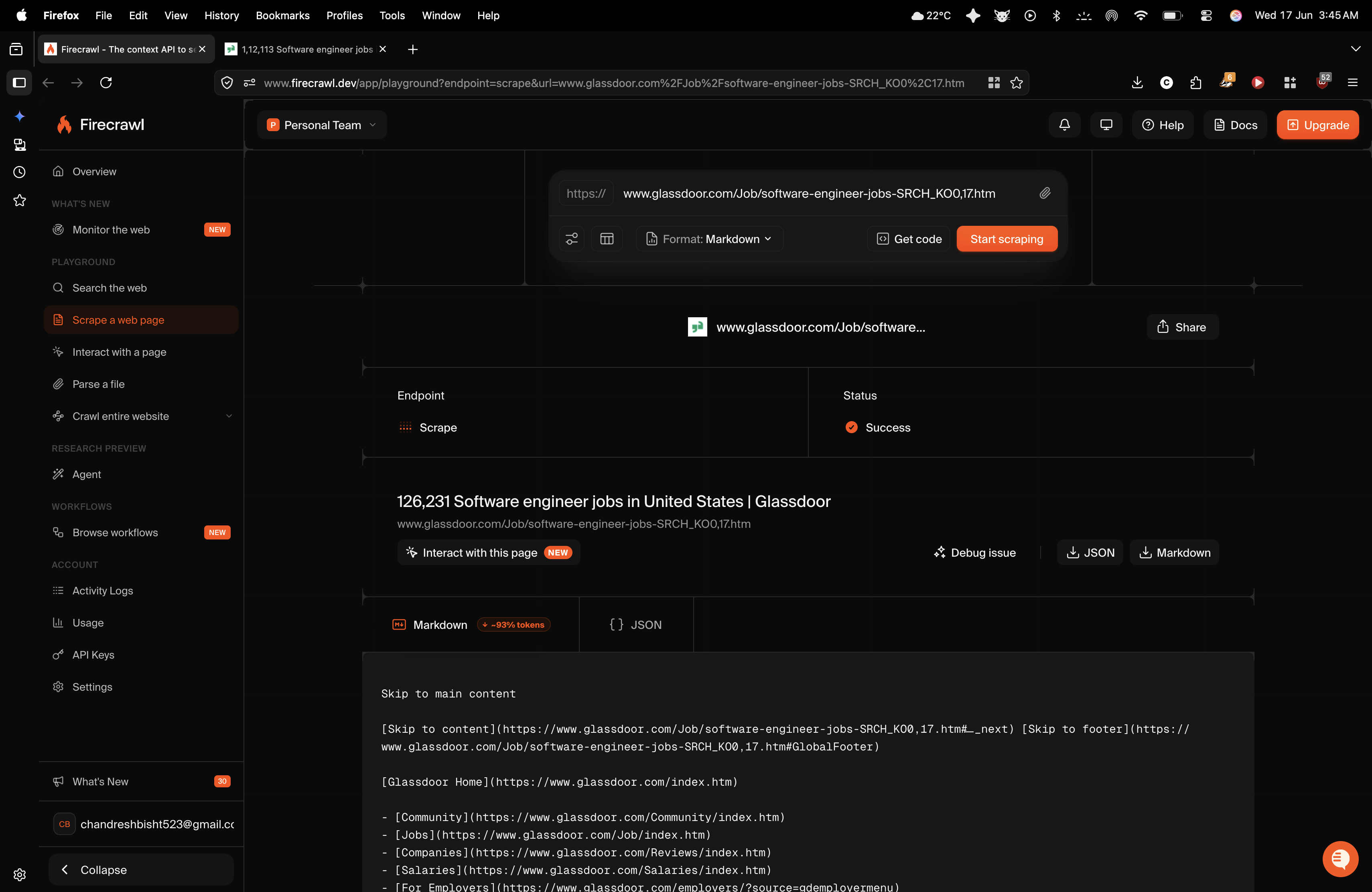
Glassdoor result screenshot

The Glassdoor output captures real job-listing text after getting past the edge defenses, but the listing data is interleaved with search controls, navigation text, and sign-in prompts.

best-ai-tools-to-scrape-web-pages-into-clean-markd-firecrawl3.pages

PAGES
Glassdoor export

The Glassdoor export was described as recovering active software-engineering jobs, company names, salary estimates, and skill arrays inside a noisy Markdown dump rather than a clean dataset.

6 full renders · same input
Full breakdown · Tool 3 of 4

Spider

Spider is a fast open-source scraper aimed at HTML and Markdown extraction, but in this benchmark it looked optimized for straightforward page flattening rather than resilient modern-page comprehension.

What worked
  • Spider did preserve visible text reasonably well on simpler content. On the recipe page, it kept the central ingredients and directions with good copy accuracy, and on Nike it still recovered the main heading, price, and some basic descriptive text. For low-complexity pages where downstream cleanup is acceptable, that raw capture may be enough.
Where it struggled
  • It fell short on the harder parts of the benchmark. Noise filtering remained poor on the recipe page, the Nike run missed the fully rendered size grid because it did not wait for client-side hydration, and the Glassdoor run failed outright at the anti-bot layer. That combination makes Spider hard to recommend for modern protected or highly dynamic sites without additional tooling.
What came out
Recipe result screenshot

The recipe-page output shows the article mixed with header links, social links, cookie notices, and other sitewide clutter, confirming weak noise removal despite accurate text capture.

best-ai-tools-to-scrape-web-pages-into-clean-markd-spider1.pages

PAGES
Recipe export

The recipe export was described as retaining the ingredients and directions accurately while also dumping large amounts of navigation and ancillary page text into the final Markdown.

Nike result screenshot

The Nike output shows the product heading and $115 price above an empty bullet stack where the size data should have been, which demonstrates that Spider missed the dynamically hydrated size selector.

best-ai-tools-to-scrape-web-pages-into-clean-markd-spider2.pages

PAGES
Nike export

The Nike export was reported to contain the product heading and some descriptive marketing text but not the critical size matrix, making the result incomplete for commerce extraction.

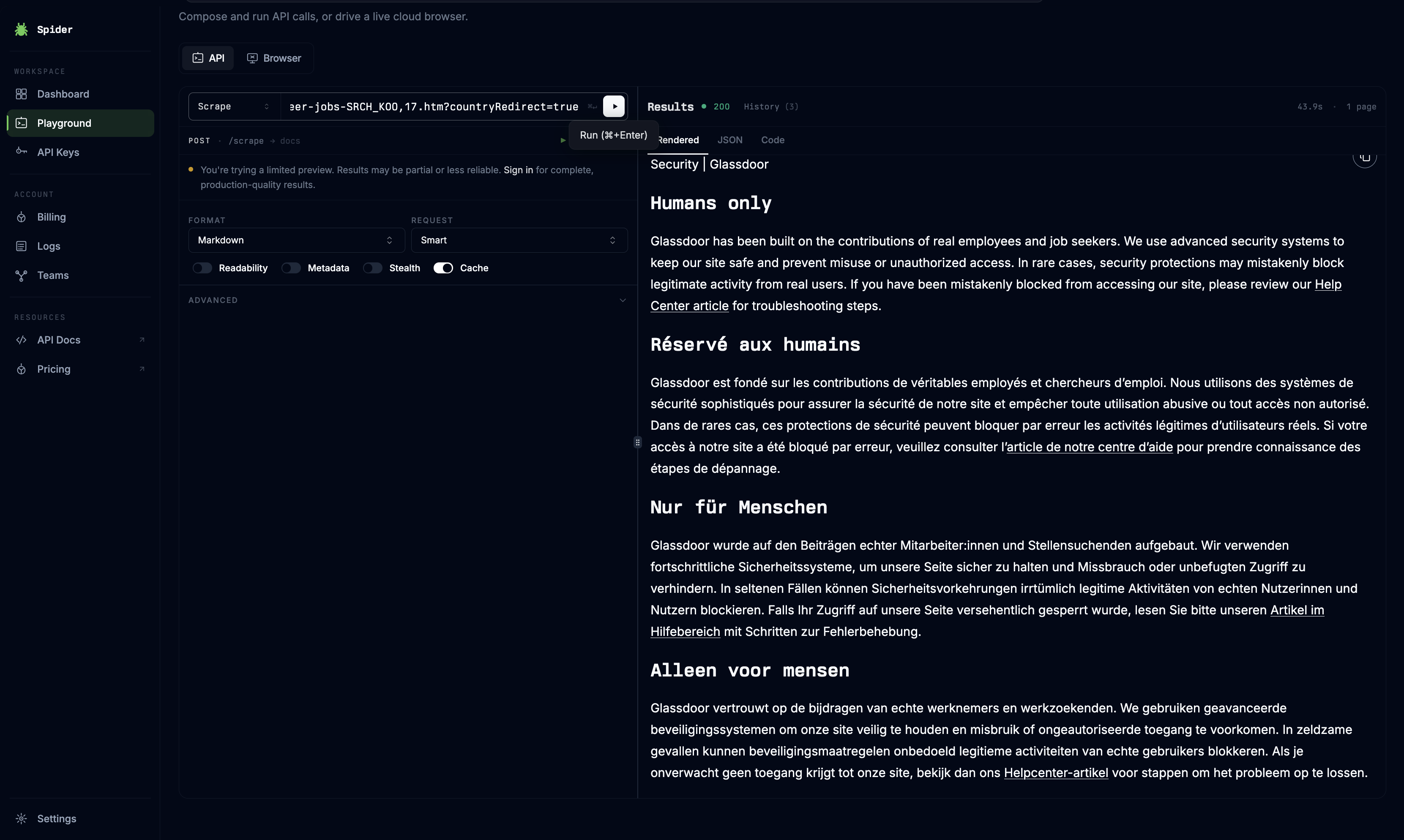
Glassdoor result screenshot

The Glassdoor evidence is a Cloudflare-style security barrier rather than job content, showing that Spider failed before it could produce any usable extraction.

best-ai-tools-to-scrape-web-pages-into-clean-markd-spider3.pages

PAGES
Glassdoor export

The Glassdoor export was described as containing only CAPTCHA or security-warning text instead of business data, so the protected-page test was effectively a hard failure.

6 full renders · same input
Full breakdown · Tool 4 of 4

Jina AI Reader

Jina AI Reader is a simple URL-to-text converter, but on this benchmark it was the least dependable option across the full set of real-world pages.

What worked
  • Jina did show flashes of usefulness on basic text recovery. It could preserve clean headings and some simple page markers, and on Nike it at least recovered the product title and static price. The per-tool report also claims that one Glassdoor run retrieved plain-text job markers, suggesting that Jina may work on some protected pages under favorable conditions.
Where it struggled
  • Overall, it was too inconsistent for this use case. The Sally's Baking Addiction run broke because of a URL-processing error, the Nike run failed to capture the dynamically rendered size grid, and the Glassdoor evidence is internally inconsistent across the research packet. Even when it recovered text, the output was described as a noisy raw dump that still needed heavy regex cleanup or a downstream LLM pass.
What came out
Recipe result screenshot

The recipe-page output shows a broken 404-style result caused by an address-routing error, so the first test did not produce usable source content at all.

best-ai-tools-to-scrape-web-pages-into-clean-markd-jina1.pages

PAGES
Recipe export

The recipe export was described as a fallback page with a 404 message and some surrounding layout text rather than the target recipe, making the result unusable for extraction.

Nike result screenshot

The Nike output shows a regional or corporate link directory instead of the product's size inventory, demonstrating that Jina missed the client-side hydrated portion of the page.

best-ai-tools-to-scrape-web-pages-into-clean-markd-jina2.pages

PAGES
Nike export

The Nike export was reported to preserve the top-level shoe heading and $115 price marker but miss the complete size selector, replacing the target data with global site navigation and country indexes.

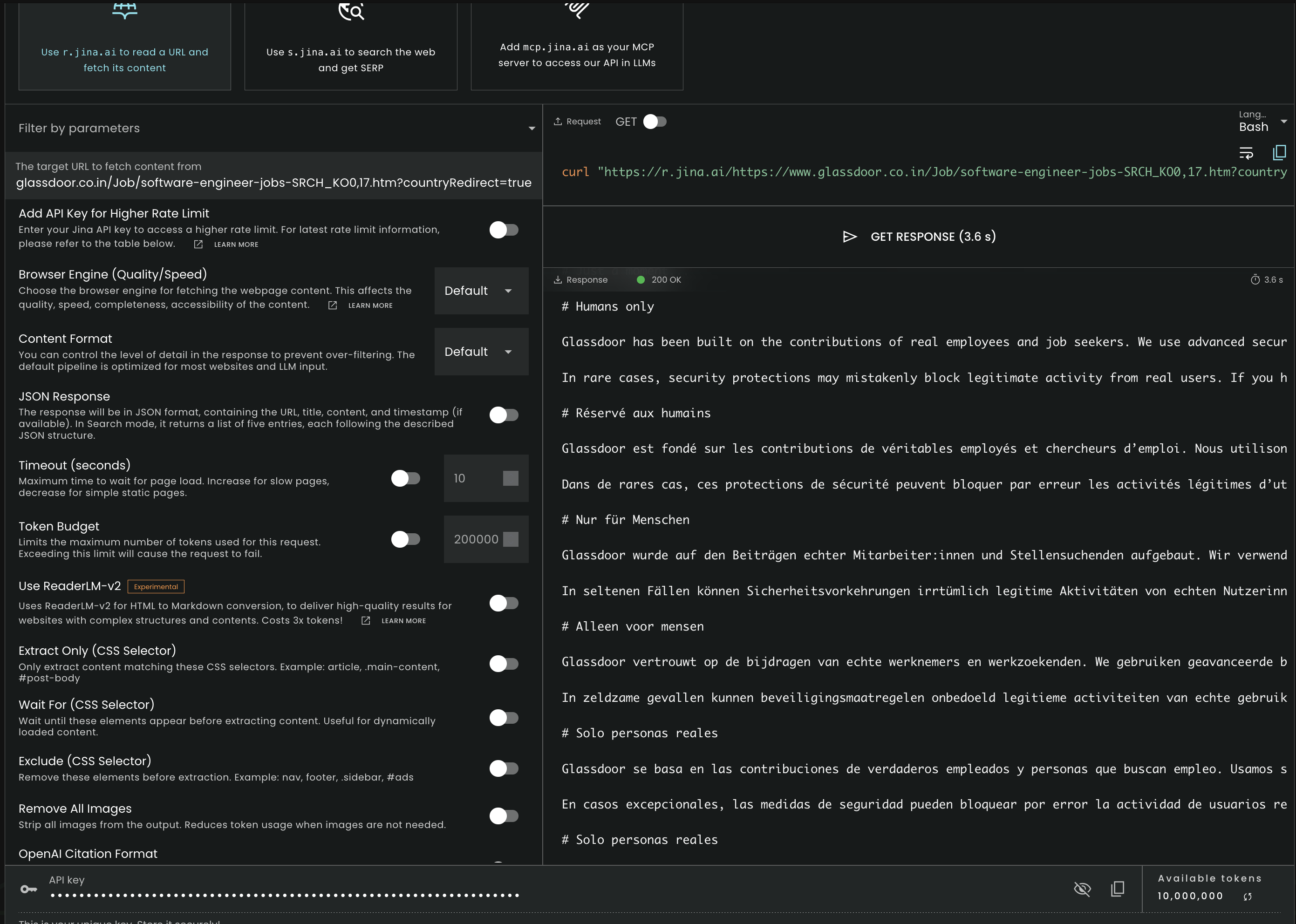
Glassdoor result screenshot

The cross-tool Glassdoor evidence shows a 'Humans only' 403-style response rather than usable listings, which conflicts with the per-tool report's claim of a noisy successful retrieval and is why this scenario needs re-verification.

best-ai-tools-to-scrape-web-pages-into-clean-markd-jina3.pages

PAGES
Glassdoor export

The per-tool Glassdoor export was described as recovering plain-text job markers mixed with sign-in alerts and header noise, but that claim conflicts with the separate 403-style screenshot in the research packet.

6 full renders · same input

Final Take

Skyvern is the best choice here if you want the cleanest output or structured data directly from messy live pages, especially when page layout understanding matters more than speed. Firecrawl is the best fallback for teams building large-scale pipelines that can tolerate noisy Markdown and clean it later with an LLM. Spider and Jina AI Reader both underperformed on modern JS-heavy or protected pages in this benchmark. The report's own closing recommendation is a hybrid: use a vision agent like Skyvern when UI interaction or modal handling matters, then pair it with a fast text flattener like Firecrawl when you need scalable downstream processing.

Tested as of 2026-06-16T00:00:00.000Z · Will be re-verified monthly
Built by FutureSmart AI — the team behind AI Demos

Need a custom AI solution for this use case?

If you are looking to build a custom web scraping, markdown extraction, or structured data extraction system for your business or internal workflow, email us at contact@futuresmart.ai.

Get a custom build

Found something inaccurate or missing? Email collaborate@aidemos.com to suggest a correction.

Comments (0)

Please Log in to join the discussion.