Accepts the best-customers question in plain English and returns a ranked answer without requiring SQL from the user.
What was measured
Plain English Query Handling
Can the tool understand business questions without SQL?
decisive for this rankingtransformation
This is the core of the ranking: the tool must understand a business question without the user writing SQL. (3 of 3 judges)
What was given, what came back
Test input: Best customers with unpaid-order and payment-method follow-ups · text · group: live-database-plain-english-queries
Input — what we sent
The exact prompt
Who are my best customers — the ones who order the most and spend the most?

Follow-up 1: For the top 3 from that list — do any of them have unpaid orders?

Follow-up 2: What payment methods do these top 3 usually use?
A conversational multi-table customer analysis with follow-up questions. It asks for the best customers by both order volume and spend, then drills into unpaid orders for the top 3 and their usual payment methods. Designed to test ranking logic, join-heavy analysis, and follow-up context retention.
Why this input is hard
- · ambiguous business term interpretation
- · multi-table joins
- · aggregation and ranking
- · follow-up context retention
- · scoping to a selected subset
- · payment behavior analysis
Output — unretouched
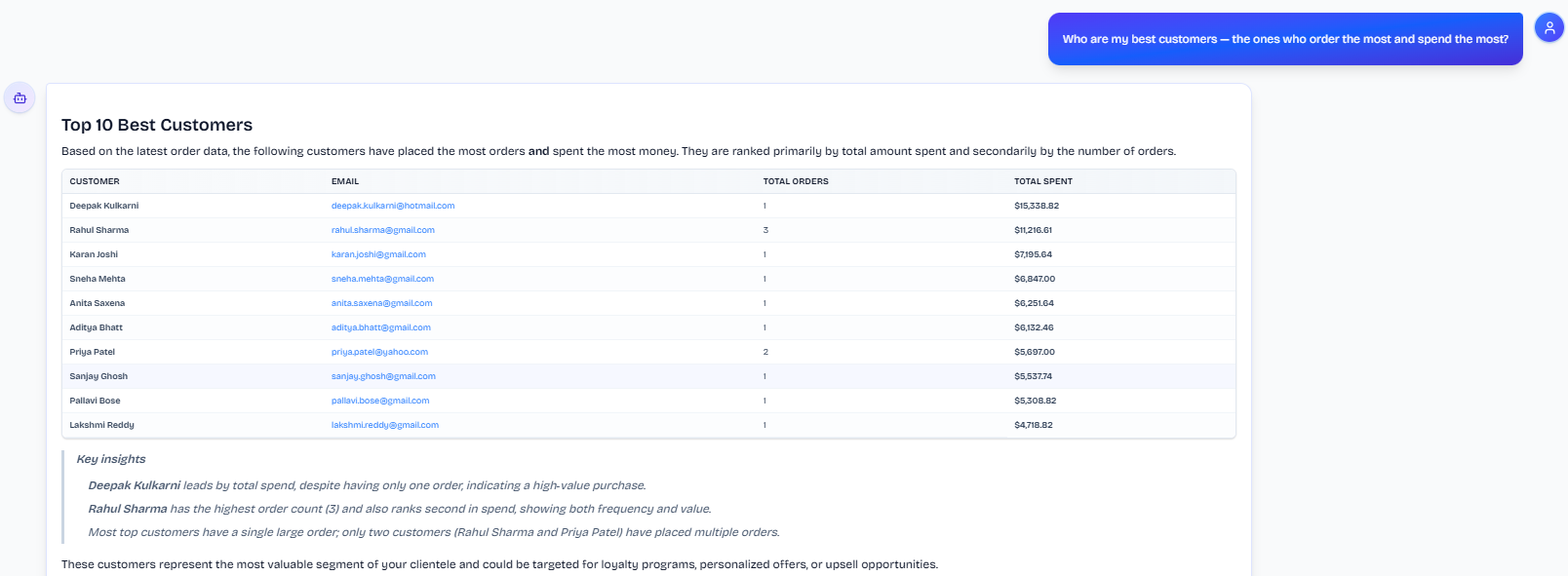
Also checked on this input — same tool, 6 other criteria
Ambiguity Handling◐ MixedIt states a ranking heuristic in prose, using spend as the primary sort and order count as a secondary sort, but it still leaves the no-status-filter assumption unstated and does not ask the user to clarify the two-dimensional wording.Business Insight✓ WorkedExplains the ranking in business terms by calling out the high-value customer, the highest-order-count customer, and a loyalty/upsell targeting opportunity.Business Insight◐ MixedThe payment-method follow-up gives a concise dominant-method insight for the top customers, but the result is incomplete as a business answer because it does not surface the full payment-method picture implied by the customer totals.Follow-Up Context✓ WorkedCarries the same top-3 customer trio forward into both follow-ups and reuses those same three customers in the later SQL filters.SQL Generation✓ WorkedGenerates a clean JOIN/GROUP BY/ORDER BY/LIMIT query for the top-customers ranking, showing the database-backed answer path is functioning on this turn.SQL Visibility✓ WorkedSurfaces the generated SQL in an Executed SQL panel with Copy Code, so the query can be inspected or copied directly.
Provenance
- Observation
- 56eb0ed0-bf0d-4077-9f04-bd1a290baeb9
- Evidence run
- af2abc96-3311-484b-a19d-854a2fdd2bf3
- Study
- Query Live Databases Using Plain English with AI
- Research task
- 86b9y6c99
- Tested at
- not recorded
- Source
- first-party
- Evidence state
- verified
- Proof shown
- input + output shown
- Cost / latency
- not captured
- Repeat run
- not captured
- Tester
- not captured
The last three rows are honest blanks, not placeholders — our capture has no field for them yet.
Query this
get_evidence({
  tool: "futuresmart-ai-database-agent",
  scenario: "live-database-plain-english-queries"
})
MCP · mcp.aidemos.com/api/mcp
Free with attribution.
Same input, same check — 5 other tools
measured on Plain English Query Handling
AskYourDatabase✓ WorkedIt can interpret informal ranking language like 'the ones who order the most and spend the most' and launch the analysis directly.Basedash✓ WorkedIt correctly handled a conversational, multi-part customer question without requiring SQL, producing two rankings plus follow-up answers.Definite◐ MixedIt accepted the natural-language request but only ranked customers by total spend, so it did not fully understand the combined 'order the most and spend the most' intent.Draxlr✓ WorkedIt accepted the informal best-customers request and both follow-up questions across the three-turn conversation.Querio✓ WorkedHandles an informal conversational request and splits 'order the most' and 'spend the most' into two separate ranking dimensions instead of guessing.
This evidence is published in
From the same study (page rebuilt from a later run)
Real inputs and real outputs, no retouching · every cell queryable via API & MCP · aidemos.com