Best AI Tools for Outreach Prospecting and Personalized Cold Email
We tested five AI outreach tools on the same core workflow: finding companies, locating real prospects, validating contact data, using browser-based enrichment, and generating outreach emails with shared business context.
How We Tested
The comparison used the same prospects, companies, and outreach context wherever each platform allowed it. Each tool was tested across company search, people search, employee discovery, company coverage validation, AI-assisted prospect discovery, browser-extension workflows, automation readiness, and AI email generation. The team kept outputs unchanged, compared tools on the same prospecting requests, and validated questionable company affiliations, workforce freshness, and contact signals against external context when possible.
The Ranking
5 toolstested head-to-head on the same input. Each card shows the verdict and per-criterion scores. Click "Full breakdown" for the artifact-level evidence.
Apollo delivered the most complete single-platform workflow across company discovery, contact research, browser enrichment, automation readiness, and email generation, with only moderate data-freshness caveats.
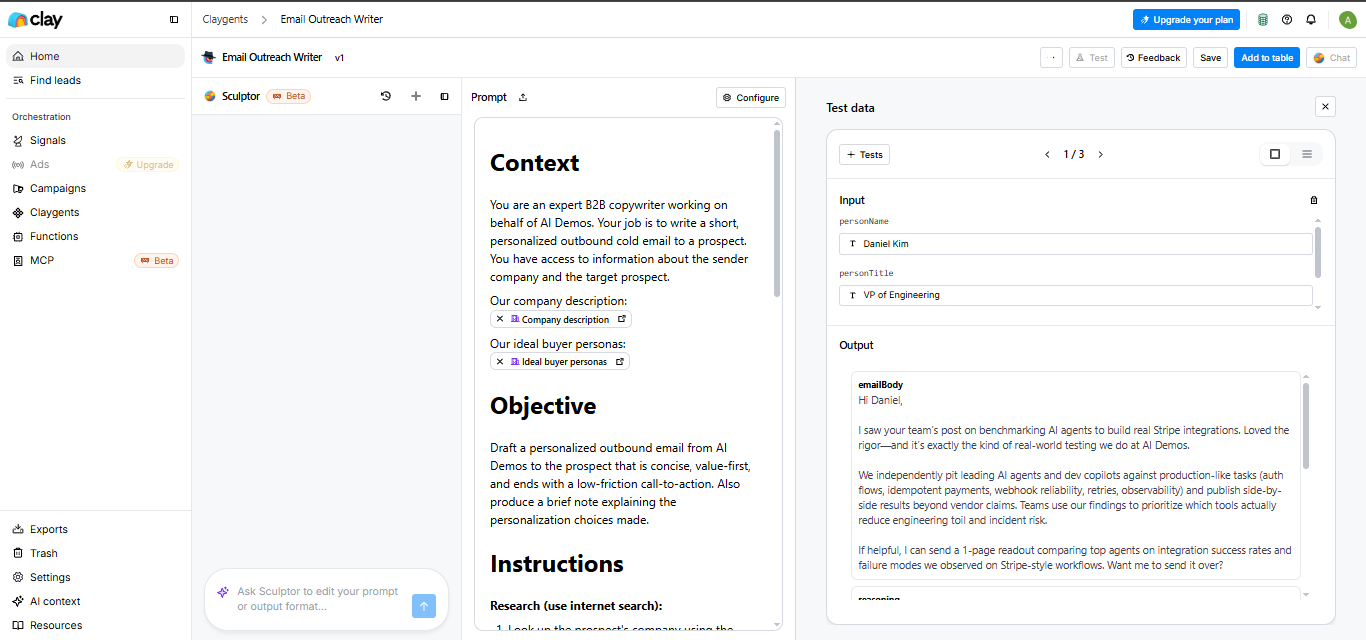
Clay required more setup and had a weak extension, but it stood out for workflow orchestration, research-driven enrichment, and the strongest personalized email writing.
Hunter was strong when the job was finding, verifying, and processing contact data at scale, but prospect coverage and LinkedIn workflows were less consistent than Apollo's.
Snov.io handled standard prospecting well and offered broad automation coverage, but workforce freshness, complex AI search precision, and email-personalization depth were only moderate.
Saleshandy was usable for company discovery, contact finding, and campaign-oriented workflows, but it lagged on extension-based enrichment, narrow AI prospecting, and deep personalization.

ApolloBest
Apollo was the strongest overall fit for this use case because it kept company discovery, people search, contact access, browser enrichment, and email drafting in one connected workflow. In testing, it reliably found target companies such as Vespa.ai, returned a validated record for Tytus Golas at Tidio with a work email, surfaced employee records inside company views, handled both LinkedIn-profile and company-website enrichment, and exposed dedicated search and enrichment APIs. Its weakest points were data freshness and template reliability: a surfaced Chapple-related employee record looked relevant at first but conflicted with supporting public-profile context, and template-based emails sometimes left variables unresolved.
- Apollo consistently found the tested companies and known prospects, kept people search and company research in one interface, surfaced employee records with usable context, and delivered the best browser-extension experience in the group. Its AI assistant handled focused requests well, its APIs clearly supported search and enrichment automation, and its assisted-personalization emails adapted meaningfully to recipient company context across Tidio and Vespa scenarios.
- Apollo still showed data-freshness risk. The Chapple validation flow showed that a prospect can look relevant in Apollo's company view while current public information raises doubts about present affiliation. Its more complex AI prospecting prompt returned a broad search rather than a finished shortlist, and its template-based email mode could leave personalization variables unresolved when supporting data was missing.

Apollo returned Vespa.ai as a direct company match from company search, showing that the platform could identify the target organization and move the user into a usable company record for downstream prospecting.

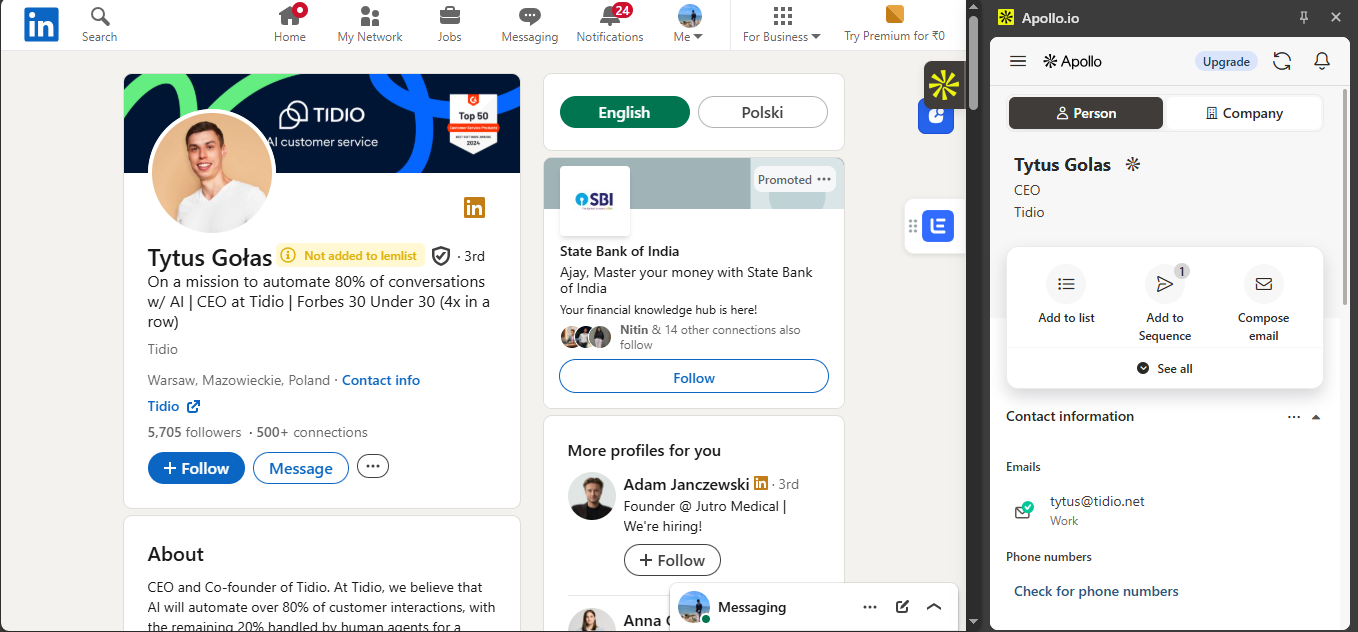
Apollo found Tytus Golas as CEO at Tidio and displayed a work email in the people results, which made the known-prospect test successful without needing a separate lookup workflow.

Apollo surfaced employee records inside the FutureSmart AI company profile, including Rugved Nichite with an email address, demonstrating that company-level research could flow directly into contact discovery.

Apollo surfaced Ann Chapple inside the Chapple company view, but this result needed validation because the test found that apparently relevant employee records were not always a reliable indicator of current affiliation.

Apollo's AI assistant translated a focused prompt into structured filters and returned 593 HubSpot decision makers, showing that simple natural-language prospecting requests could be converted into an immediately usable search.

For the more complex request to find AI startups in customer support automation, Apollo generated filters and a large company list, but it broadened the task into a wide search that still required manual review and prioritization.

Apollo's browser extension recognized Tytus Golas directly on LinkedIn and surfaced contact information, including a work email, reducing the need to switch back into the main platform during prospect research.

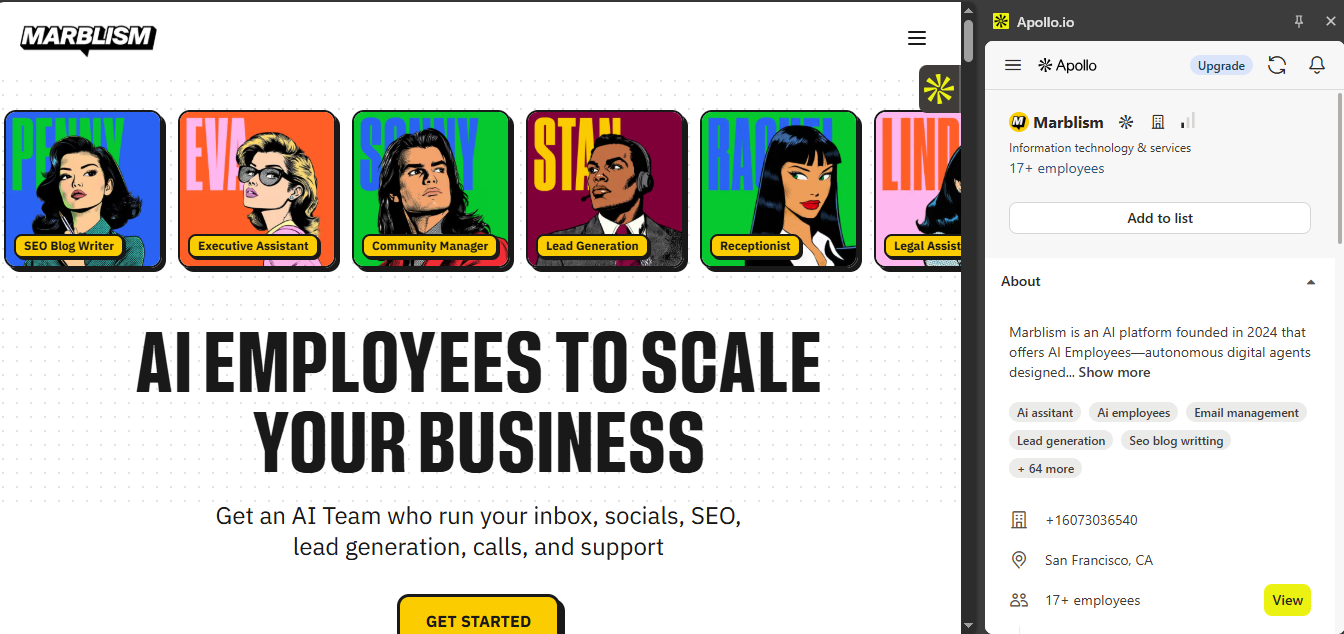
Apollo identified Marblism from its website and displayed company-level enrichment such as industry, employee count, location, keywords, and business summary while the user stayed on the site.

Apollo exposed dedicated Enrichment API and Search API entry points, supporting programmatic company and contact workflows rather than forcing prospecting to stay inside the UI.

Apollo's template-driven email closely mirrored the original sequence template and left at least one variable unresolved, showing that this mode was fast but still needed review before sending.

Apollo's prompt-based generator adapted the outreach message to Tidio's support-tool context, producing a more custom message than the template-only workflow.

Apollo generated a different outreach angle for Jon Bratseth at Vespa that referenced RAG and benchmark positioning, showing that prompt mode could shift company-level messaging across recipients.

Apollo's assisted-personalization mode used research options and company context to write a stronger AI-support benchmarking pitch for Tidio than its simpler template mode produced.

Apollo personalized the email for Vespa around search infrastructure and benchmarking themes, confirming that assisted mode produced the best Apollo email variant in this evaluation.
Clay
Clay was less convenient than Apollo for quick in-browser prospecting, but it was one of the most powerful systems once workflow setup and enrichment were part of the job. It found Vespa.ai and Tytus Golas successfully, enriched employee records with contact-related data, and went beyond simple search with a prospecting agent that combined company research, ICP matching, and contact recommendation in one structured output. Its email writer produced the deepest personalization in the test set. The tradeoff was usability: contact details often required extra enrichment steps, the Chrome extension was weak for prospect research, and AI-generated search criteria still needed manual review.
- Clay was excellent when the workflow included enrichment, custom logic, and agent-style research. It found core companies and prospects reliably, offered rich filtering, supported structured qualification workflows through its prospect agent, and produced the most deeply personalized email outputs in the evaluation.
- Clay was not the easiest tool for fast prospecting. Contact data often required extra enrichment steps, AI-assisted discovery still broadened niche requests, and the extension was poor for direct prospect research: LinkedIn was unsupported and company-website browsing did not surface usable prospect intelligence.

Clay found Vespa.ai from a domain-based company search and returned company attributes such as industry, size, type, location, and LinkedIn information, showing strong company discovery depth.

Clay identified Tytus Golas and surfaced job title, company, location, and LinkedIn information, making the known-prospect test successful even before deeper enrichment steps.

Clay's enrichment workflow added contact-related details and validation signals to a surfaced employee record, demonstrating that prospect data could be strengthened after initial search rather than appearing fully formed in the first result view.

Clay's prospecting agent combined company research, ICP evaluation, and prospect recommendation into one structured workflow, which was more automated and reasoning-heavy than a standard search screen.

Clay surfaced employees across multiple functions within FutureSmart AI, and the validation notes indicated that many matched current workforce information even though coverage was not perfectly complete.

Clay turned the natural-language customer-support-automation request into structured search criteria, but the resulting company list still depended heavily on whether the generated filters captured the intended niche accurately.

Clay also generated filters for a broader AI video-editing startup search, illustrating that its AI assistant was useful for building searches quickly even when the final company list still needed refinement.

Clay's extension was not supported on LinkedIn profile pages in this test, so users could not capture or enrich prospects directly while browsing LinkedIn.

On the Marblism website, Clay could extract webpage content but did not surface company intelligence, employee records, or contact details useful for immediate prospecting.

Clay emphasized webhooks, HTTP actions, and third-party automation tools, with limited People and Company API access for enterprise users, reinforcing that Clay is more orchestration layer than traditional public-data API.

Clay's outreach writer assembled email content from workflow research and contextual fields instead of relying only on mail-merge variables, which is why its emails felt more research-driven than template-led.

Clay generated a personalized email for Tytus using prospect and company context gathered in the workflow, showing stronger prospect-specific tailoring than the more template-consistent tools.

Clay also personalized outreach for a different recipient with contextual variation, supporting the report's conclusion that Clay showed the strongest multi-recipient personalization depth.
Hunter
Hunter was strongest when the core need was email discovery, verification, and bulk processing rather than all-in-one prospect research. It found companies through both Discover and Finder, returned a high-confidence email for Ajay Vekhande, surfaced employee records with role and validity indicators, and exposed bulk workflows for domain search, email finding, and verification. It also had solid API support. The main issue was inconsistency: one known-prospect search for Tytus Golas returned nothing, different workflows returned different contacts for the same company, and the LinkedIn extension no longer enriched profiles in place.
- Hunter did a good job on direct email finding, domain-based discovery, bulk workflows, verification, and API accessibility. When the input matched Hunter's available data, it could return actionable contacts with confidence signals and make large-scale cleanup or discovery much faster.
- Hunter was less consistent than Apollo or Clay on known-prospect coverage. Tytus Golas was not found through Email Finder, company coverage varied by organization, and different internal workflows exposed different contacts for the same company. Its LinkedIn extension was effectively unavailable for in-profile enrichment, and its email-writing outputs stayed fairly template-like across scenarios.

Hunter's Discover workflow found Vespa.ai and exposed 11 people results grouped by department, showing that company search could lead directly into contact discovery.

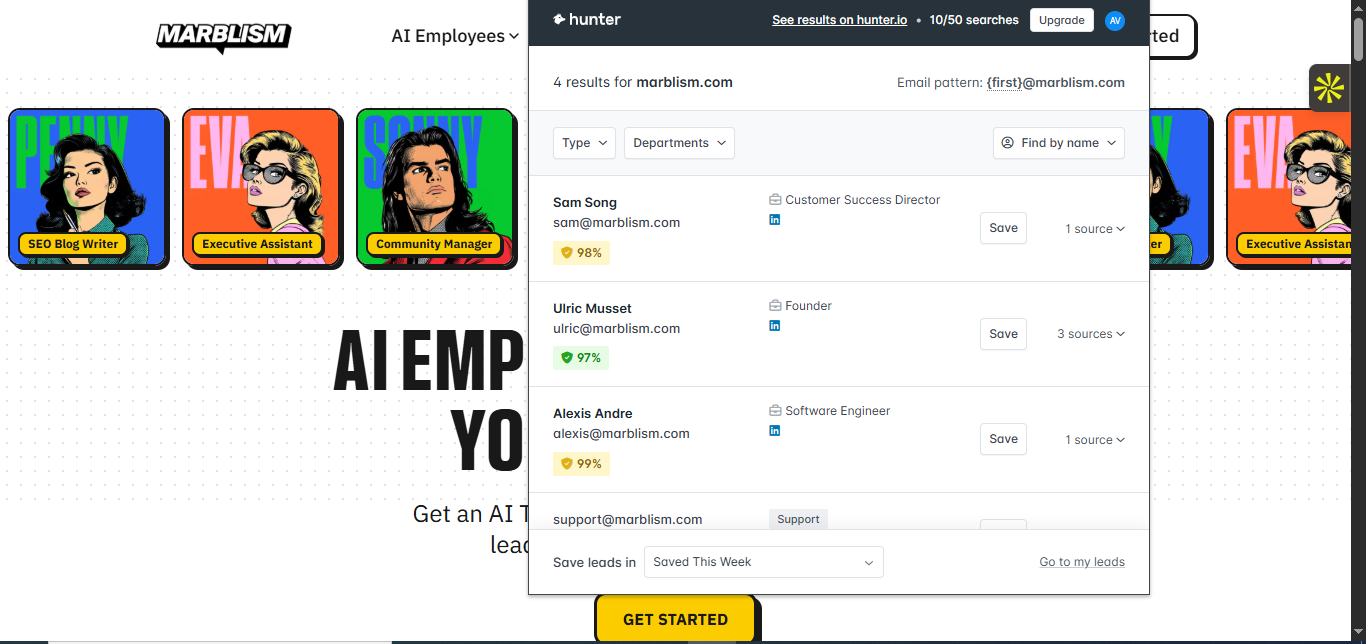
Hunter's Domain Search found Marblism and displayed four matching contacts with decision-maker and department breakdowns, giving users another entry point into company-level prospecting.

Hunter's Email Finder returned ajay.vekhande@futuresmart.ai with 98% confidence and a job title, demonstrating that the tool could produce a strong direct-match email result when data was available.

Hunter failed to find an email for Tytus Golas at tidio.com and explicitly said it did not have enough data for the domain, making the known-prospect test inconsistent.

Hunter surfaced employee records for FutureSmart AI with contact details and validity indicators, but one returned contact was marked invalid even though validation later suggested the address itself was usable, so those indicators could not be treated as ground truth.

Hunter's direct Email Finder found pradip@futuresmart.ai with 96% confidence and a verified status, showing that a person-first workflow could reveal contact data not obvious from the company view.

Hunter's company employee discovery view returned a different slice of contact data for the same organization, which is why the report concluded users may need multiple workflows to maximize coverage.

Hunter returned employee and email data for FutureSmart AI, confirming that its company coverage could be useful when the organization existed clearly in Hunter's database.

Hunter returned a Tidio company profile without any email results, showing that employee coverage varied sharply by company even when the organization itself was identifiable.

Hunter exposed bulk Domain Search, Email Finder, and Email Verifier workflows, supporting high-volume prospecting and cleanup use cases beyond one-off lookups.

Hunter's bulk verification produced both summary-level and record-level outcomes, including a case where 90% of the uploaded emails were marked invalid, which made quality review scalable.

Hunter translated the focused HubSpot decision-maker prompt into a relevant company-and-contact search with a decision-maker subset, showing solid performance on narrow prospecting requests.

For the more complex AI-startups prompt, Hunter returned a very broad company set rather than a tight list of ten relevant startups, so manual filtering was still required.

Hunter's browser extension showed a message that it was no longer available on LinkedIn and redirected the user toward Email Finder instead of enriching the profile in place.

On the Marblism website, Hunter surfaced named contacts, email addresses, job titles, confidence scores, and the company's email pattern directly inside the extension, making website-based prospecting efficient.

Hunter displayed direct API endpoints for Discover, Domain Search, and Email Finder, making its automation surface clear and easy to operationalize.

Hunter generated a complete cold email draft from structured inputs such as audience, problem, solution, and value proposition, which made first-draft generation fast.

A second Hunter draft used a very similar structure and messaging pattern despite a different scenario, showing that the assistant produced relevant copy but not especially deep personalization.
Snov.io
Snov.io offered a balanced prospecting stack with solid company search, workable people and employee discovery, strong API coverage, and a browser extension that supported lightweight prospect collection. It found Tidio in company search, returned a usable record for Rugved Nichite, surfaced multiple FutureSmart AI prospects, and supported both AI-assisted search and AI email generation. But its limitations were visible in three places: a known search for Tytus Golas returned no result, workforce coverage for FutureSmart AI was incomplete and included outdated records, and its generated emails changed less across recipients than the best performers.
- Snov.io covered the basics well: it found companies, surfaced employee records, supported both website and LinkedIn-adjacent collection workflows, and exposed one of the broadest automation surfaces in the group through API and webhook support. For standard prospecting tasks, it was a practical and fairly complete tool.
- Snov.io was less dependable when precision mattered. The known-prospect test for Tytus Golas failed, company workforce coverage was incomplete and not always current, complex AI prospecting requests broadened beyond the niche, and AI email outputs reused a largely stable structure across recipients. Its LinkedIn extension was useful mainly for collection, not rich in-profile enrichment.

Snov.io found Tidio and returned a company record with location, industry, size, and revenue band, giving users enough firmographic context to start prospecting.

Snov.io located Rugved Nichite and tied the record to FutureSmart AI, which showed that the platform could return person-level results with enough context to judge whether the match was relevant.

Snov.io returned no prospect for Tytus Golas, even though the same known prospect was found in other tools, confirming that person coverage was inconsistent.

Snov.io surfaced an employee record for FutureSmart AI with an email address and save status, proving that the platform could move from company context into actionable prospect records.

Snov.io listed 20 prospects for FutureSmart AI with positions, emails, LinkedIn links, and partially locked records, but the validation notes found that some current team members were missing and some surfaced records appeared outdated.

Snov.io handled the focused HubSpot decision-maker request reasonably well by applying management-level filters and returning a large contact set tied to the target company.

Snov.io broadened the customer-support-automation startup request into a much larger prospect pool that was not consistently aligned with the intended niche, so extra review was necessary.

Snov.io's LinkedIn extension supported lightweight profile capture during browsing, but the workflow was limited to basic prospect collection rather than full in-profile enrichment or immediate contact reveal.

Snov.io's website extension surfaced associated employee records from the Marblism site, allowing users to collect prospects without switching back into the main app.

Snov.io's email generator accepted structured product, ICP, and selling-point inputs, which let the team standardize context across multiple recipient tests.

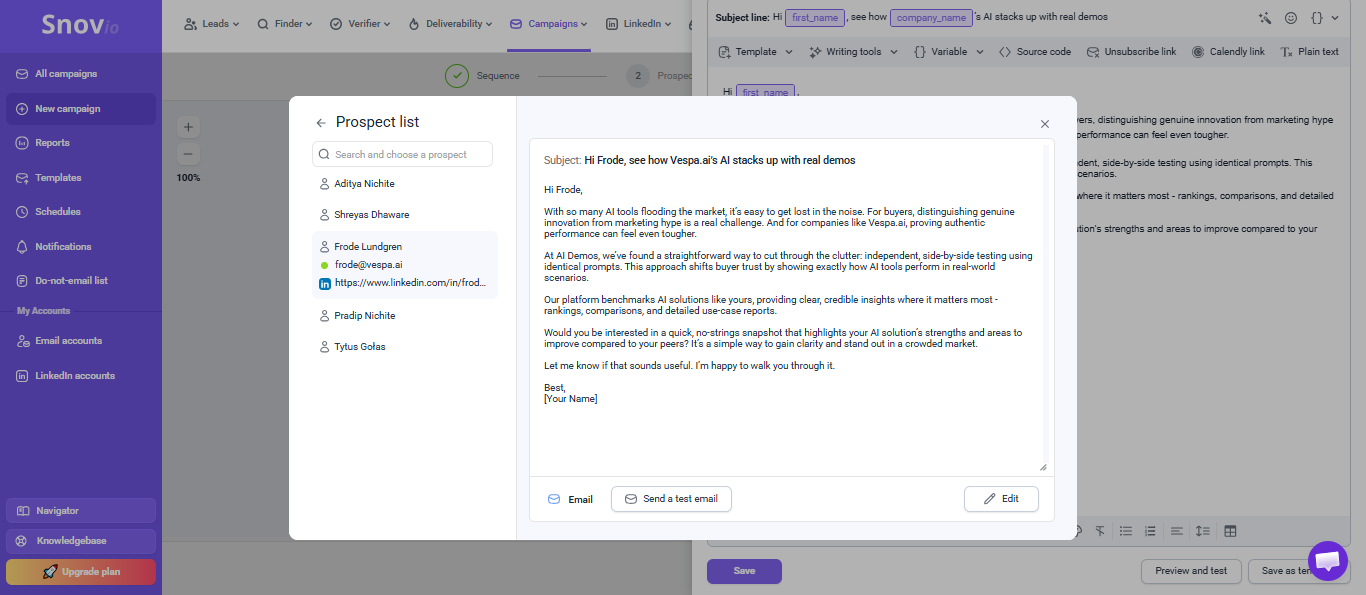
Snov.io produced a relevant outreach email for Frode Lundgren that referenced recipient and company context, showing that the generator could personalize at least at a surface level.

Snov.io also generated a Tytus-specific email, but the report found that the overall structure and value proposition stayed largely the same across recipients, limiting personalization depth.
Saleshandy
Saleshandy combined lead finding and outreach sequencing well enough to be a practical all-in-one option, but it was the weakest of the five for enrichment depth and extension-based research. It found Tidio in company search, returned validated contact information for a FutureSmart AI prospect, and showed that LinkedIn URL lookup could recover a target prospect even when name search failed. It also offered broad API coverage. The tradeoff was that its AI assistant struggled with highly specific prospecting requests, its extension focused on calling instead of enrichment, and its email personalization stayed fairly template-driven.
- Saleshandy was effective at basic company discovery, could return actionable contact information, and had a helpful fallback where LinkedIn URL search found a prospect that name search missed. Its API coverage was broad enough for prospecting and outreach automation, and the sequence-focused workflow made first-draft email generation easy.
- Saleshandy's prospect data was less robust than the top tools. Name-based lookup was inconsistent, workforce freshness still needed validation, the AI assistant struggled with the narrow customer-support-automation scenario, the Chrome extension did not meaningfully support prospect enrichment, and email outputs remained fairly template-like.

Saleshandy returned Tidio with useful firmographic details such as industry, location, company type, founding year, and B2B classification, making company discovery straightforward.

Saleshandy surfaced prospect records with company, job, and department data in people search, proving the interface could return workable lead candidates even though coverage varied by individual.

Saleshandy surfaced a FutureSmart AI prospect with company affiliation, role, department, and a work email, and the research notes state that the tested validated prospect's email matched the intended individual.

Saleshandy's direct name search did not return Tytus Golas, showing that the tool could miss known prospects in standard lookup mode.

Using the LinkedIn profile URL instead of a name search, Saleshandy successfully identified the correct prospect and surfaced contact details, which made lookup method a meaningful variable in results quality.

Saleshandy listed 27 employee records across departments for FutureSmart AI, but validation found that some profiles looked outdated while some current team members were absent.

Saleshandy's AI assistant did not directly satisfy the request for ten AI startups in customer support automation and instead suggested broadening the criteria, which weakened its performance on tightly defined prospecting tasks.

Saleshandy handled a broader video-editing startup request better by generating usable search filters, though it still returned a larger result set than the prompt requested.

Saleshandy's extension exposed calling-oriented functionality rather than prospect enrichment on the LinkedIn profile, so it added little value for research-heavy workflows.

Saleshandy's AI sequence workflow accepted company and campaign context in a structured setup, making it easy to configure first-draft outreach generation.

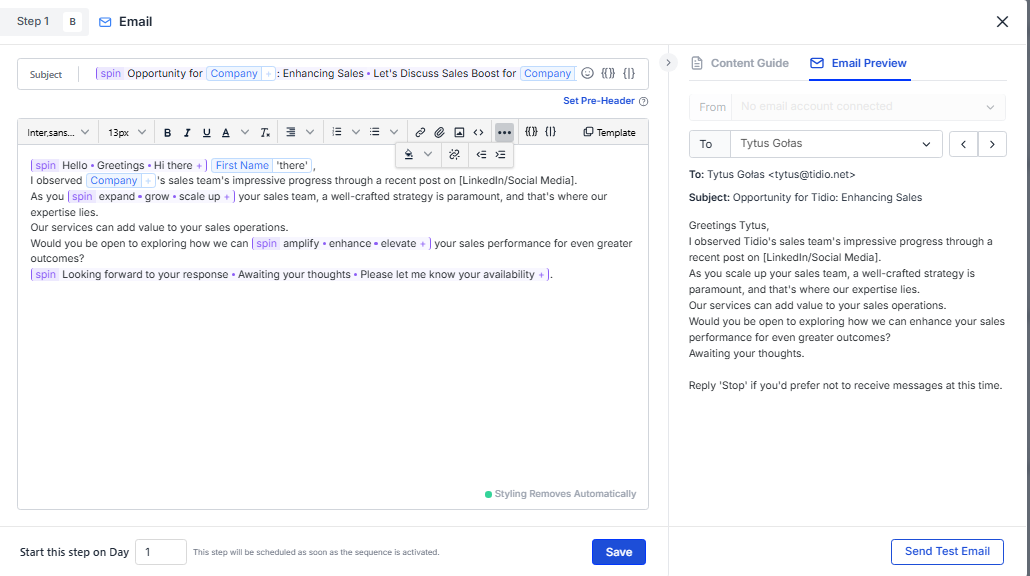
Saleshandy generated a usable outreach draft with inserted personalization variables, but the report found that the overall message structure and value proposition changed little across recipients.
Final Take
Apollo is the safest default if you want one platform that can find companies, identify contacts, enrich prospects in-browser, support automation, and draft outreach without forcing you into separate systems. Choose Clay if your priority is custom enrichment workflows, agent-like prospect qualification, and the deepest personalized email generation, and you are willing to accept more setup. Hunter is a strong pick for teams centered on email discovery, verification, and bulk operations. Snov.io is a solid balanced option with strong API coverage but more moderate precision and freshness. Saleshandy is serviceable for sequencing-led outbound teams, especially when LinkedIn URL lookup fits the workflow, but it offers lighter enrichment and weaker research tooling than the top-ranked options.