
Voiceflow
Best-in-test website chatbot for policy-heavy knowledge bases, with strong follow-up memory and complex rule handling.
Strongest overall performer in this knowledge-base chatbot test
- You need a website chatbot for policy-heavy support content where users ask a direct question and then follow up conversationally.
- You need the bot to combine multiple policy layers, such as membership tier, shipping region, product status, and warranty rules, inside one answer.
- You want a more human support tone; the researcher repeatedly called out Voiceflow's empathy and proactive guidance.
- You rely on quick-reply buttons as a core part of the user journey; they failed at the end of the complex session.
Our take
Voiceflow was the top performer in this comparison. Across simple, medium, and complex support-policy questions, it was repeatedly described as accurate, fast, context-aware, and unusually good at proactively surfacing useful details the user did not explicitly ask for. Its standout strength was handling layered follow-ups without losing context, especially on the international Premium-member scenario. The main issue found here was not retrieval quality but interaction reliability: quick-reply buttons failed at the end of the complex session.
In-Depth Review
Our detailed analysis of Voiceflow — features, performance, and real-world testing.
Feature-by-Feature Breakdown
Knowledge-grounded policy retrievalStrong on direct support-policy retrieval, with some missing operational edge details.▾
Feature tested: Knowledge-grounded policy retrieval
Result: Passed
Verdict: Strong on direct support-policy retrieval, with some missing operational edge details.
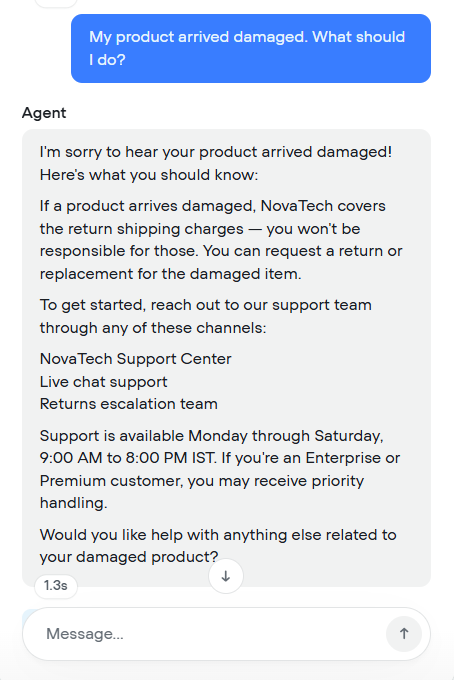
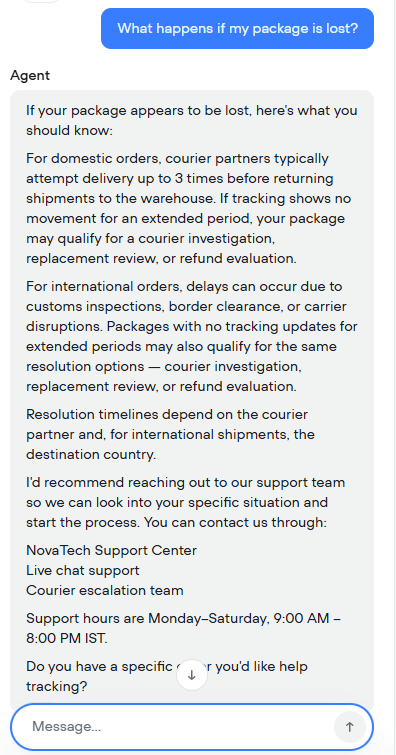
Expected behavior: Voiceflow retrieved and structured policy answers for straightforward website-support questions from the knowledge base. In testing, this covered a damaged-product question and a lost-shipment question, where it returned next steps, support channels, and policy outcomes rather than generic chatbot filler.
Test case: Text prompt → Image
Input type: Text prompt
Input used: Input artifact (Text prompt): Damaged product question
Observed output: Output artifact (Image): Observed answer — voiceflow-input1-damaged-product-step1-ingestion.png
Input artifact: Input artifact (Text prompt): Damaged product question
Output artifact: Output artifact (Image): Observed answer — voiceflow-input1-damaged-product-step1-ingestion.png
What changed: Text prompt transformed into Image
Test case: Text prompt → Image
Input type: Text prompt
Input used: Input artifact (Text prompt): Lost shipment question
Observed output: Output artifact (Image): Observed answer — voiceflow-input2-lost-shipment-step1-initial-response.png
Input artifact: Input artifact (Text prompt): Lost shipment question
Output artifact: Output artifact (Image): Observed answer — voiceflow-input2-lost-shipment-step1-initial-response.png
What changed: Text prompt transformed into Image
Why it matters / Conclusion: For direct factual policy questions, Voiceflow behaved like a grounded support bot rather than a generic LLM, but it did not always cover every operational detail.
Voiceflow retrieved and structured policy answers for straightforward website-support questions from the knowledge base. In testing, this covered a damaged-product question and a lost-shipment question, where it returned next steps, support channels, and policy outcomes rather than generic chatbot filler.
Context-aware follow-up answersExcellent conversation memory; some follow-ups were handled cautiously rather than with a precise threshold.▾
Feature tested: Context-aware follow-up answers
Result: Passed
Verdict: Excellent conversation memory; some follow-ups were handled cautiously rather than with a precise threshold.
Expected behavior: Voiceflow kept prior context across follow-up questions instead of resetting the conversation. This was tested by asking follow-ups after both a damaged-product query and a lost-shipment query.
Test case: Text prompt → Image
Input type: Text prompt
Input used: Input artifact (Text prompt): Damaged product follow-up
Observed output: Output artifact (Image): In the captured follow-up, Voiceflow clearly understood that the user was still asking about the damaged-product case. Instead of inventing a deadline, it said — voiceflow-reporting-deadline-support-response.png
Input artifact: Input artifact (Text prompt): Damaged product follow-up
Output artifact: Output artifact (Image): In the captured follow-up, Voiceflow clearly understood that the user was still asking about the damaged-product case. Instead of inventing a deadline, it said — voiceflow-reporting-deadline-support-response.png
What changed: Text prompt transformed into Image
Test case: Text prompt → Image
Input type: Text prompt
Input used: Input artifact (Text prompt): Lost shipment follow-up
Observed output: Output artifact (Image): In the captured lost-package follow-up, Voiceflow preserved context and answered both parts of the question together. It said the policy did not define an exact — voiceflow-lost-package-refund-timeline.png
Input artifact: Input artifact (Text prompt): Lost shipment follow-up
Output artifact: Output artifact (Image): In the captured lost-package follow-up, Voiceflow preserved context and answered both parts of the question together. It said the policy did not define an exact — voiceflow-lost-package-refund-timeline.png
What changed: Text prompt transformed into Image
Why it matters / Conclusion: Voiceflow was strong at maintaining conversational continuity, but it sometimes chose a cautious, support-escalation answer when the policy detail was not clearly retrievable.
Voiceflow kept prior context across follow-up questions instead of resetting the conversation. This was tested by asking follow-ups after both a damaged-product query and a lost-shipment query.
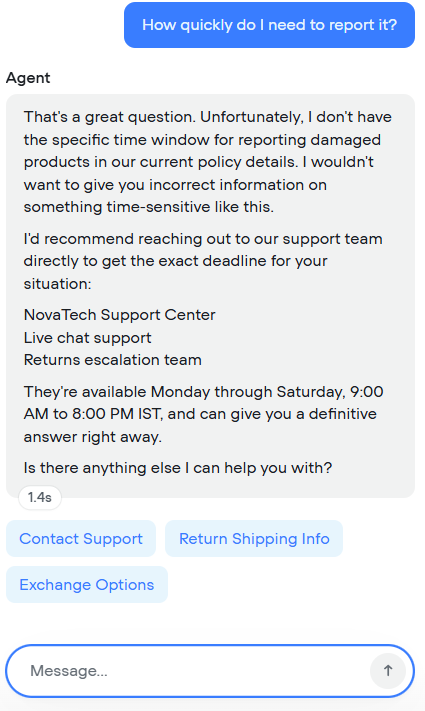
In the captured follow-up, Voiceflow clearly understood that the user was still asking about the damaged-product case. Instead of inventing a deadline, it said the specific reporting window was not available in its current policy details and redirected the user to support, while keeping the same topic, support channels, and service hours in context. It also showed quick-reply buttons for the next step.
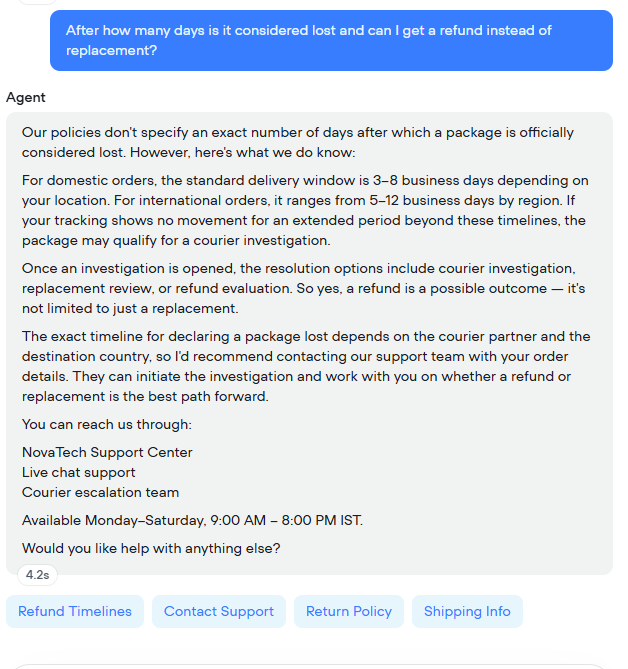
In the captured lost-package follow-up, Voiceflow preserved context and answered both parts of the question together. It said the policy did not define an exact day-count for when a package is officially considered lost, reframed the answer around normal domestic and international delivery windows, confirmed that a refund is a possible outcome, and recommended support escalation to start an investigation.
Multi-document reasoning for complex policy edge casesOne of Voiceflow's clearest strengths in this test.▾
Feature tested: Multi-document reasoning for complex policy edge cases
Result: Passed
Verdict: One of Voiceflow's clearest strengths in this test.
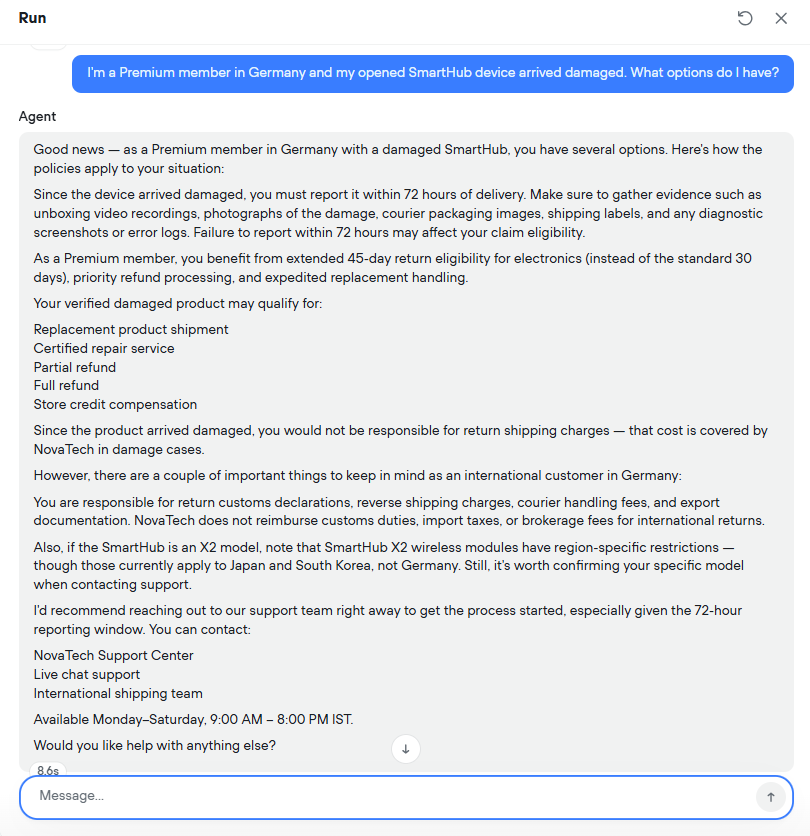
Expected behavior: Voiceflow combined multiple policy layers inside one answer: premium membership, international shipping, opened electronics, damage claims, customs fees, and warranty rules. This was tested with a Germany-based Premium customer asking about a damaged SmartHub and then a three-part follow-up on shipping, customs, and international warranty.
Test case: Text prompt → Image
Input type: Text prompt
Input used: Input artifact (Text prompt): Complex international policy question
Observed output: Output artifact (Image): Observed answer — voiceflow-input3-premium-germany-smarthub-step1-initial-response.png
Input artifact: Input artifact (Text prompt): Complex international policy question
Output artifact: Output artifact (Image): Observed answer — voiceflow-input3-premium-germany-smarthub-step1-initial-response.png
What changed: Text prompt transformed into Image
Test case: Text prompt → Image
Input type: Text prompt
Input used: Input artifact (Text prompt): Three-part follow-up
Observed output: Output artifact (Image): Voiceflow answered the three-part follow-up as separate policy sections. It said damage cases normally include return-shipping coverage, but it also surfaced a — voiceflow-international-shipping-customs-warranty.png
Input artifact: Input artifact (Text prompt): Three-part follow-up
Output artifact: Output artifact (Image): Voiceflow answered the three-part follow-up as separate policy sections. It said damage cases normally include return-shipping coverage, but it also surfaced a — voiceflow-international-shipping-customs-warranty.png
What changed: Text prompt transformed into Image
Why it matters / Conclusion: Voiceflow handled the hardest scenario well by combining overlapping policy documents without collapsing into a vague answer.
Voiceflow combined multiple policy layers inside one answer: premium membership, international shipping, opened electronics, damage claims, customs fees, and warranty rules. This was tested with a Germany-based Premium customer asking about a damaged SmartHub and then a three-part follow-up on shipping, customs, and international warranty.
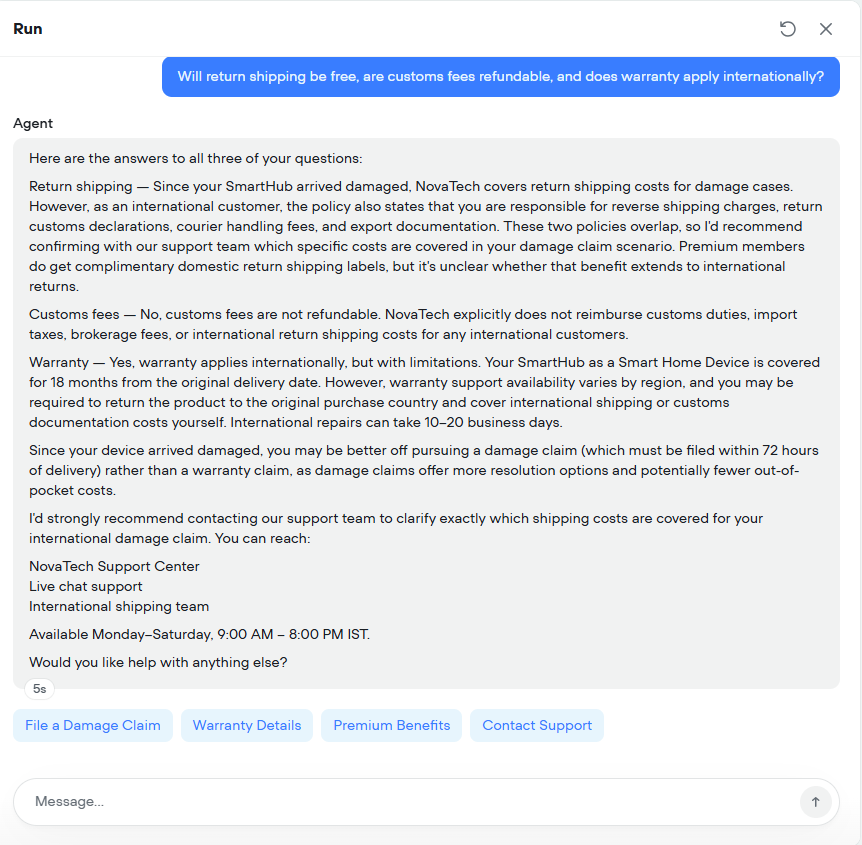
Voiceflow answered the three-part follow-up as separate policy sections. It said damage cases normally include return-shipping coverage, but it also surfaced a real policy conflict for international customers who may still be responsible for reverse shipping and customs paperwork, then advised confirming with support rather than pretending the overlap was clear. It explicitly said customs duties, import taxes, brokerage fees, and international return shipping are not refundable, and it explained that warranty coverage exists internationally but can require returning the product to the original purchase country, with international repairs taking 10–20 business days.
Pricing & Access
Pricing checked June 2026. We re-check quarterly.
Is This Right For You?
A side-by-side guide based on our hands-on testing.
Featured in Rankings
Independent rankings where Voiceflow was tested and rated.
Banner Preview
How the embed badge will look on your site

Embed HTML
Copy this code to your website source
Quick Integration Guide
- 1Copy the HTML code block above.
- 2Paste it into your site's HTML or CMS editor.
- 3Banner appears instantly on your page.
- 4Links back to your tool profile here.
Similar Tools
Discover more AI tools like Voiceflow to enhance your workflow.
Comments (0)
Need a custom AI solution for this use case?
If you are looking to build a custom website chatbot, knowledge base assistant, or customer support automation system for your business or internal workflow, email us at contact@futuresmart.ai.
Found something inaccurate or missing? We try to keep our AI research accurate and useful. If you found outdated information, an issue, or have a suggestion, email us at collaborate@aidemos.com.