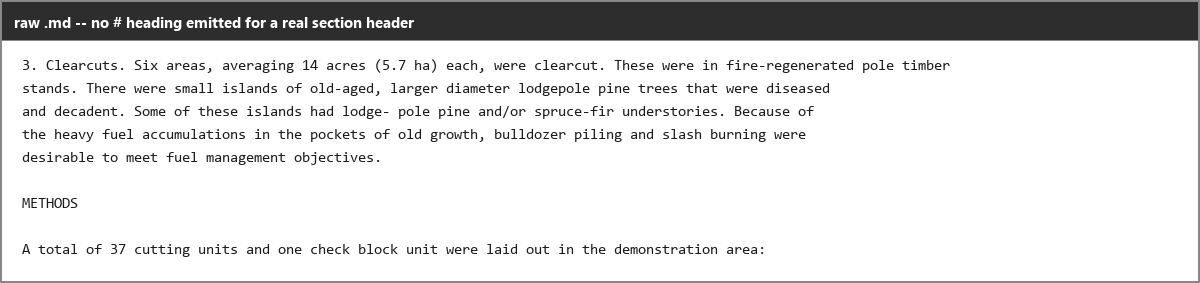
Uses no invented tags or malformed markdown; the only HTML seen is legitimate <br /> inside table cells, so the syntax stays clean even though the document does not surface real heading markup.
What was measured
Markdown Quality
Produces clean, well-structured, usable markdown rather than a flat text dump.
decisive for this rankingtransformation
The ranking is specifically about producing clean Markdown, so the quality and usability of the Markdown output directly measures success. (3 of 3 judges)
What was given, what came back
Test input: Scanned Research Paper · pdf · group: scanned-research-paper
Input — what we sent
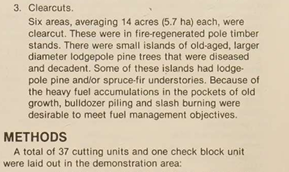
An image-only scanned research paper used to stress OCR and layout recovery in a multi-column academic document with figures, charts, tables, captions, and references.
Why this input is hard
- · OCR on scanned pages
- · Multi-column reading order
- · Figure and chart handling
- · Table reconstruction from scans
- · Caption association
- · Reference extraction
- · Overall document structure retention
Output — unretouched
Also checked on this input — same tool, 8 other criteria
Advanced Features✓ WorkedSchema-driven extract.run fully recovers the corrupted Table 4 rows, returning all 12 checked rows exactly, including the 10-inch-cut 1979 MPB row whose parse.run output was badly garbled.Advanced Features◐ MixedThe confidence signal flags the faint handwritten margin note and the garbled Table 4 as low confidence, but it misses the hallucinated 'USA' word in the title, which is still rated 0.9354 confident.Complex Document Handling⚠ StruggledHandles the 12-page scan in 10.6 seconds with no truncation, but the densest 17-column table has unreadable stretches with injected glyphs and run-on numbers.Reading Order & Structure⚠ StruggledDisplaces the byline by a full column: the author line that sits above the two-column split in the source is emitted only after the entire left column, and its footnote markers are rendered inconsistently.Table Preservation✗ FailedCatastrophically corrupts the dense 17-column Table 4, injecting non-Latin glyphs into numeric cells and producing run-on strings such as 238-563NT, 2231, and 8998 6 in the 10-inch and 12-inch blocks.Table Preservation◐ MixedPartially reconstructs Table 1: most of the roughly 90 numeric values are exact, but literal 0 values in the 12-inch column become blanks, one mean cell picks up stray digits (33.0 830000), and a row-label-only section header is broadcast across all six columns in one instance.Text & OCR Completeness✓ WorkedConverts all 12 scanned pages with no gaps; the page-11-to-page-12 handoff is preserved verbatim, and a separate page-marker output shows pages 1 through 12 present with no missing markers.Visual Content Retention✓ WorkedSegments a shield logo out of a single full-page raster scan and also retains Figure 1 as an image with an accurate synthesized caption; the returned logo crop is a tight 77x81px cut with legible shield text.
Provenance
- Observation
- 39ecbd6f-1599-4ba1-ae17-16b29b9c07cb
- Evidence run
- 6e3160de-fe46-4b45-b071-72560b5c5d0e
- Study
- Convert a Complex PDF into Clean Markdown with an API
- Research task
- 86b9h7t37
- Tested at
- not recorded
- Source
- first-party
- Evidence state
- verified
- Proof shown
- input + output shown
- Cost / latency
- not captured
- Repeat run
- not captured
- Tester
- not captured
The last three rows are honest blanks, not placeholders — our capture has no field for them yet.
Query this
get_evidence({
  tool: "reducto",
  scenario: "scanned-research-paper"
})
MCP · mcp.aidemos.com/api/mcp
Free with attribution.
Same input, same check — 2 other tools
measured on Markdown Quality
This evidence is published in
Real inputs and real outputs, no retouching · every cell queryable via API & MCP · aidemos.com