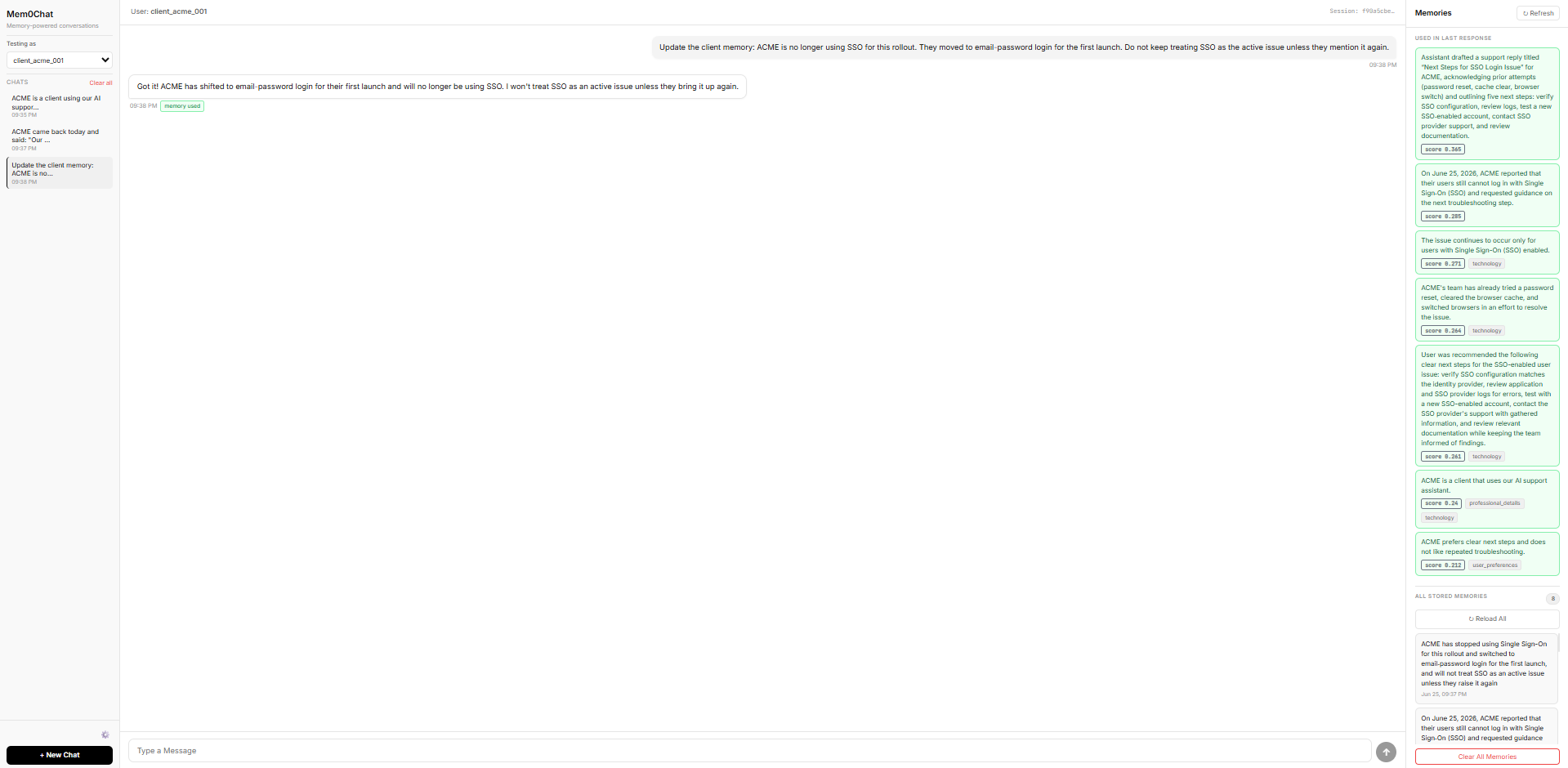
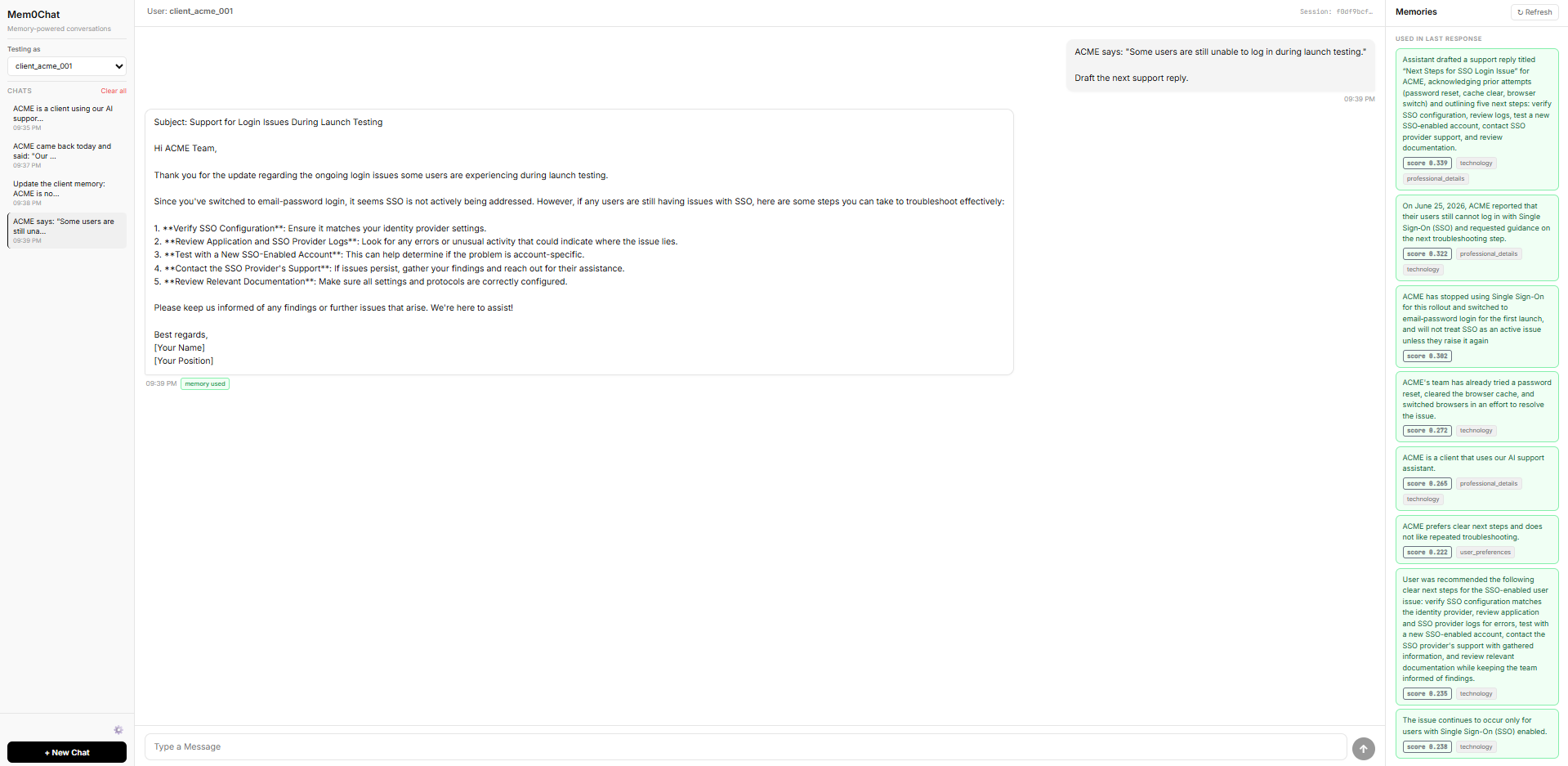
Accepts the ACME correction and stores the rollout change, but does not retire the older SSO memory strongly enough to stop later reuse.
What was measured
Update and Correction Handling
Checks whether the tool can replace or invalidate outdated memories when corrected.
decisive for this rankingtransformation
A memory system has to replace or invalidate outdated information, or it will keep feeding the agent wrong context. (3 of 3 judges)
What was given, what came back
Test input: Client Relationship Memory · text · group: memory-for-ai-agents
Input — what we sent
The exact prompt
Session 1:
Use this under account_id: client_acme_001

ACME is a client using our AI support assistant. They prefer clear next steps and do not like repeated troubleshooting. Their team already tried password reset, clearing browser cache, and switching browsers. The issue is still happening only for users with SSO enabled.

Session 2:
Use this under account_id: client_acme_001

ACME came back today and said: "Our users still cannot log in with SSO. What should we try next?"

Draft a support reply that respects what they already tried and moves to the next useful step.

Session 3:
Use this under account_id: client_acme_001

Update the client memory: ACME is no longer using SSO for this rollout. They moved to email-password login for the first launch. Do not keep treating SSO as the active issue unless they mention it again.

Session 4:
Use this under account_id: client_acme_001

ACME says: "Some users are still unable to log in during launch testing."

Draft the next support reply.

Session 5:
Use this under account_id: client_beta_002

BetaCorp is a new client. They say: "Our users cannot log in for the first time."

Draft the first support reply for BetaCorp.
A client-support memory test that checks whether the assistant remembers prior troubleshooting, handles a changed rollout context, keeps client scope isolated, and avoids leaking one client’s history into another client’s support reply.
Why this input is hard
- · client history recall
- · avoid repeating troubleshooting
- · update handling
- · scope isolation between clients
- · support response continuity
Output — unretouched
Also checked on this input — same tool, 4 other criteria
Correct Application✗ FailedKeeps applying old ACME SSO context after the rollout changed, so the later reply still falls back to SSO troubleshooting instead of the new email-password path.Memory Capture Quality✓ WorkedStores detailed client-support history as memory cards, including the ACME issue state and the already-tried troubleshooting steps.Relevant Retrieval✓ WorkedRetrieves the right ACME troubleshooting history for the follow-up reply and avoids restarting from basic password, cache, or browser troubleshooting.Scope Control✓ WorkedKeeps client scope separated so BetaCorp does not inherit ACME's prior troubleshooting history or SSO context.
Provenance
- Observation
- 133f3e43-ac89-437b-8b33-251e882a8ed0
- Evidence run
- 6e31afbb-34d7-459a-b688-68ef76fc615a
- Study
- Memory for AI Agents
- Research task
- 86ba16xrp
- Tested at
- not recorded
- Source
- first-party
- Evidence state
- verified
- Proof shown
- input + output shown
- Cost / latency
- not captured
- Repeat run
- not captured
- Tester
- not captured
The last three rows are honest blanks, not placeholders — our capture has no field for them yet.
Query this
get_evidence({
  tool: "mem0",
  scenario: "memory-for-ai-agents"
})
MCP · mcp.aidemos.com/api/mcp
Free with attribution.
Same input, same check — 4 other tools
measured on Update and Correction Handling
Cognee✗ FailedAccepts an explicit client-memory update that SSO is no longer the rollout path, but the following reply still resurfaces SSO-specific troubleshooting language, so the old context was not fully retired.Hindsight◐ MixedWhen the later login-testing reply is generated, stale SSO context is still visible in retrieval, but it does not dominate the final answer and the newer rollout context stays primary.Supermemory⚠ StruggledAfter ACME's rollout context was updated away from SSO, the UI still showed a '0 memory used' tag while the side panel continued to surface the old SSO memory at 71% and then 79% relevance on later replies, so it is not possible to confirm from the UI that the update reliably superseded the stale context.Zep✗ FailedAfter a correction that ACME had moved from SSO to email-password login, the next reply still reused SSO/SAML/IdP troubleshooting, showing that one explicit update did not retire the stale context.
This evidence is published in
Real inputs and real outputs, no retouching · every cell queryable via API & MCP · aidemos.com